What is Voodoo?
Voodoo is a name that appeared on Egyptian streets after Strox spread, and it is applied to small bags of chopped dried herbs. The herbs themselves do not cause the effect. What does is the manufactured chemicals sprayed on them, which belong to a huge family known scientifically as synthetic cannabinoid receptor agonists.
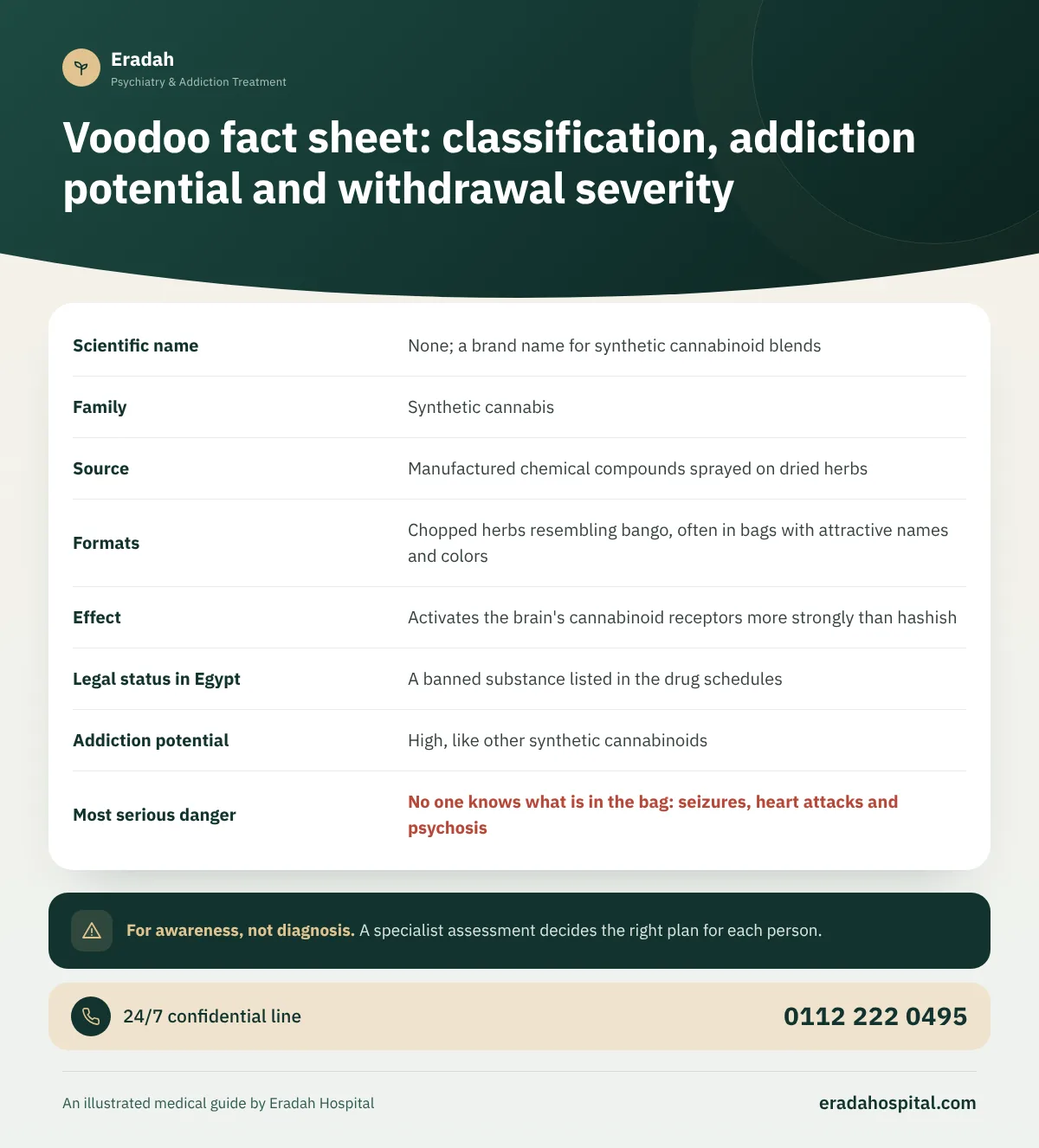
In other words, Voodoo is an informal trademark more than a separate "type" of drug. A person who buys "Voodoo" does not know which chemical compound they are getting, at what concentration, or whether it has been mixed with something else.
That is why doctors treat Voodoo and Strox as two faces of one problem, synthetic cannabis, and use the same plan for diagnosis and treatment.
Voodoo is a name, not a substance: why does the difference matter?
When people hear a fixed name, they assume there is a fixed product behind it, as with medicines and foods. But in the synthetic drug market the opposite happens:
An attractive, mysterious name is chosen so it is easy to pass around and remember, not to describe the contents.
When one compound is banned it is replaced by a new one, and the name on the bag stays the same.
No authority checks what is in the bag, how strong it is or how clean it is before it reaches the person using it.
Someone used to "Voodoo" thinks they know its effect, while the next bag may contain a far stronger compound.
The United Nations early warning system has identified more than 320 different synthetic cannabinoid compounds since 2009, with new chemical groups appearing every so often. Any of them may be sold under the name "Voodoo".
What does Voodoo look like?
Voodoo usually comes in small bags containing chopped dried herbs, pale green or brown, similar in appearance to bango or to the leaves used in shisha tobacco. The bags may be colorful with a name or picture printed on them, or they may be plain bags with no markings. Fragrances are often added to mask the chemical smell.
You cannot tell from the look, smell or color which compound it contains or how strong it is. Two bags that look identical can be completely different in content and potency.
How is Voodoo marketed? "Herbs", "incense" and "not drugs"
Since synthetic cannabis appeared worldwide, its sellers have relied on linguistic trickery to make the product look innocent. The European Union Drugs Agency describes how these blends were sold as "herbal smoking blends" or "incense and room fresheners", with the phrase "not for human consumption" on the packaging to evade the law.
- "Natural" and "herbs": because it looks like a plant, while the active ingredient is entirely chemical.
- "Legal" or "not drugs": this is false advertising, since synthetic cannabinoids are banned in Egypt.
- "Incense" or "air freshener": a cover for trading that has nothing to do with how it is actually used.
- Colorful packaging and mysterious names: they suggest a safe recreational product, and attract teenagers in particular.
Voodoo and bango: why do people confuse them?
Voodoo looks like dried bango leaves and is rolled and smoked in a similar way, so many people assume it is "strong bango" or "improved bango". But the difference between them lies in the substance, not the appearance:
| Point of comparison | Voodoo | Bango |
|---|---|---|
| What is it? | Unspecified herbs sprayed with synthetic substances | Dried leaves and tops of the cannabis plant |
| The substance responsible for the effect | Variable synthetic cannabinoids | Natural THC |
| Strength | Much higher and unpredictable | Lower and more consistent |
| Serious acute poisoning | Seizures, heart attacks and kidney injury recorded | Very rare |
| A standard cannabis test | Mostly does not detect it | Detects it |
This confusion is dangerous, because someone used to bango may treat Voodoo with the same confidence and be surprised by a far stronger effect. That does not mean bango is safe, as it has its own well-known psychological and addictive harms.
How does Voodoo affect the brain?
The brain has receptors called cannabinoid receptors, which help regulate mood, memory, sleep, appetite and movement. THC in bango activates them partially, while the compounds in Voodoo activate them fully and bind more strongly. Beyond the "stronger high", many systems are disrupted at the same time:
- Disturbed perception: confusion, a distorted sense of time, and sometimes hallucinations.
- Disturbed mood: a brief calm that can suddenly turn into panic or anger.
- Strain on the heart: a sudden rise in pulse and blood pressure.
- Nervous system irritation: it may make seizures more likely.
Voodoo and Strox: is there a real difference?
Many people ask which one is "milder". The honest answer is that they cannot be ranked, since both are brand names for the same family of substances, and the difference between one bag and another under the same name may be greater than the difference between the two names. The US Centers for Disease Control and Prevention note that two containers that look identical may hold different substances of different strength.
Instead of asking "which is milder?", ask "do I know what is in this bag?" The answer is always no.
Common myths about Voodoo
| What people say | The truth |
|---|---|
| Voodoo is milder than Strox | There is no way to know; the contents change from bag to bag under both names. |
| Voodoo is made from a veterinary drug | There is no scientific evidence for this; what is seized of this type is herbs sprayed with synthetic cannabinoids. |
| As long as it is herbs, it will not harm | The active substance is chemical, and seizures and deaths have been recorded because of it. |
| It is not illegal | Synthetic cannabinoids are listed in Egypt's drug schedules. |
| It does not cause addiction the way hashish does | It causes tolerance, dependence and withdrawal symptoms that may be more severe than those of hashish. |
The legal status of Voodoo in Egypt
Voodoo is banned in Egypt. Synthetic cannabinoids have been added to the drug schedules attached to Law No. 182 of 1960, and the schedules are updated by later decrees to cover new compounds. There is no truth to the claim that it is "legal" or "not a drug".
Free, confidential treatment can be requested through the hotline of the Fund for Drug Control and Treatment of Addiction, 16023, or through specialized centers.
This is general educational information and not legal advice.
Voodoo guide: everything you need to know
We have gathered everything about Voodoo into 5 pages, each answering one question in detail. Choose what you are looking for:
Harms of Voodoo
What Voodoo does to the heart, kidneys and brain, and why unknown contents and hidden substances raise the risk of acute poisoning.
Signs of Voodoo addiction
How families can spot use, how its signs differ from those of bango, and when use becomes addiction.
Strox and Voodoo withdrawal symptoms
What happens after stopping, when symptoms begin and how long they last, and why heavy users need medical supervision.
Strox and Voodoo addiction treatment
One treatment plan for both names: assessment, safe detox, individual and family therapy, and relapse prevention.
How long Voodoo stays in the body
Why a cannabis test comes back negative with Voodoo, what the right test is, and how long its products remain in urine, blood and hair.
How do you talk to your son about Voodoo?
Many young people defend Voodoo with phrases like "it's herbs" or "it's not even hashish". Arguing over the name rarely works. It is better to turn the conversation into questions:
- Ask him calmly: "Do you know what substance is in the bag? Who made it?"
- Share one reliable fact instead of a long lecture, such as the fact that the same bag can differ from one time to the next.
- Focus on his safety: the danger signs, and when to call an ambulance if he or a friend becomes unwell.
- Do not let fear of punishment stop him from asking for help in a moment of danger.
- If you notice signs of repeated use, ask for specialist family counseling.
You will find the signs a family may notice on the page about signs of Voodoo addiction.
Signs of acute Voodoo poisoning: call an ambulance (123) immediately
- A seizure or violent involuntary movements
- Loss of consciousness or no response to calling out or touch
- Complaining of chest pain, or a very fast, irregular pulse
- Severe agitation or aggression, or talking about things that are not there
- Very high body temperature, or confusion with heavy sweating
Call an ambulance on 123 immediately and do not wait for him to "come around on his own". Do not restrain him by force or put anything in his mouth, and move away anything that could hurt him. If he loses consciousness or the seizures stop, place him on his side in the recovery position, stay beside him, and tell the paramedics he used Voodoo and any other substances.
Call the ambulance 123