Is a bango test different from a hashish test?
No. Bango and hashish are parts of the same plant, and the compound THC turns into in the body is the same, so the same test detects both and cannot tell them apart.
What a urine test usually looks for is an inactive product the liver makes from THC, known as THC-COOH. This product keeps leaving the body in urine for some time after the mental effects have ended, which explains why the result can be positive in a person who shows no sign of use.
How long does bango stay in urine, blood, saliva and hair?
Urine after occasional use
Urine with repeated weekly use
Urine with long-term daily use
Blood
Saliva
Hair
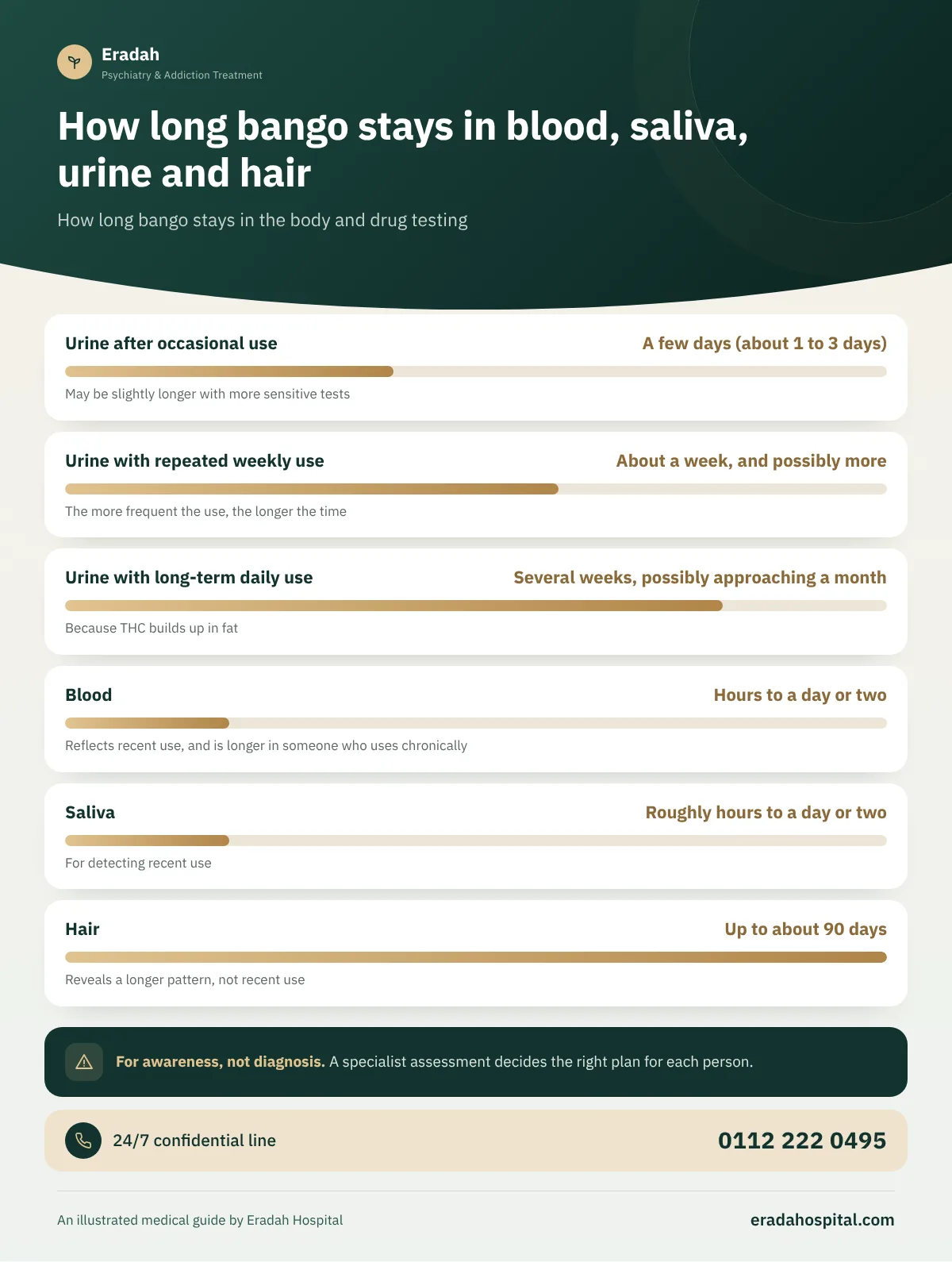
All of these time frames are approximate and vary by lab, the cutoff level used, the individual and the pattern of use. To interpret a specific result, consult a doctor or the lab.
Why do the numbers you hear about how long bango stays differ?
You may read that bango stays in urine for “a month,” and read elsewhere that it disappears within days. The reason is that the time depends on the pattern of use and the sensitivity of the test. Scientific reviews of urine tests suggest that someone who uses occasionally rarely stays positive for more than a week on standard tests, while the time may stretch to weeks in someone who uses daily over a long period.
| Factor | How it affects the result |
|---|---|
| How often someone uses | From a single use to daily use, the detection time multiplies |
| Length of use | Years of use mean a larger store in body fat |
| Strength of the strain | Strong strains leave more metabolites |
| The lab's cutoff level | A lower cutoff means longer detection |
| Body characteristics | Body fat percentage and metabolism matter, but less than frequency of use |
Why doesn't a bango test detect Strox?
The synthetic cannabinoids found in Strox and Voodoo are chemically different from THC, and the standard cannabis test strip does not recognize them. The European Union Drugs Agency also points out that most of these substances are hard to detect with the usual rapid tests. For that reason, a bango test may be negative in someone using herbs sprayed with a synthetic substance.
Do CBD products or “legal” cannabis show up on a test?
In some countries CBD products are sold as THC-free, but studies that tested these products found that some contain THC in amounts the label does not state. As a result, a person who uses them may test positive for cannabis without intending to. For this reason, you should tell the doctor or lab about any product of this kind.
Can secondhand bango smoke make a test positive?
Under ordinary conditions, such as sitting with someone who is smoking in an open or well-ventilated space, the amount the body absorbs is far below the usual cutoff. Experiments have shown that very heavy exposure in a completely enclosed space can raise the level temporarily, but those are unusual conditions. Even so, secondhand smoke remains harmful to health, especially for children.
Why is a confirmatory test needed?
A rapid strip gives only a preliminary result, and rarely it can be affected by certain medications and give a false positive. A confirmatory lab test using mass spectrometry identifies the THC metabolite precisely. For that reason, important decisions should not be based on a rapid strip alone.
When is a bango test requested?
- In emergencies: When there is severe anxiety, psychosis or repeated vomiting, keeping in mind the possibility of a synthetic substance.
- In treatment programs: To monitor commitment and encourage the patient by rewarding negative tests.
- At employers: According to each organization's regulations, especially in safety-related jobs.
- In official proceedings: With confirmatory tests and set procedures.
In every case, a test result alone is not enough to diagnose or rule out addiction; the test shows exposure to the substance, not the nature of a person's relationship with it.
Are there ways to hide bango from a test?
We do not publish any methods for influencing test results; in the context of treatment, testing is a tool for protecting the patient and monitoring their progress. The drinks and recipes that circulate for this purpose are also unreliable, and some can cause a dangerous imbalance in body salts. If a test worries you, it may be a good time to talk confidentially with a specialist about the use itself.
To learn about the steps of treatment, see hashish and bango addiction treatment.