Does a person who uses Blue Elephant need treatment?
“He tried it once at a wedding, and since then he says he sees colors on the wall and is afraid to sleep alone.” This is how many families arrive at the clinic: they are not asking about addiction in the usual sense, but about an effect that has not gone away. For this reason, treating Blue Elephant addiction differs from treating heroin or tramadol addiction.
The guide to Blue Elephant explains that the name is a marketing label for pills sold as hallucinogens, and that their contents are not known precisely. According to the US National Institute on Drug Abuse (NIDA), classic hallucinogens do not usually lead to addiction, based on the limited research available, unlike opioids. But an unknown pill may contain another substance, and use may be repeated as an escape from psychological distress. Treatment therefore needs to ask two questions: what did the pill do to the mind, and why does the use keep recurring?
A person needs a specialist assessment if they have had a severe panic attack or hallucinations that continued after the effects ended, if use is repeated despite the fear, if they are using other substances with it, or if they show withdrawal from others, strange talk, or thoughts of death.
During a bad trip: what should the family do?
A “bad trip” is an episode of terror and confusion that can happen with any hallucinogen, and the symptoms of Blue Elephant use describe its signs. What helps in the first hours is simple but structured:
- Move them to a quiet place with little light and noise, and keep away crowds and phones that record.
- Speak in a calm voice and short sentences: “You are safe. This is the effect of the pill, and it will pass.”
- Remove sharp objects and car keys, and do not leave them alone for a moment.
- Do not argue about what they see, and do not try to scare them or snap them out of it with cold water.
- Do not give them a sedative from home or any substance to “bring them down,” as it may interact with what is in the pill.
Stages of Blue Elephant addiction treatment
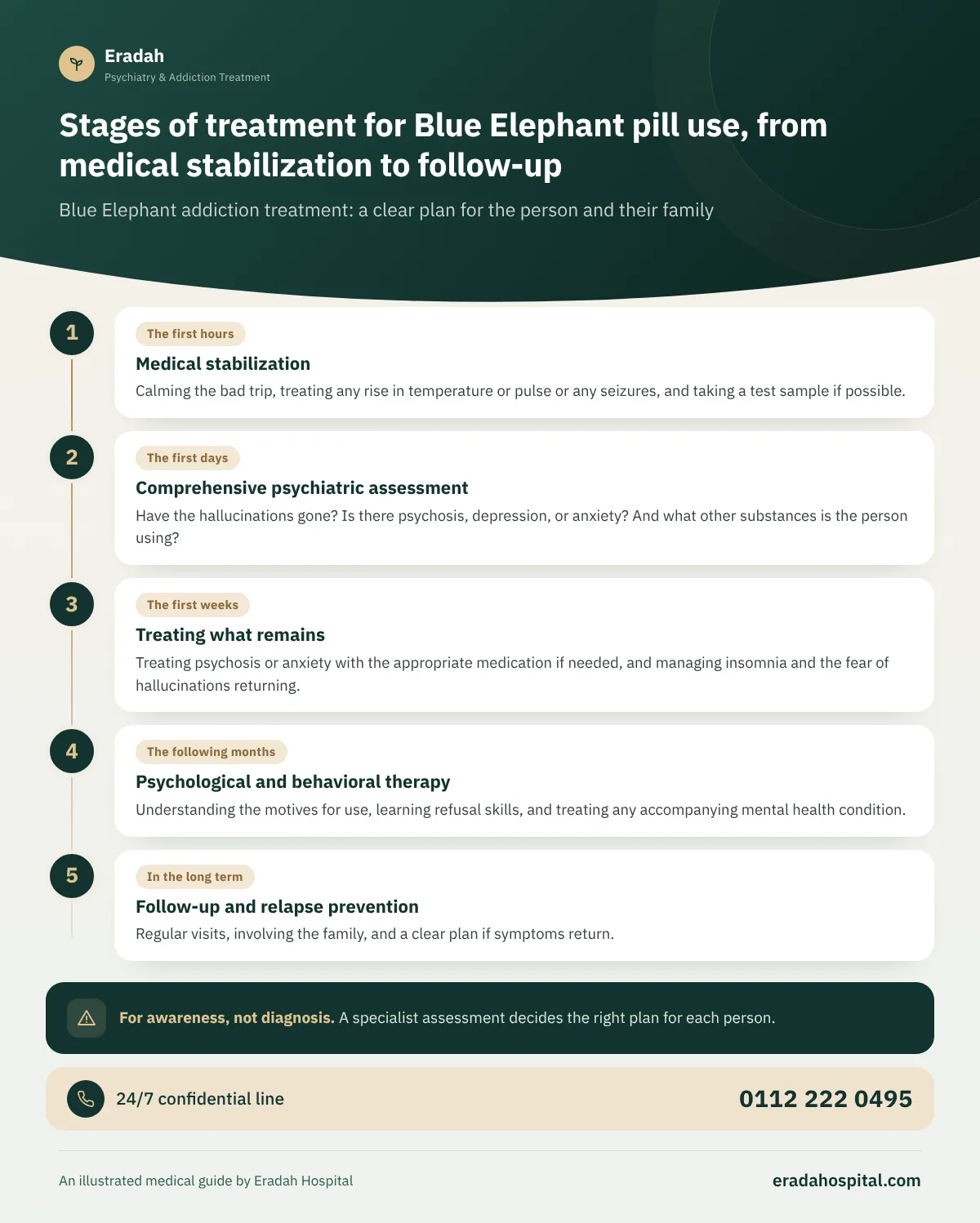
The plan varies with what the assessment shows, but it usually passes through five stops:
- The first hoursMedical stabilization
Calming the bad trip, treating any rise in temperature or pulse or any seizures, and taking a test sample if possible.
- The first daysComprehensive psychiatric assessment
Have the hallucinations gone? Is there psychosis, depression, or anxiety? And what other substances is the person using?
- The first weeksTreating what remains
Treating psychosis or anxiety with the appropriate medication if needed, and managing insomnia and the fear of hallucinations returning.
- The following monthsPsychological and behavioral therapy
Understanding the motives for use, learning refusal skills, and treating any accompanying mental health condition.
- In the long termFollow-up and relapse prevention
Regular visits, involving the family, and a clear plan if symptoms return.
Treating psychosis and persistent hallucinations
The most serious thing hallucinogens may leave behind is psychosis: hallucinations or delusions that do not go away when the effects end. In a pooled analysis published by the journal Schizophrenia Bulletin in 2020, 26% of cases of hallucinogen-induced psychosis later converted to schizophrenia, based on three studies. This figure does not mean everyone who uses will be affected, but it does mean that any psychosis after use deserves serious treatment and follow-up.
Treatment relies on antipsychotics chosen by the doctor according to the case, complete abstinence from all substances, and psychotherapy that helps the patient understand what they went through. The page on treating drug-induced psychosis explains this plan in detail. The patient may need a period in a psychiatric hospital if they are a danger to themselves or others.
There is another, less well-known condition: the return of images, scenes, or feelings the person experienced while under the influence. NIDA notes that these “flashbacks” are usually mild and brief and occur within a week of use, but a rare few develop hallucinogen persisting perception disorder, in which episodes are prolonged and may recur after years. It is not treated by waiting alone, but by an assessment that rules out other causes, then a plan set by the doctor, avoiding any substance that might make it worse.
Psychotherapy: why does use recur?
If medication treats the effects of the substance, psychotherapy treats the reason for going back to it. Among the motives we see with Blue Elephant pills are:
The wish to “try what they showed in the movie”; treatment turns curiosity into a conscious decision.
Depression, anxiety, or emptiness; treatment addresses the distress itself.
Use is part of the “night out”; treatment trains refusal skills and changing the environment.
Blue Elephant often comes with cannabis, alcohol, or stimulants.
Cognitive behavioral therapy and motivational interviewing are used to help the person see what they have lost and what they want. If other substances are being used, the plan covers all of them, because stopping one substance while continuing another does not protect the mind.
Outpatient or residential?
Most people who tried the pills a few times without complications can be treated through outpatient treatment with regular sessions and family follow-up. Residential care is more suitable if there is psychosis or suicidal thoughts, multiple substance use that is hard to stop at home, or if outpatient treatment attempts have failed. Eradah's residential treatment program provides a safe environment for men, with a free, confidential first consultation.
How long does Blue Elephant addiction treatment take?
There is no single duration. A panic attack usually ends within hours, and assessment takes days, while treating psychosis, if present, takes weeks to months followed by longer follow-up. Psychotherapy for repeated use usually extends over months, and the doctor sets the duration according to response.
The family's role after treatment
The family is the first to notice symptoms returning: new insomnia, strange talk, or withdrawal from others. Agree with the doctor on clear signs that call for contacting them immediately, and avoid mocking the person for “seeing things” or exaggerating. If the patient talks about death or harming themselves, do not leave them alone, and call the mental health support line 16328 or the ambulance (123). Never start or stop any medication without a doctor.
Danger signs after using the Blue Elephant: call ambulance (123) immediately
- Severe agitation or an attempt to harm themselves or others.
- Seizures or loss of consciousness.
- Chest pain or a very fast pulse.
- High temperature with confusion and heavy sweating.
- Slow or weak breathing.
Call ambulance (123) immediately. If the person is unconscious but breathing, place them on their side so they do not choke on vomit. Stay with them and do not leave them alone. Do not give them food or drink, and tell the paramedics everything they took or used, and the amount and time if you know them.
Call the ambulance 123