What is the Blue Elephant drug?
“The Blue Elephant” is a name many people know from the cinema before they ever hear it in the drug market. In 2014 the film “The Blue Elephant” was released, directed by Marwan Hamed, based on a novel by Ahmed Mourad published in 2012, followed by a second part in 2019.
In the film, the protagonist, a psychiatrist, takes a blue pill printed with a six-legged elephant, which becomes his gateway to a world of hallucinations. With the film’s success, the name “Blue Elephant pills” appeared in the illicit market and came to be used for pills sold as a powerful hallucinogen.
In other words, “Blue Elephant” is a marketing name, like many street names, and does not indicate a fixed composition. This point alone changes how the danger should be understood: the question worth asking first is “what is actually in this pill?” before “what are the harms of the Blue Elephant?”
Is the Blue Elephant DMT?
It is repeated in the media and in forums that the active ingredient in these pills is DMT (dimethyltryptamine), a powerful hallucinogen from the family of classic hallucinogens such as LSD and magic mushrooms, known to cause a short, intense effect.
But this claim runs into a pharmacological fact: according to a scientific review published in 2024 in Cellular and Molecular Life Sciences, DMT is rapidly broken down in the liver before it reaches the bloodstream, so it has almost no effect when swallowed on its own. So a pill that is swallowed and said to be “DMT” may in fact contain something else entirely: another synthetic hallucinogen, a stimulant, or an unknown mixture. As of the writing of this guide, we have not found a published lab analysis identifying the contents of pills seized in Egypt under this name.
How do hallucinogens like DMT affect the brain?
The US National Institute on Drug Abuse (NIDA) explains that classic hallucinogens, including DMT, act mainly on type 5-HT2A serotonin receptors, and that their most prominent effects stem from activity in the prefrontal cortex, which is responsible for mood and perception; they also temporarily disrupt communication between brain regions linked to the sense of self.
The result is a change in perception and in the sense of time and self, visions, colors and distorted shapes, and strong emotions that may range from overwhelming happiness to fear and confusion. The institute stresses that these effects are hard to predict, because they depend on the amount and potency, the user’s personality, mood and expectations, the setting they are in, and any impurities the substance may contain.
Names and forms of the Blue Elephant
The name circulates in forms such as “Blue Elephant pills” and “the Blue Elephant pill,” and is sometimes used as a synonym for “DMT.” Since it is a marketing name, a seller may apply it to any pill they want to link to the film’s fame, regardless of its color, shape or contents. There is no visual marker that can be relied on to know what is inside.
Why do young people try Blue Elephant pills?
The US institute notes that people say they use hallucinogens seeking a new, enjoyable, “spiritual” or therapeutic experience. With the Blue Elephant in particular, other motives are added:
- Curiosity created by the fame of the novel and film, and the wish to “see what the hero saw.”
- The belief that hallucinogens are “natural” or safe because they do not cause physical dependence the way opioids do.
- Escaping sadness, anxiety or emptiness, or searching for meaning.
- Peer pressure and social media content that presents the experience as an adventure.
- Trying it as part of a mix with hashish, alcohol or other substances.
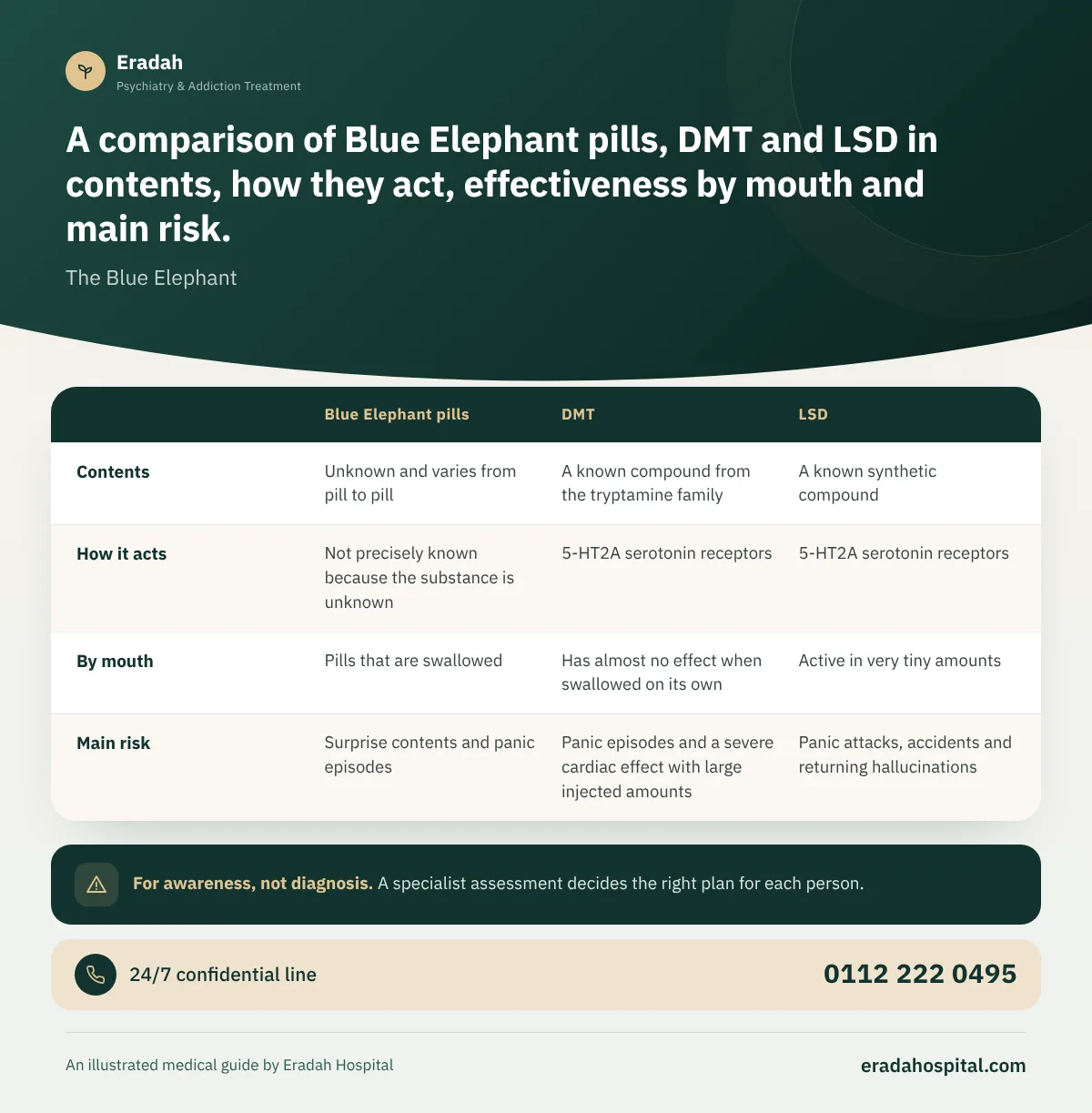
The Blue Elephant compared with real DMT and LSD
| Blue Elephant pills | DMT | LSD | |
|---|---|---|---|
| Contents | Unknown and varies from pill to pill | A known compound from the tryptamine family | A known synthetic compound |
| How it acts | Not precisely known because the substance is unknown | 5-HT2A serotonin receptors | 5-HT2A serotonin receptors |
| By mouth | Pills that are swallowed | Has almost no effect when swallowed on its own | Active in very tiny amounts |
| Main risk | Surprise contents and panic episodes | Panic episodes and a severe cardiac effect with large injected amounts | Panic attacks, accidents and returning hallucinations |
A scientific review of DMT published in 2016 notes that its neurotoxicity appears limited, apart from severe cardiac effects when large amounts are injected. But this does not necessarily apply to an unknown pill that may not contain DMT at all.
Do Blue Elephant pills cause suicide?
A statement circulates online that “75% of those who took the Blue Elephant killed themselves or died suddenly.” This figure is not based on any published study that can be consulted. What is true is that hallucinogens can cause panic episodes and psychosis during which self-harm may occur, and that the risk rises with depression or prior mental health conditions and with mixing them with other substances. The US institute points out that the risk of psychosis or suicide is very low in controlled medical research that excludes vulnerable patients, but poor psychological outcomes are more likely outside that setting.
So the risk is real, but inflating it with invented numbers harms awareness. If you or someone you love is having thoughts of self-harm, seek help right away through the mental health support line 16328, and you will find help on the suicidal thoughts page.
The legal status of the Blue Elephant in Egypt
One cannot speak of a legal status for a street name that does not point to a specific substance. But these pills circulate only in the illicit market, and possessing narcotic pills of unknown origin or trading in them exposes a person to prosecution under the narcotics law once analysis shows they contain a listed substance. On the other side, the Fund for Drug Control and Treatment of Addiction offers free, confidential consultation and treatment through hotline 16023.
This is general educational information and not legal advice.
The Blue Elephant and hallucinogens in numbers
Sources: Murrie and colleagues (2020) in Schizophrenia Bulletin, and the US National Institute on Drug Abuse (NIDA), citing a survey of about 2,000 people who used psilocybin.
Blue Elephant Guide: Everything You Need to Know
We have gathered everything about the Blue Elephant into 4 pages, each answering one question in detail. Choose what you are looking for:
Harms of Blue Elephant to the mind and body
What are the harms of Blue Elephant pills? Panic episodes and harmful behavior, effects on the heart and blood pressure, the risk of psychosis that may become an ongoing illness, returning hallucinations, and the dangers of unknown contents.
Blue Elephant use symptoms and warning signs
How can you tell someone took Blue Elephant pills? The physical and perceptual signs while under the influence, signs of a bad trip, what lingers afterward, and other substances that may be in the pill.
Blue Elephant addiction treatment: a clear plan for the person and their family
Blue Elephant addiction treatment step by step: what to do during a panic episode, treatment of psychosis and returning hallucinations, psychological treatment for repeated use, how long treatment takes, and when residential care is needed.
How long LSD stays in the body and drug testing
How long does LSD stay in the body? Approximately how long LSD stays in urine, blood and hair, why it does not show up in routine tests, specialized tests, and the factors that affect it.
Heard your son talking about the Blue Elephant? Start here
- Do not assume he has used just because the name came up; the film made it a name young people commonly use.
- Open a calm conversation about what he knows, and correct misinformation without exaggeration.
- Explain that the main problem is that no one knows what is in the pill, which can mean poisoning from the very first time.
- If he has already used, ask about episodes of fear or hallucinations that continued after the effect wore off, and seek a psychological assessment.
- Learn the emergency signs and save the ambulance number, 123, and use the guide to signs of drug use.
Harms, symptoms and treatment of the Blue Elephant in brief
Harms: Panic episodes and harmful behavior while under the influence, effects on the heart, a risk of psychosis that may persist, and sometimes returning hallucinations. Details are in harms of the Blue Elephant.
Symptoms: Dilated pupils and a fast pulse, distorted perception, sharp mood swings, and signs of a “bad trip.” Details are in symptoms of Blue Elephant use.
Addiction and withdrawal: The US institute describes classic hallucinogens as “weakly reinforcing” and not usually leading to addiction, although tolerance develops quickly. But this does not necessarily apply to unknown pills that may contain stimulants, nor to a pattern of repeating the experience to escape psychological problems.
Treatment: Anyone who has had an episode of psychosis or severe panic needs a psychological assessment even if they feel better, and repeated use is treated with a psychological and behavioral plan like the one explained in the guide to LSD addiction treatment, and the guide to treatment of drug-induced psychosis explains what happens if hallucinations continue.
Danger signs after using the Blue Elephant: call ambulance (123) immediately
- Severe agitation that does not settle, or an attempt to harm oneself or others
- Seizures, loss of consciousness, or no response to calling
- Chest pain, or a very fast or irregular pulse
- A very high body temperature with confusion
- Slow or weak breathing, as the pill may contain an unexpected substance
Call ambulance (123) immediately. If the person is unconscious but breathing, place them on their side so they do not choke on vomit. Stay with them calmly in a place with little light and noise, remove dangerous objects and do not leave them alone. Do not give them any medicine or other substance, and tell the paramedics everything you know about the pill and what else they took with it.
Call the ambulance 123