Physical signs of Blue Elephant use
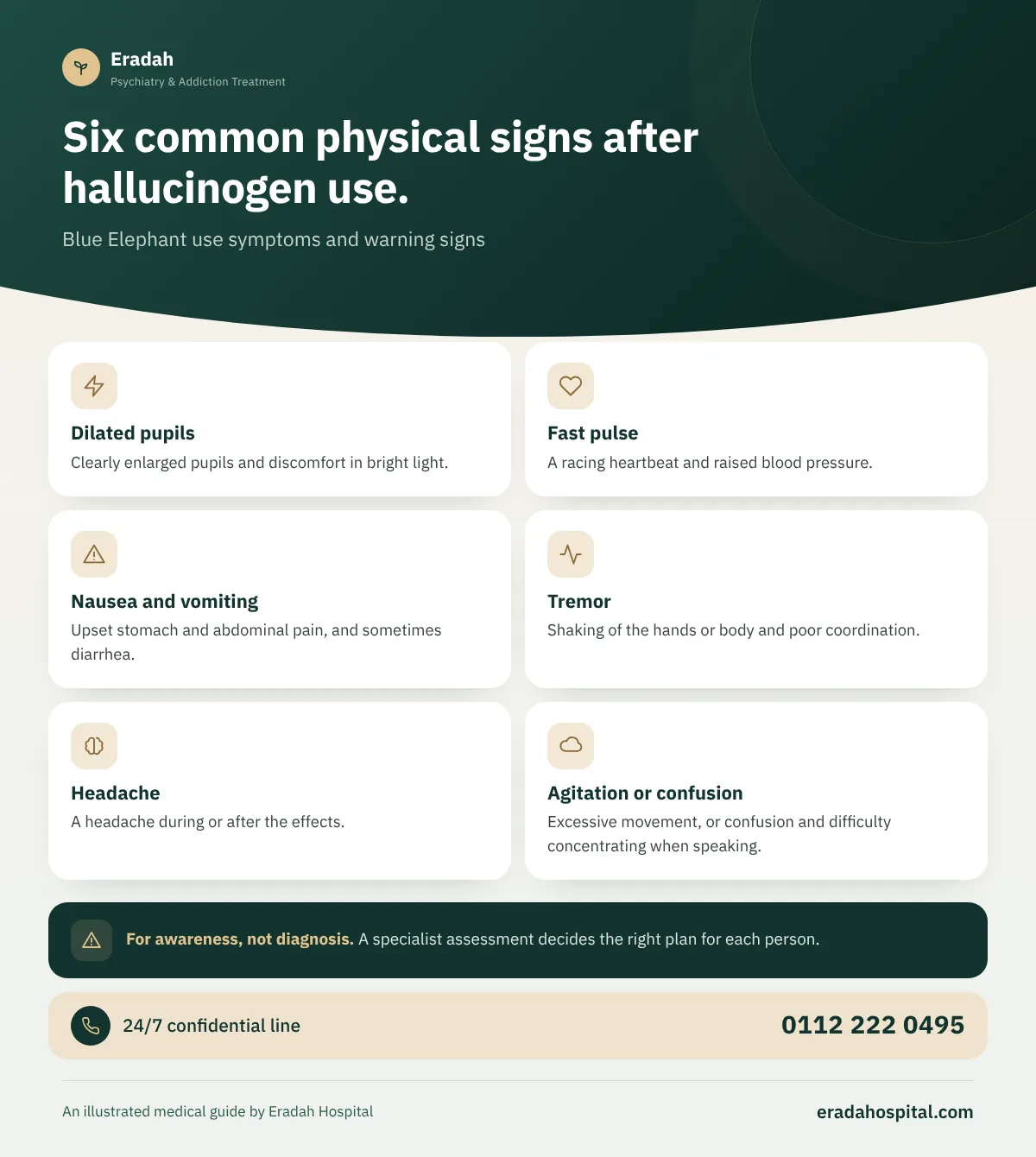
If a Blue Elephant pill contains a hallucinogen, as is rumored, the physical effects that the US National Institute on Drug Abuse lists for hallucinogens are the first to appear.
Clearly enlarged pupils and discomfort in bright light.
A racing heartbeat and raised blood pressure.
Upset stomach and abdominal pain, and sometimes diarrhea.
Shaking of the hands or body and poor coordination.
A headache during or after the effects.
Excessive movement, or confusion and difficulty concentrating when speaking.
Perceptual and behavioral signs during the effects
Hallucinogens change how a person perceives their surroundings and themselves, so you may notice:
- Long staring at objects or lights, or talk about colors and shapes that no one else sees.
- A disturbed sense of time, such as thinking hours have passed in minutes or the reverse.
- Sharp mood swings between laughter, euphoria, crying, and fear.
- Strange talk about “discoveries,” deep meanings, or a connection to something greater.
- A feeling of detachment from the body or that the world is not real.
Signs of a “bad trip”
- Intense fear or panic that reassurance does not calm.
- Screaming, crying, or trying to escape from “something” that is not there.
- Suspicion of those around them and accusing them of trying to harm them.
- Saying they are going to die or “lose their mind.”
- Reckless behavior that puts them or others at risk.
What remains after the effects wear off?
- Exhaustion, insomnia, and disturbed sleep for a night or more.
- Anxiety or low mood in the following days.
- Brief flashbacks that bring back images or feelings from the experience, usually mild and within a week.
- Persistent suspicions or hallucinations, which are a warning sign calling for urgent assessment.
A pooled analysis published in 2020 indicates that about a quarter of cases of hallucinogen-induced psychosis later converted to schizophrenia. So do not treat persistent suspicions and hallucinations as “effects that will pass,” and learn the signs of psychosis and what the doctor does about it.
Signs of repeated use
- Frequent talk about “experiences” or constant online searching for hallucinogens.
- New friends and unexplained parties or nights out away from home.
- Withdrawal from school or work, and excessive preoccupation with strange or “philosophical” ideas.
- Frequent requests for money, or unknown pills or small pieces of paper.
- Using other substances alongside it, especially cannabis or alcohol.
When do Blue Elephant symptoms start, and how long do they last?
There is no precise answer for a pill of unknown contents, but what we know about DMT helps in interpreting what you see. According to a scientific review published in 2016 in the journal Brain Research Bulletin, DMT is known for a short, intense effect, while a more recent review published in 2024 explains that the body breaks it down quickly when it is swallowed on its own, so it almost loses its effect.
In practical terms, this means that strong symptoms that begin after swallowing the pill and last many hours may point to a substance other than DMT, which is one more reason to tell the doctor everything you know about it. Do not judge the danger by how long or short the effects last, but by the type of signs: severe agitation, high temperature, seizures, or difficulty breathing is an emergency at any time, even if it begins hours after use.
How do you tell hallucinogens from other substances that may be in the pill?
Because the pill's contents are unknown, the person may show signs of an entirely different substance. The following table outlines the general features; telling them apart precisely is the doctor's job:
| Possible substance | What usually distinguishes it |
|---|---|
| Classic hallucinogen | Dilated pupils, visual distortions, and shifting emotions, with the ability to move and speak. |
| An anticholinergic substance such as Parkinol (trihexyphenidyl) | Hot, dry, flushed skin and little sweating, and delirium and disorientation in which the person is unaware of their surroundings. |
| A stimulant such as crystal meth (shabu) | Sweating, excess energy, rapid speech, insomnia, and a very fast heart rate. |
| Synthetic cannabis such as Strox | Seizures, violent agitation, or sudden loss of consciousness. |
| Opioid | Very small pupils, deep drowsiness, and slow breathing; this is an emergency. |
Is Blue Elephant use an addiction?
The DSM-5 diagnostic manual includes “other hallucinogen use disorder” among its diagnoses. But NIDA points out that classic hallucinogens do not usually lead to addiction, and that a small laboratory study described DMT, psilocybin, and mescaline as “weakly reinforcing,” although tolerance can develop quickly. With Blue Elephant, what matters is the whole pattern of use: repeating the experience despite panic attacks, using it with other substances, or using it to escape psychological problems are all signs that call for assessment.
What should you do if you notice these symptoms?
- During the effects: stay with them, make the place safe, and call the ambulance (123) at any sign of danger.
- Keep any leftover pills or packaging to show the doctor.
- After they calm down: talk with them about the experience without blame, and ask what they felt and whether any symptoms persist.
- Seek a psychiatric assessment if suspicions, hallucinations, or anxiety persist.
- If use recurs, offer a clear step such as a confidential consultation, and use the guide to persuading a person with an addiction to accept treatment.
Danger signs after using the Blue Elephant: call ambulance (123) immediately
- Severe agitation that does not settle, or an attempt to harm oneself or others
- Seizures, loss of consciousness, or no response to calling
- Chest pain, or a very fast or irregular pulse
- A very high body temperature with confusion
- Slow or weak breathing, as the pill may contain an unexpected substance
Call ambulance (123) immediately. If the person is unconscious but breathing, place them on their side so they do not choke on vomit. Stay with them calmly in a place with little light and noise, remove dangerous objects and do not leave them alone. Do not give them any medicine or other substance, and tell the paramedics everything you know about the pill and what else they took with it.
Call the ambulance 123