Why are the harms of Blue Elephant hard to predict?
Anyone asking about the harms of Blue Elephant is asking about a substance whose composition nobody knows for certain. The name is a marketing label, and the pills sold under it can differ from one source to another.
The US National Institute on Drug Abuse (NIDA) explains that the effects of hallucinogens are hard to predict in the first place, because they depend on the amount, the potency, the person's nature, mood, and expectations, and the setting. It adds that substances made illicitly may be contaminated with dangerous substances, including potent opioids such as fentanyl that have no color or smell and can cause overdose and death. So here we present what is known about the harms of hallucinogens, with the constant reminder that the pill may contain something worse.
Panic attacks: the “bad trip”
The most common immediate harm is what people who use hallucinogens call a “bad trip”: feelings of intense fear, confusion, and panic that can reach a sense of dying or losing one's mind. It can include:
- Intense fear for no clear reason, or a sense that something bad is about to happen.
- Frightening hallucinations or terrifying distortion of faces and objects.
- A feeling of detachment from the body, or of the self “dissolving.”
- Suspicion of others and defensive aggression.
- Inability to tell the real from the imagined.
Risky behavior and accidents
NIDA notes that disordered thinking and perception under the influence of hallucinogens can lead a person to unusual and dangerous behavior that causes injuries, especially if no one is with them who can step in. In a survey of about two thousand people who had a difficult experience with psilocybin outside a medical setting, 11% said they had put themselves or others at risk of harm.
Harms of Blue Elephant to the body
| System | Possible harms |
|---|---|
| Brain | Headache, confusion, agitation, panic attacks, and psychosis in those who are predisposed. |
| Heart | A faster heartbeat and higher blood pressure, with greater risk in people with heart disease. |
| Digestive system | Nausea, vomiting, abdominal pain, and diarrhea. |
| Muscles | Tremor, poor coordination, and injuries from accidents. |
| The eyes | Dilated pupils and sensitivity to light. |
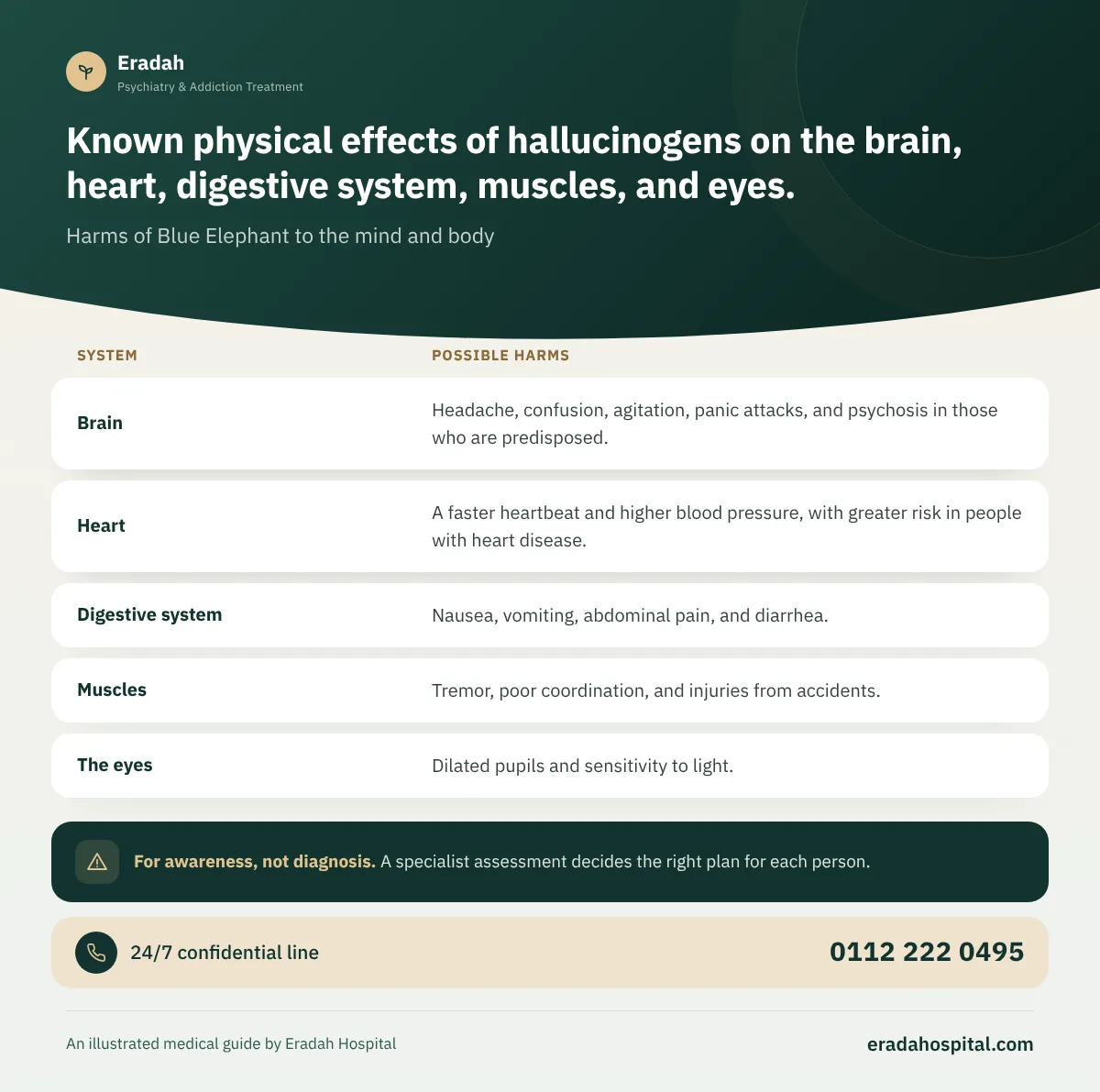
NIDA describes these physical effects as mostly mild to moderate, but they may need medical care. In US poison center data from 2000 to 2016, the most common complaints after LSD and magic mushrooms were agitation, a racing heart, dilated pupils, confusion, and vomiting, and about 17% of callers for LSD and about 6% for mushrooms were admitted to intensive care. A review of DMT also reports severe cardiac effects when large amounts are injected.
Psychosis: when does use become a lasting illness?
Hallucinations may end when the substance wears off, or they may not. In a pooled analysis published in 2020 in the journal Schizophrenia Bulletin, 26% of cases of hallucinogen-induced psychosis later converted to schizophrenia, based on three studies, compared with 34% for cannabis and 22% for amphetamines. The researchers concluded that these cases need firm, early psychological intervention.
NIDA adds that hallucinogens may trigger an illness resembling schizophrenia in people with predisposing factors, although there is little evidence that they cause long-term mental health problems for most people. That is why suspicions or hallucinations that persist after the effects have worn off are a sign that calls for urgent assessment, as in cases of drug-induced psychosis.
Hallucinations returning days or years later
Some people who use hallucinogens describe “flashbacks” that bring back images or feelings they experienced under the influence. According to NIDA, these flashbacks are usually mild and brief, lasting seconds or minutes, and occur within a week of use. But a rare few develop what is called “hallucinogen persisting perception disorder,” in which these episodes are prolonged and recur even after years, causing distress that affects daily life. Research on this disorder remains limited.
Harms of mixing Blue Elephant with other substances
| The mix | The main risk |
|---|---|
| With antidepressants that raise serotonin | A rare risk of serotonin syndrome, which can be dangerous in a few cases. |
| With cannabis | A greater chance of panic and psychosis. |
| With stimulants | Double strain on the heart, raised body temperature, and unpredictable behavior. |
| With alcohol | More severe confusion, and mixing with alcohol has been linked to rare deaths with some hallucinogens. |
This does not mean stopping antidepressants suddenly; that decision belongs to the doctor. What matters most is to avoid unknown substances and to tell the doctor about any previous use.
Who is most vulnerable to the harms of Blue Elephant?
- People with a personal or family history of psychosis or bipolar disorder: which is why medical research on hallucinogens excludes them as a precaution.
- Teenagers: because the brain is still developing, and because they are more prone to accidents and peer pressure.
- People with heart disease or high blood pressure: because of the faster pulse and raised blood pressure.
- People with severe depression or anxiety: the experience may turn into terror, or worrying thoughts may increase.
- Pregnant women: data on the effect of hallucinogens on pregnancy is limited, and no safe level is known.
Can Blue Elephant cause death?
NIDA states that death from overdose is rare with usual use of common hallucinogens, but some synthetic hallucinogens, such as the NBOMe compounds, have been linked to deaths and serious harm, and that deaths usually occur with very large amounts or mixing, especially with alcohol. Because the contents of Blue Elephant are unknown, it cannot be ruled out that a pill contains a substance of this kind. Added to this is the risk of accidents and self-harm while under the influence, which is the risk most present in reality. If use recurs, the next step is to seek specialist treatment.
Danger signs after using the Blue Elephant: call ambulance (123) immediately
- Severe agitation that does not settle, or an attempt to harm oneself or others
- Seizures, loss of consciousness, or no response to calling
- Chest pain, or a very fast or irregular pulse
- A very high body temperature with confusion
- Slow or weak breathing, as the pill may contain an unexpected substance
Call ambulance (123) immediately. If the person is unconscious but breathing, place them on their side so they do not choke on vomit. Stay with them calmly in a place with little light and noise, remove dangerous objects and do not leave them alone. Do not give them any medicine or other substance, and tell the paramedics everything you know about the pill and what else they took with it.
Call the ambulance 123