What does a test detect in Captagon pills?
The test does not see the pill's “name,” but the substances that entered the body. Because Captagon pills are varying mixtures, what shows up in a test depends on what the pill actually contained:
The main substance in most pills, which standard amphetamine-stimulant tests detect.
In the original medicine it was converted in the body into amphetamine and theophylline, so amphetamine shows up in the test as well.
Standard drug tests do not look for them, because they are found in beverages and some medicines.
If the pill contained another stimulant such as methamphetamine, it may show up differently, and if it contained no amphetamine, nothing may show up despite the harm.
How long Captagon stays, by sample type
Urine
Blood
Saliva
Hair
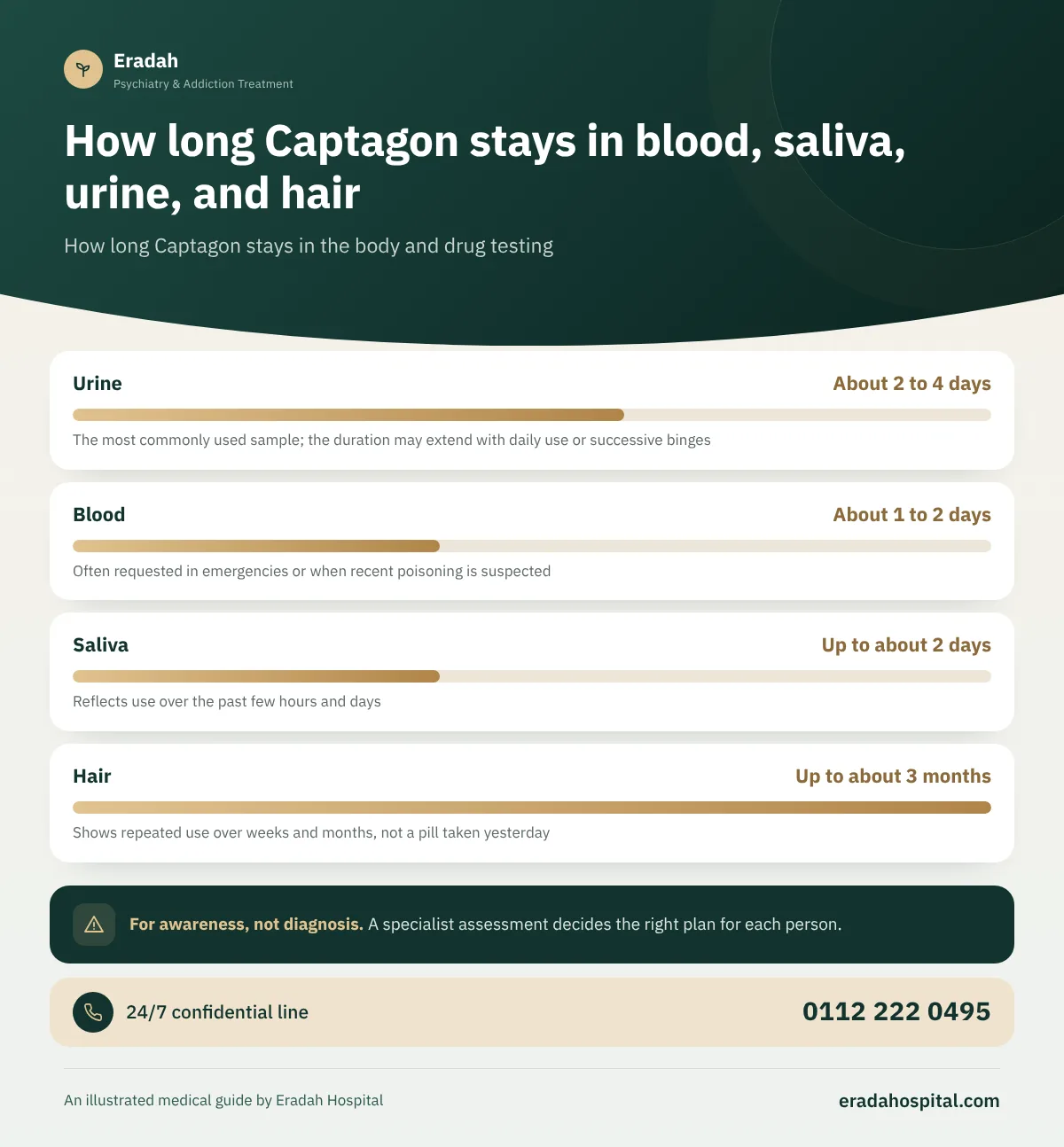
These are approximate windows for amphetamine, the active substance in most pills, and they vary by laboratory, the detection threshold used, and the composition of the pill itself.
Why does Captagon leave a trace in urine for days?
Amphetamine leaves the body mainly through the kidneys, and a large part of it is excreted unchanged. Because its half-life is relatively long compared with stimulants such as cocaine, the body needs days to clear it completely, so traces remain in urine long after the stimulant effect itself has gone. And the substance leaving the urine does not mean the brain has recovered; the crash, depression, and cravings can last for weeks.
Why do Captagon test results differ from person to person?
With any substance, detection time varies with the body and the amount, but Captagon adds another reason: not knowing what is in the pill in the first place. That is why two people may use “the same type” of pills and get different results. The most important factors are:
- The amount of amphetamine in the pill: it varies from pill to pill and batch to batch.
- Number of pills and frequency of use: daily or successive use lengthens the detection time.
- Kidney and liver function: the kidneys are the main route by which amphetamine leaves the body.
- Age, general health, and body mass.
- Test sensitivity: laboratories differ in the minimum level at which a sample is considered positive.
Rapid and confirmatory testing for Captagon
| Rapid (preliminary) test | Confirmatory test | |
|---|---|---|
| Where it is done | In clinics, emergency departments, and some workplaces | In a specialized laboratory |
| What it detects | The presence of a substance from the amphetamine family in general | The specific substance and its approximate amount |
| Accuracy | May give a false positive or false negative | Highest accuracy and can be relied on |
| When it is requested | As a first step | After any positive preliminary result, or when a documented result is needed |
Can a result be positive without using Captagon?
Yes. A rapid amphetamine test may react to other medications, such as some decongestants and cold remedies containing pseudoephedrine, some antidepressants such as bupropion, and the drug selegiline. This is why the preliminary result is not relied on alone, and it must be confirmed in a specialized laboratory before any decision.
Does a negative result mean the person did not use Captagon?
Not necessarily. The detection window in urine is relatively short, and the use may have happened before it, and some pills circulating as Captagon contained no amphetamine at all according to forensic analyses, so they leave no trace in a standard test even though they may be harmful. So a negative result does not replace observation, conversation, and specialist assessment.
Why does the emergency doctor ask about pills?
When a young man arrives at the emergency department with palpitations, chest pain, agitation, or a high temperature, knowing that he took stimulant pills changes the treatment and speeds it up. So family or friends should tell the doctor everything they know, even if they are not sure, and bring any remaining pills if possible. The doctor here is treating, not investigating, and the right information can save a life.
When is a Captagon test requested?
- In the emergency department when signs of stimulant poisoning, acute psychosis, or unexplained chest pain appear in a young person.
- At the start of an addiction treatment program, and during it to monitor adherence and encourage progress.
- In some occupational screenings, especially for drivers and people in sensitive jobs.
- In some official and legal procedures.
The role of testing during Captagon addiction treatment
In treatment programs, periodic tests are used to encourage the patient, not just to monitor them; a run of negative results is tangible evidence of progress that the patient and family can feel, and some programs reward this commitment. Tests also help detect any relapse early, and whether the patient has moved to another substance, so the treatment team can adjust the plan in time.
How should the family handle a test result?
If the result is positive, treat it as the beginning of a conversation, not the end of one; ask about the motive, request a specialist assessment, and avoid harsh punishment that pushes the young person to hide. If it is negative while clear signs continue, do not ignore what you see, and keep up calm follow-up. Most important, let your son know that your goal is his health, not catching him in the act.