Understand what they are going through before you speak
“Two days awake and never stops talking, then he sleeps a whole day and wakes up fighting with everyone.” This is how one mother describes what happens in her home, without knowing that what she sees is a known pattern of stimulant use. Dealing with someone addicted to Captagon becomes easier when you know that the irritability and long sleep are not just “bad manners,” but stages in a cycle with its own logic.
Most Captagon pills in circulation today are amphetamine, caffeine, and other substances, and a systematic review published in 2025 describes their effect as increased alertness, concentration, and physical capacity with euphoria, the price of which the body and mind pay with continued use. A section in the Family Guide to Addiction sets out the principles of dealing with it briefly, and here we detail a practical plan from the beginning through to treatment.
The Captagon cycle: what suits each stage?
- During the effectEnergy, a lot of talking, and staying up
No serious conversation now, and no arguing. Watch only for danger signs.
- The crashLong sleep, exhaustion, irritability, and sadness
Quiet, food, and water; ease demands temporarily without giving up the limits.
- After the crashA relative return of calm
This is the best time for a conversation: after sleep and food, and in short sentences.
- CravingsThinking about the pills, anxiety, and looking for money
Clear limits around money, and alternatives for the need the pill meets.
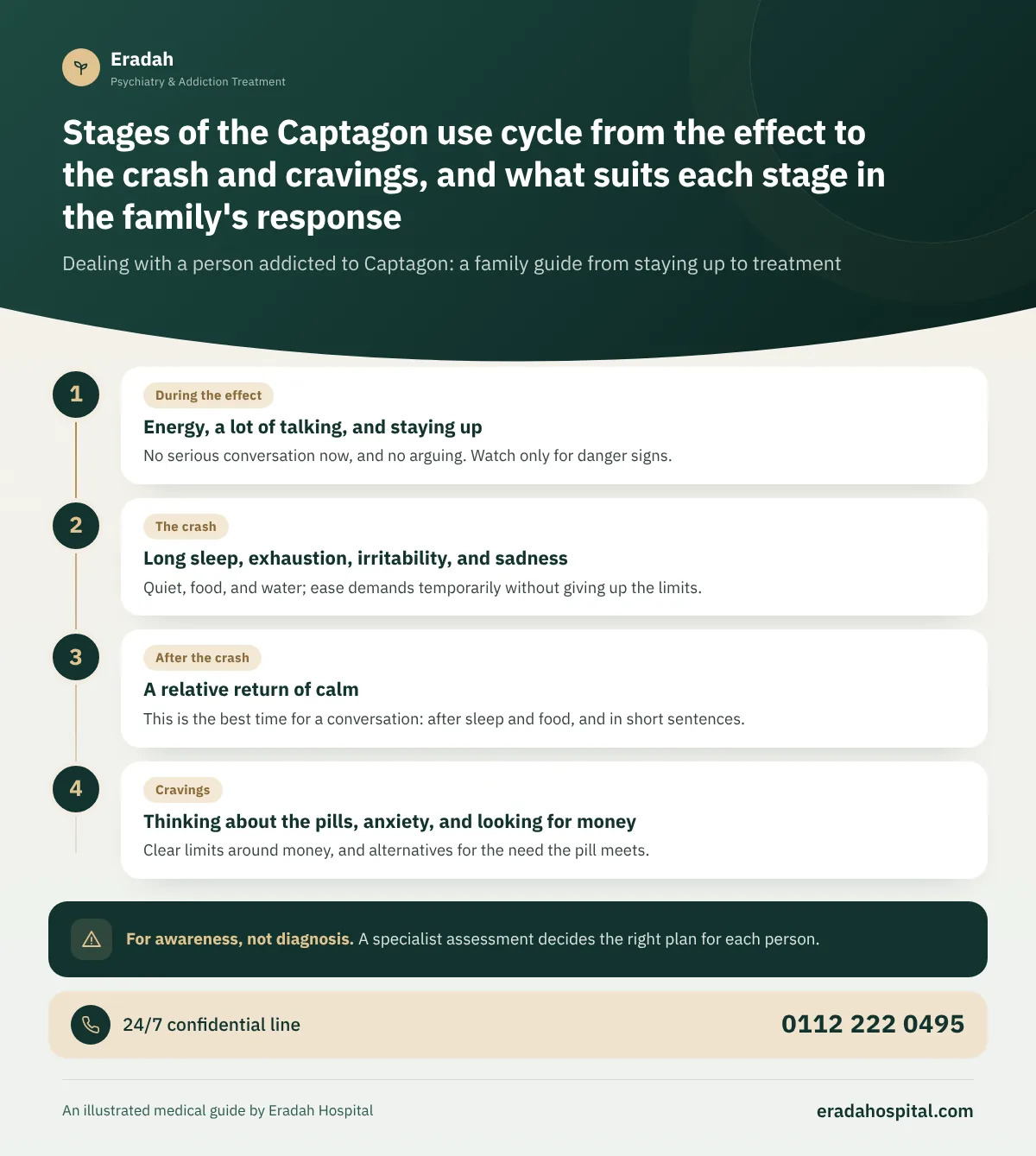
The length of each stage varies from person to person and from pill to pill, because the contents of the pills are themselves unknown.
Look for the need the pill meets
Captagon rarely begins as a search for a “mood” alone. The common reasons are:
Staying up to study becomes a habit, even though sleep deprivation weakens memory.
Shifts or long-distance driving that call for “energy.”
Some young people have undiagnosed ADHD (hyperactivity and attention deficit).
The pill lifts the mood temporarily, then leaves it worse.
When the need itself is treated, the drive to return to the pill weakens. The page on ADHD and addiction explains how attention problems are treated in safe ways.
What do you say to them?
At the right moment, after sleep and food, try short phrases that link your concern to what matters to them:
- “I noticed you've been sleeping only every other day for two weeks, and I'm worried about your health.”
- “The exam matters to you, and staying up on pills wipes out what you studied.”
- “I'm not going to talk about your mistake now; I want us to see a doctor and understand what's happening.”
Avoid phrases that close the door: belittling, comparing them to others, and threats you don't intend to carry out. The page on Captagon addiction symptoms sets out the signs you can rely on calmly.
The approach that raises the chances they accept treatment
Instead of a big confrontation or silence, the CRAFT approach trains the family to reward periods of abstinence with attention and shared activities, to let the person face the consequences of their use without being shielded, and to choose the right moment to offer treatment. In a systematic review published in 2010 of four high-quality trials, this approach got participants into treatment three times as often as encouraging the family to attend support groups alone, and twice as often as group confrontation, and it worked with about two-thirds of those who refused, usually after four to six sessions.
Practical limits: money, driving, and school
- No open-ended money without knowing where it is spent, and provide needs directly instead of cash when necessary.
- No driving after sleepless nights or under the influence of pills, even if that means taking the keys.
- Contact the school or university tactfully if attendance has been affected, without exposing them.
- A clear agreement on what will happen if pills are found in the house, then follow through on it.
Irritability and suspiciousness: how do you act safely?
Amphetamine stimulants can cause suspiciousness and hallucinations, especially with long sleeplessness and large amounts, and 22% of cases of amphetamine-induced psychosis later turned into schizophrenia, according to a pooled analysis published in 2020. If suspiciousness or accusations appear, do not argue with the thoughts or confirm them, reduce noise and the number of people around them, and quietly remove sharp objects.
Days of stopping: how do you support without giving in?
After stopping come days of exhaustion, long sleep, sadness, and strong cravings. According to a Cochrane review of the treatment of amphetamine withdrawal, no medication has been proven effective for treating this withdrawal itself, so treatment relies on support, psychological follow-up, and treating depression if it appears. What helps at home: regular sleep, enough food, fewer demands for a while, and not letting money or old friends bring them back into the cycle.
When should you seek specialist help?
If use recurs despite promises, or suspiciousness or violence appears, or there is severe depression after stopping, or they combine Captagon with other substances, this is the time for assessment. The page on amphetamine addiction treatment sets out the stages of treatment that apply to most Captagon pills, and treatment may begin with outpatient treatment or residential care depending on the case. At Eradah the first consultation is free and confidential, and do not start or stop any medication without a doctor.
Warning signs after using Captagon: call an ambulance (123) immediately
- Chest pain or pressure, or severe palpitations.
- A very high temperature with agitation or confusion.
- Seizures or loss of consciousness.
- Hallucinations, or threats to harm themselves or others.
- Talk of death or suicide on crash days.
Call ambulance (123) immediately. If the person is unconscious but breathing, place them on their side so they do not choke on vomit. Stay with them and do not leave them alone. Do not give them food or drink, and tell the paramedics everything they took or used, and the amount and time if you know them.
Call the ambulance 123