How does the body get rid of codeine?
After codeine is taken, it is absorbed from the digestive tract, and the liver handles it by more than one route: a small part is converted to morphine by the CYP2D6 enzyme, part to norcodeine by the CYP3A4 enzyme, and most is bound to substances that ease its removal. The kidneys then clear most of these products in the urine.
Codeine’s half-life is relatively short, estimated at a few hours, which is why its effect disappears from the blood quickly, while its metabolites stay in the urine longer.
How long does codeine stay in the body, by type of test?
Urine
Blood
Saliva
Hair
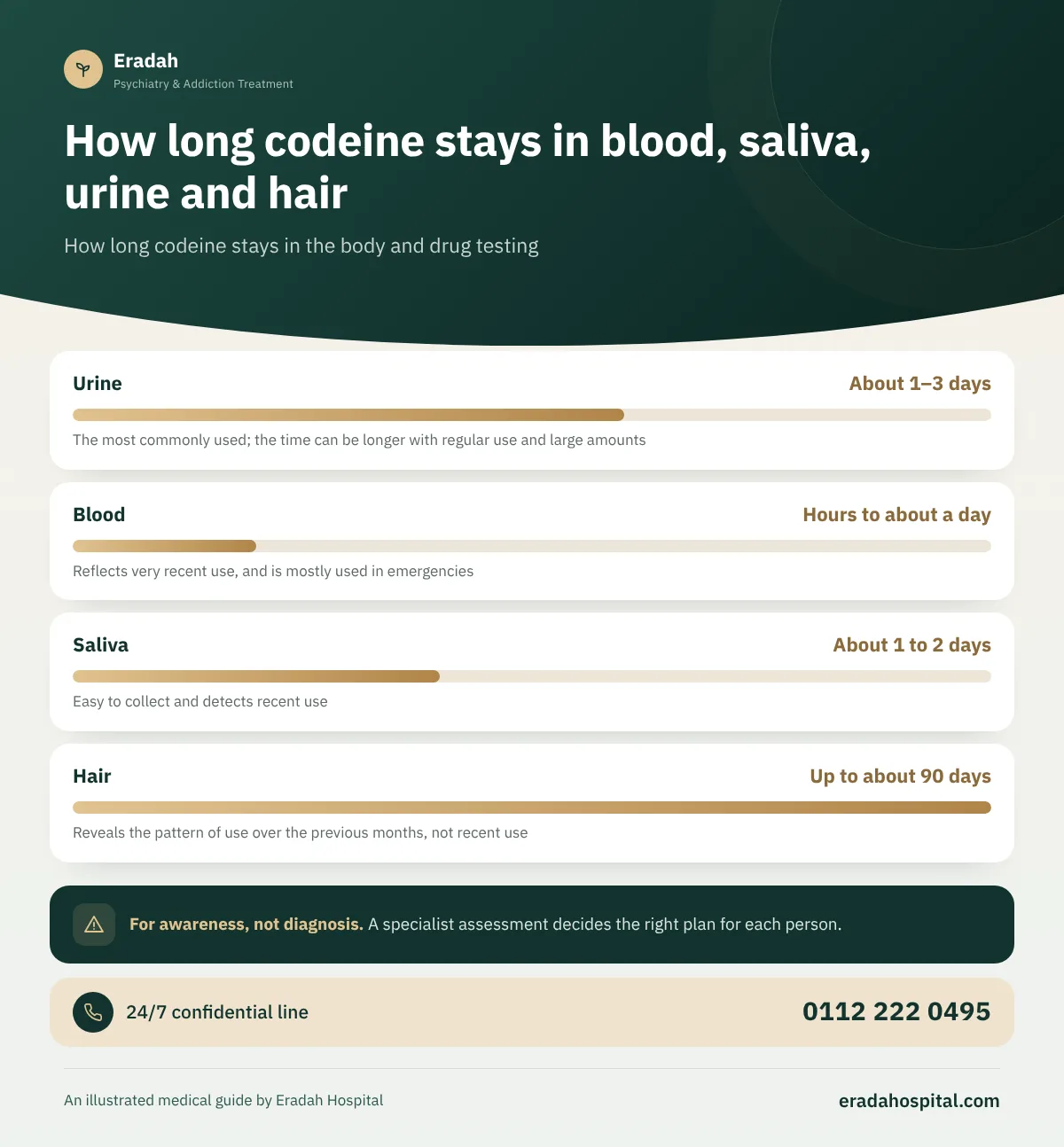
These durations are approximate and vary by laboratory, test sensitivity and the individual. For an accurate interpretation of a specific result, consult the doctor or the laboratory.
What factors affect how long codeine stays?
- Frequency and length of use: regular use lengthens the detection time compared with a single dose.
- Amount: larger amounts take longer to clear.
- Liver enzyme activity: it varies genetically, so the proportions of metabolites in urine differ from person to person.
- Kidney and liver function: weakness in either slows clearing of the drug and its metabolites.
- Age and general health: clearance is often slower with advancing age.
- Test sensitivity and cutoff: these differ between laboratories and types of test.
Why does codeine show up on a test as morphine?
Because the liver converts part of the codeine to morphine, it is normal for a urine sample to contain both codeine and morphine. The quick screening test usually cannot tell them apart and gives only an “opiates” result. A confirmatory test measures each substance separately, and a specialist doctor can interpret the result more precisely from the ratios and the presence of distinctive metabolites of other substances.
What is the difference between a screening test and a confirmatory test?
| Screening test | Confirmatory test | |
|---|---|---|
| Method | A rapid immunoassay, using strips or laboratory instruments | Precise techniques such as chromatography with mass spectrometry |
| What it detects | The opiate class in general | The specific substance and its metabolites |
| Speed | Minutes to hours | Usually days |
| Accuracy | May give false positives | High accuracy, relied on medically and legally |
Can a false positive result occur?
Yes. A screening test can be affected by various factors, the best known for opiates being:
- Eating foods containing poppy seeds, which can contain traces of morphine and codeine.
- Prescribed medicines that contain codeine, such as some painkillers and cough medicines.
- Some other medicines that may interfere with immunoassay tests, depending on the type of test.
- Errors in collecting or storing the sample.
That is why medical bodies recommend confirming any positive result with a confirmatory test, and telling the doctor or laboratory about all medicines used before the test.
What is the difference between how long codeine acts and how long it shows on a test?
Many people confuse the two durations. The painkilling and sedative effect of codeine usually lasts a few hours, then the feeling fades, while its metabolites stay in urine much longer. So the end of drowsiness, or the person returning to normal, does not mean the drug has left the body, nor that combining it with another sedative has become safe.
| Measure | Approximate duration | What it means |
|---|---|---|
| Felt effect | A few hours | How long the person feels pain relief or drowsiness |
| In the blood | Hours to about a day | Reflects very recent use |
| In the urine | About one to three days | Metabolites remain after the effect has gone |
| In the hair | Months | A long record of the pattern of use |
Can the time or amount of use be known from a test?
Only approximately. A urine test cannot pinpoint when codeine was used or how much, because its concentration is affected by the amount of fluid, the time the sample was taken and the genetic speed of conversion. A blood test gives a closer picture of recent use, while a hair test gives a picture of the past months without identifying a particular day. That is why the doctor always interprets a result in light of the medical history and symptoms, not as an isolated number.
What if you use codeine by prescription?
If you take a codeine-containing medicine by prescription, you have the right to explain that. Keep the prescription or the doctor’s report, and inform the party requesting the test before it is done. A confirmatory test together with the prescription often clarifies the situation. Do not stop or change your medication before a test without consulting your doctor.
Why is a codeine test requested?
- In the emergency department: to explain loss of consciousness or slow breathing and decide on the right treatment.
- In treatment: to follow adherence to the recovery plan in a supportive, non-punitive way.
- Before prescribing certain medicines: to avoid dangerous interactions with other opioids.
- In employment or legal screening: according to the regulations in force.
Why don’t we publish ways to hide a test result?
Because testing in the context of treatment is a tool to protect the patient, not to punish them; it helps the doctor understand what is happening and adjust the plan. Also, the recipes circulating for hiding results are often ineffective, and some are harmful to the kidneys and heart. If testing is a source of worry for you, this is a good time to ask for help. Learn about codeine addiction treatment.