What are the stages of codeine addiction treatment?
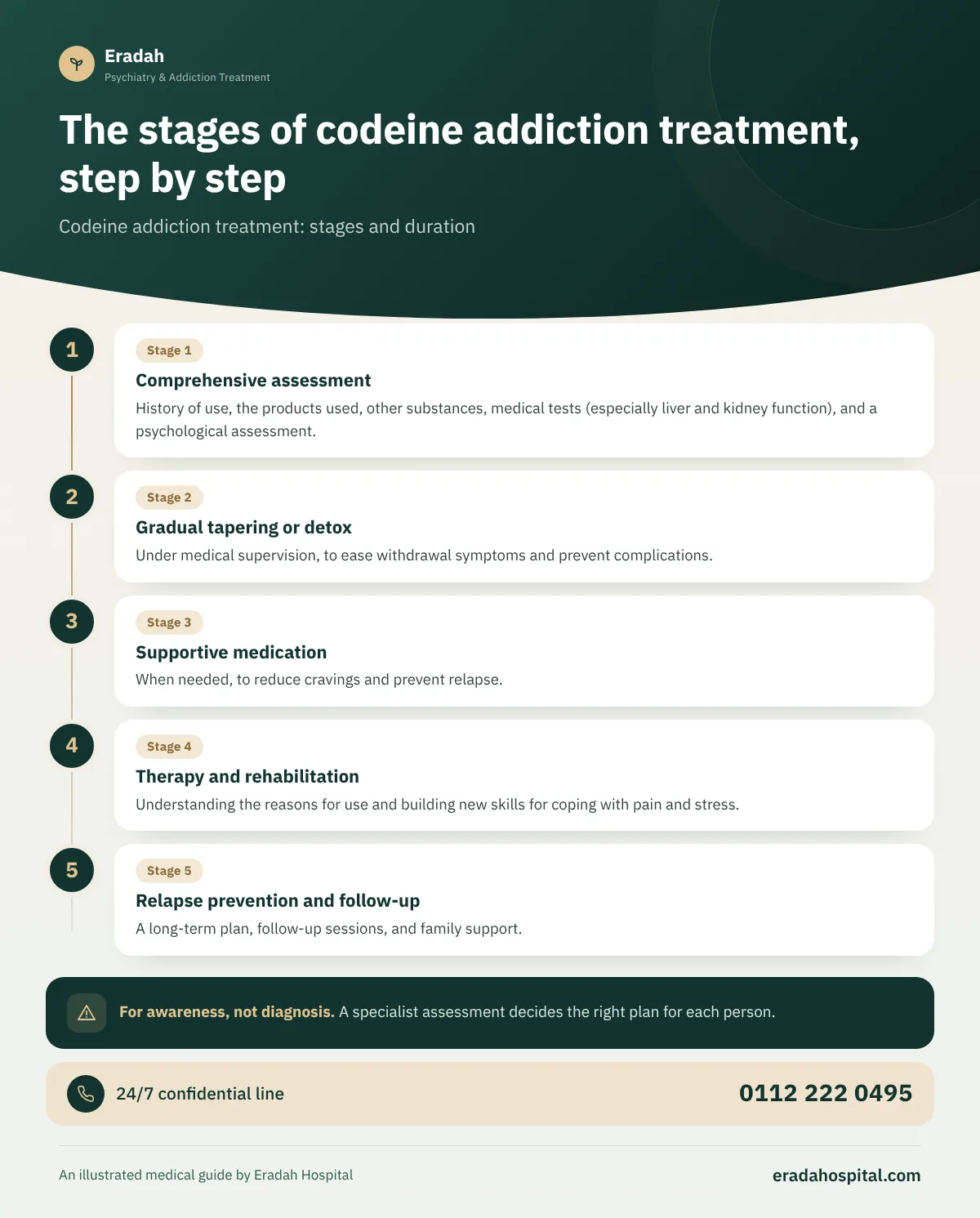
There is no single plan that suits everyone. Someone who became dependent on a combination painkiller after chronic back pain is not in the same position as a young person who misuses cough syrup along with other substances. Most plans, however, move through the following stages:
- Stage 1Comprehensive assessment
History of use, the products used, other substances, medical tests (especially liver and kidney function), and a psychological assessment.
- Stage 2Gradual tapering or detox
Under medical supervision, to ease withdrawal symptoms and prevent complications.
- Stage 3Supportive medication
When needed, to reduce cravings and prevent relapse.
- Stage 4Therapy and rehabilitation
Understanding the reasons for use and building new skills for coping with pain and stress.
- Stage 5Relapse prevention and follow-up
A long-term plan, follow-up sessions, and family support.
Why does treatment begin with a careful assessment?
Because codeine addiction often involves more than one problem at the same time. A person may have hidden liver damage from paracetamol, an ulcer from ibuprofen, rebound headaches, depression and anxiety, or may be using sedatives alongside it. The assessment establishes:
- The type of product used, its ingredients, and how long it has been used.
- Liver, kidney and stomach function, and general health.
- Whether other substances are involved that need their own withdrawal management, such as benzodiazepines or alcohol.
- Mental health, and whether a co-occurring disorder needs treatment.
- The cause of the original pain, and an alternative plan for managing it.
How is detox from codeine done?
In many codeine cases the doctor chooses gradual tapering over several weeks, because it eases symptoms and lowers the chance of returning to use. In other cases, especially with large amounts or severe dependence, the doctor may switch the person to a long-acting opioid medication and then reduce it in a structured way. Accompanying symptoms such as nausea, diarrhea and insomnia are treated with suitable medication.
For details of the symptoms in this stage and how long they last, see the page on codeine withdrawal symptoms.
What medications are used to treat codeine addiction?
Internationally approved medications are used to treat opioid use disorder, and the doctor chooses among them according to each case and what is available and approved locally. They are listed here only to explain their roles:
| Medicine | Role in treatment |
|---|---|
| Buprenorphine (alone or with naloxone) | Eases withdrawal and cravings; used in detox or long-term treatment |
| Methadone | A long-acting opioid used within structured programs for severe dependence |
| Naltrexone | Blocks the effects of opioids and helps prevent relapse after detox is completed |
| Symptom-relief medications | Such as clonidine or lofexidine, and medications for nausea, diarrhea and insomnia as needed |
| Non-opioid painkillers and headache medications | To manage the underlying pain without returning to opioids |
Doses are deliberately not given here; they are set and adjusted by the doctor alone, according to each patient's condition.
What is the role of psychological and behavioral therapy?
Helps the person recognize the thoughts and situations that drive use, and build practical alternatives.
Strengthens the person's own motivation to change and reduces ambivalence.
Rebuilds trust and teaches the family how to support without enabling use.
Sharing the experience with others going through the same recovery reduces isolation and shame.
Stress management, healthy sleep, and a gradual return to work and study.
If the person also has depression, anxiety or another disorder, it is treated at the same time within a dual diagnosis program.
How is pain treated without codeine?
Many people with codeine addiction started with real pain, and if that pain is not treated, relapse is almost certain. A good plan therefore includes:
- Accurately diagnosing the cause of the pain, together with the relevant specialist.
- Non-opioid painkillers and targeted medications suited to the type of pain, prescribed and monitored.
- Physical therapy and guided exercises for back and joint pain.
- A dedicated plan for medication-overuse headache, and preventive medication for migraine when needed.
- Psychological techniques for managing chronic pain, such as relaxation and cognitive behavioral therapy for pain.
Inpatient or outpatient: which is more suitable?
| Inpatient treatment | Outpatient treatment | |
|---|---|---|
| Suits | Severe dependence, use of multiple substances, medical or psychiatric complications, or repeated relapses | Milder cases with good family support and relative stability |
| Advantages | Continuous medical supervision and a safe environment away from triggers | Work, study and family life can continue |
| Challenge | Temporary time away from daily life | Exposure to triggers and to medication available nearby |
How long does codeine addiction treatment take?
The tapering or detox stage usually takes from a few days to a few weeks depending on the plan, while psychological rehabilitation takes weeks to months, and follow-up to prevent relapse may continue for a year or more. Research shows that staying in treatment for long enough is one of the strongest factors linked to success.
How is relapse prevented?
- Identifying personal triggers: pain, insomnia, stress, and particular places or people.
- A written plan for dealing with pain flare-ups without going back to codeine.
- Telling doctors and dentists about your history of dependence before any painkiller is prescribed.
- Keeping opioid medications out of the home.
- Continuing follow-up sessions even after you start feeling better.
- Treating a relapse, if it happens, as a signal to adjust the plan rather than as a final failure.
How do you choose the right treatment center?
- An official license and a team that includes psychiatrists, internal medicine doctors and psychotherapists.
- A written individual treatment plan, not one program for everyone.
- The ability to handle chronic pain and co-occurring psychiatric disorders.
- Respect for privacy, confidentiality and dignity.
- A follow-up program after discharge, and involvement of the family.
Choosing a hospital for codeine addiction treatment
With codeine, the story often starts at the pharmacy: a cough syrup, or a combination painkiller for headaches and toothache, and then the use turns into a habit that is hard to break. That means the right facility must treat two things together: a dependence on an opioid that seems mild but is real, and the pain or headache that started it all. Any place that ignores the pain paves the way for a return to use. Ask the center:
- Does the doctor choose between gradual tapering and direct withdrawal after assessing the amount and type of product, rather than applying one rule to everyone?
- Does the team review combination products, since some contain other painkillers that may call for liver or stomach tests?
- Is there a plan for treating pain or medication-overuse headache, in cooperation with a specialist?
- Does the doctor ask about accompanying sedatives or alcohol, since withdrawal from them is more dangerous and needs supervision?
- Does the team explain to the patient and family the risk of overdose if the person returns to their old amount after tolerance has dropped?
At Eradah, a doctor and nursing staff monitor the patient day and night during the medical detox stage. The doctor sets the medication plan according to the case, then specialists continue with cognitive behavioral therapy, and a follow-up plan to prevent relapse is built before discharge. If the condition needs the care of a general hospital, the patient is taken there by ambulance.
Codeine addiction treatment at Eradah
At Eradah we begin with a comprehensive medical and psychological assessment, including the necessary tests. We then set an individual plan for gradual tapering or detox under medical supervision, with individual, group and family therapy, a plan for managing pain together with specialist doctors, and follow-up after discharge. All of this is done in complete confidentiality.