How is flakka transformed inside the body?
Flakka reaches the brain quickly and its effect begins within minutes, after which the liver starts breaking it down through several pathways. A scientific review published in 2018 explains that α-PVP undergoes extensive transformation in the body, and that the substance itself and its breakdown products, especially two known by the abbreviations β-OH-α-PVP and the lactam, are what urine tests look for.
In a study of eight volunteers published in 2025, 10 breakdown products of the substance were found in urine, the most abundant being one formed by the opening of a ring in its molecule, while β-OH-α-PVP was a minor product. These results show why laboratories need to look for more than one compound to detect flakka.
Indicates recent use, and disappears faster than its breakdown products.
What confirmatory urine tests look for.
Forms in which breakdown products are excreted in urine, which may need special sample processing.
How long the effects of flakka last
According to a review published in 2020, the psychological effect of flakka appears after about 10 minutes, peaks within 10 to 40 minutes, and lasts two to three hours. In the volunteer study, the substance reached its highest concentration in saliva within roughly the first hour after it was inhaled. But the effect wearing off does not mean the substance and its breakdown products have left the body.
What do we know about each type of sample?
| Sample | What we know |
|---|---|
| Urine | The main sample for detection; it needs a specialized test that looks for the substance and its breakdown products. |
| Saliva | Found at high concentration within the first hour in a study of volunteers. |
| Blood | Reflects recent use, and is used in emergencies and forensic medicine. |
| Hair | Detected exposure to flakka in a study of young people, some of whom denied using it; it reflects an earlier period, not the most recent use. |
There are not yet enough studies to say how many days flakka remains detectable in each sample, and results vary with the laboratory, the amount and how often it was used. To interpret a specific result, consult the doctor or the laboratory.
Does flakka show up on a standard drug test?
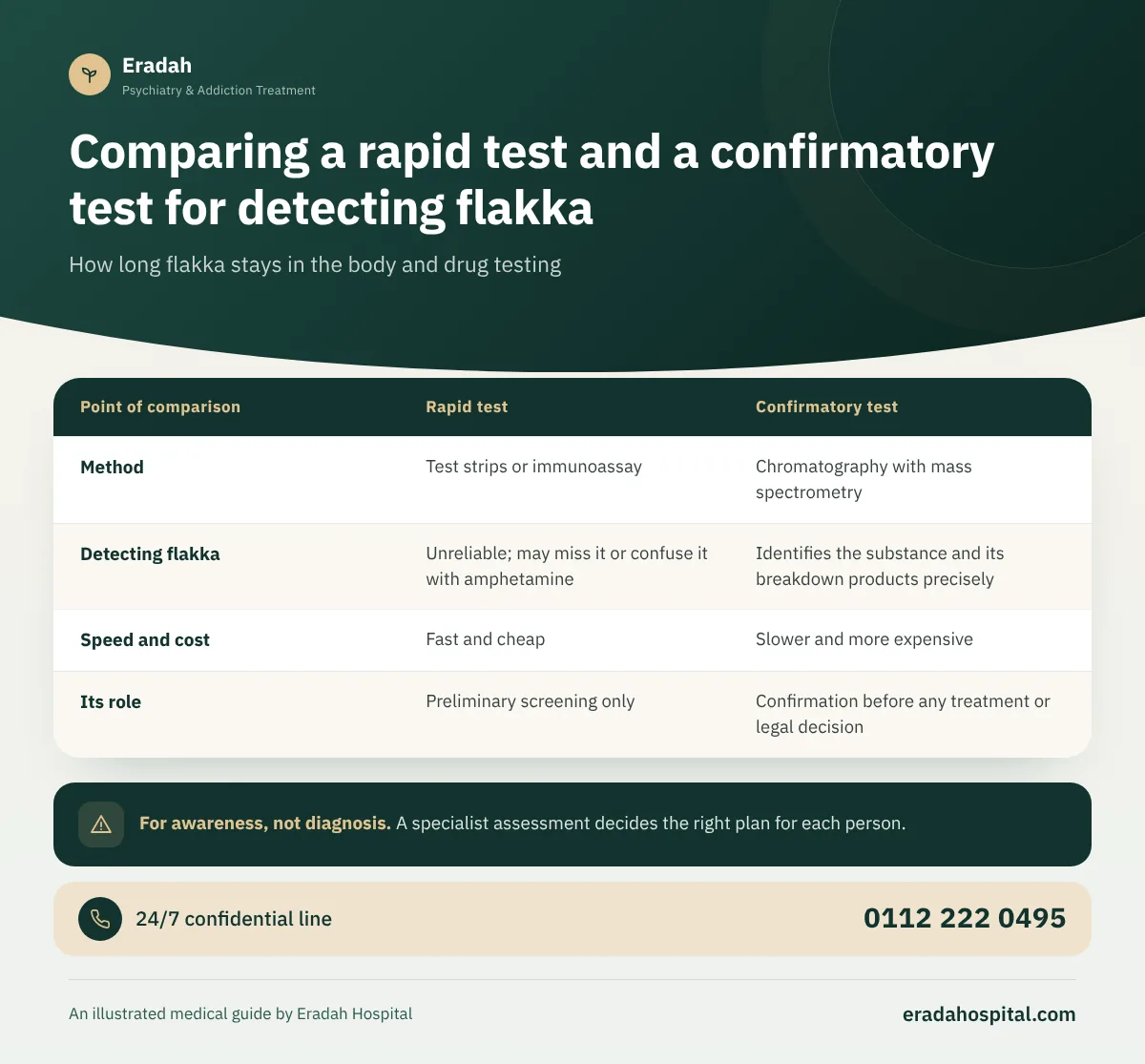
Usually not. The 2018 review explains that α-PVP cannot be detected by traditional routine testing procedures, which makes it hard even to estimate how widespread it is. On the other hand, a French study published in 2025 found that synthetic cathinones were responsible for 16.3% of positive amphetamine results and 17.1% of positive ecstasy results in emergency and intensive care patients, meaning immunoassays can err in both directions: they miss the substance, or attribute it to another one.
The difference between a rapid test and a confirmatory test
| Point of comparison | Rapid test | Confirmatory test |
|---|---|---|
| Method | Test strips or immunoassay | Chromatography with mass spectrometry |
| Detecting flakka | Unreliable; may miss it or confuse it with amphetamine | Identifies the substance and its breakdown products precisely |
| Speed and cost | Fast and cheap | Slower and more expensive |
| Its role | Preliminary screening only | Confirmation before any treatment or legal decision |
Factors that affect detecting flakka
- How often it is used: repeated sessions over hours increase the amount of the substance and its breakdown products.
- Method of use: the speed of reaching the blood differs between smoking, inhaling and swallowing.
- What the powder contains: what is sold as flakka may be another closely related substance that the requested test does not look for.
- Liver and kidney function: these affect how fast it is converted and excreted.
- Laboratory capability: not every laboratory is equipped to look for synthetic cathinones.
Why is there no precise time for how long flakka stays in the body?
Because it is a relatively new substance and few studies have given it to volunteers; the 2025 study describes data on how it moves through the body as still limited. Most of the information also comes from poisoning cases or deaths involving multiple substances, and from powder of unknown concentration. For this reason, we prefer to say clearly “we do not know precisely” rather than give an unreliable number.
What does a positive result mean, and what is the next step?
- Make sure the result came from a confirmatory test, not a rapid strip.
- If the result is “amphetamine” in a person suspected of using flakka, ask for a test that identifies the substance precisely.
- The result does not show the amount or number of times, and is not enough on its own to diagnose addiction.
- If use is confirmed, make it the start of an assessment and treatment; you can begin with flakka addiction treatment.