Stages of flakka addiction treatment
Many flakka treatment journeys do not begin in a clinic but in an emergency room: a young man severely agitated and paranoid, and a family who do not know what he took. Surviving that night matters, but it is not the treatment. The real treatment is what comes after.
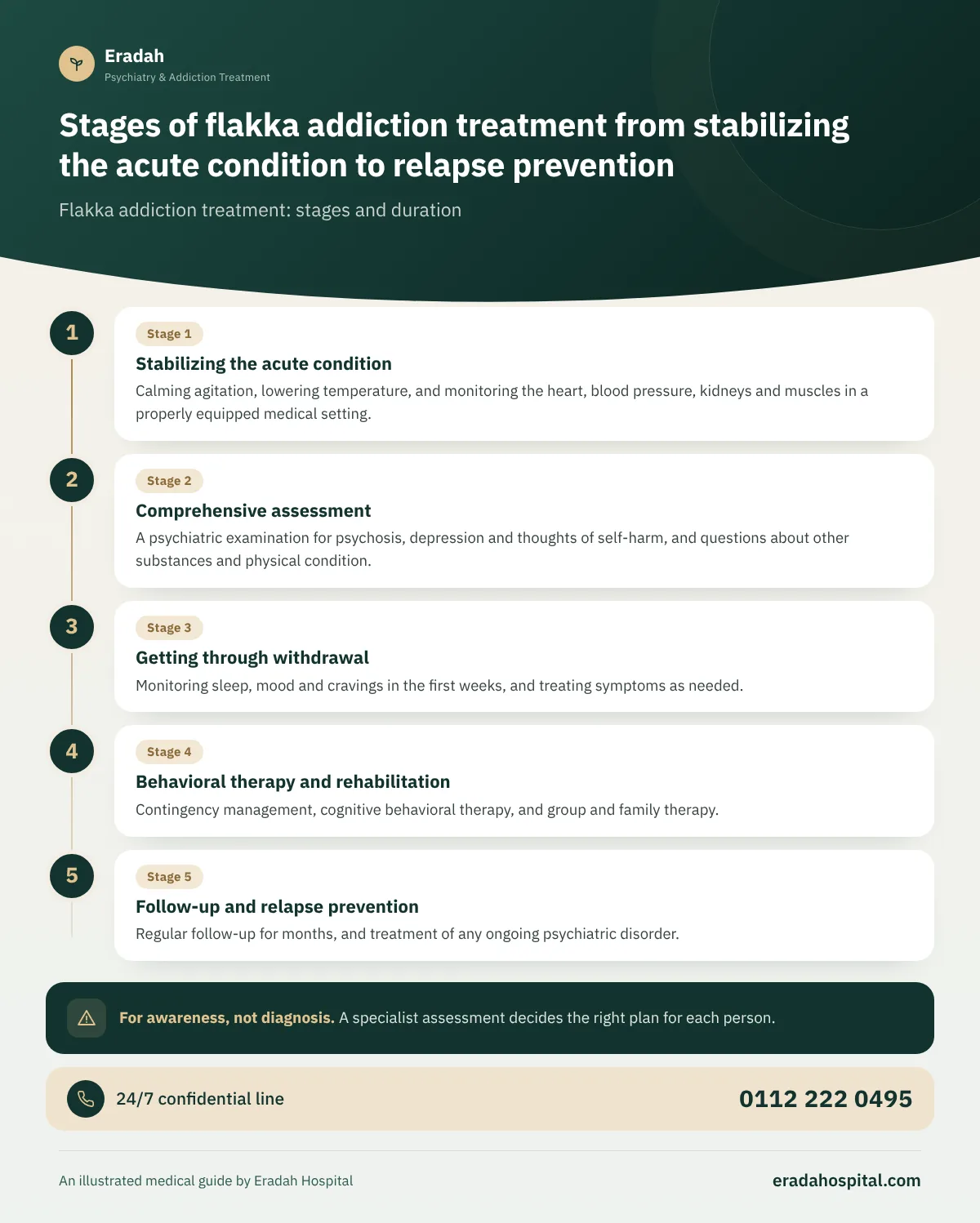
- Stage 1Stabilizing the acute condition
Calming agitation, lowering temperature, and monitoring the heart, blood pressure, kidneys and muscles in a properly equipped medical setting.
- Stage 2Comprehensive assessment
A psychiatric examination for psychosis, depression and thoughts of self-harm, and questions about other substances and physical condition.
- Stage 3Getting through withdrawal
Monitoring sleep, mood and cravings in the first weeks, and treating symptoms as needed.
- Stage 4Behavioral therapy and rehabilitation
Contingency management, cognitive behavioral therapy, and group and family therapy.
- Stage 5Follow-up and relapse prevention
Regular follow-up for months, and treatment of any ongoing psychiatric disorder.
What makes flakka addiction treatment different?
Flakka is a common name for the substance alpha-PVP (α-PVP), one of the synthetic cathinones, which are stimulants that work by blocking the reuptake of dopamine and norepinephrine. A scientific review published in 2020 summarizes its main harmful effects as mania, rapid heartbeat and hallucinations, with a growing number of emergency admissions because of it. Its pattern resembles crystal meth (shabu) and cocaine, so the foundations of treatment are similar to those for stimulant addiction, with greater attention to psychosis and agitation. What applies here usually applies to the other synthetic cathinones sold under different names, because a person who uses often does not know exactly which compound they got.
Stage one: handling the emergency
Flakka poisoning can cause delirium with severe agitation, a rise in body temperature and rapid pulse, and may be accompanied by muscle breakdown and kidney strain, a condition that is not treated at home. In the published cases, patients needed sedative medication and antipsychotics for several days until they regained touch with reality, and one case even described prolonged psychosis with catatonia; an accompanying review estimates that catatonia occurs in about 1% of synthetic cathinone cases.
Flakka withdrawal symptoms and duration
There are not enough studies on flakka withdrawal specifically, but it resembles withdrawal from other stimulants. The US National Institute on Drug Abuse describes methamphetamine withdrawal, the closest well-studied stimulant, as peaking two to three days after the last use and lasting about a week, and including:
- Depression and low mood.
- Anxiety and irritability.
- Sleep disturbance, which may be excessive sleep after periods of staying awake.
- Cravings to use.
- Difficulty concentrating.
- Aches and a general feeling of discomfort.
After the acute phase, low mood, anxiety and cravings may continue for months in some people. The most dangerous thing in this phase is depression turning into hopelessness or thoughts of self-harm, and in that case help must be sought immediately through the mental health support line (16328) or the ambulance (123).
Treating psychosis that accompanies flakka
Psychosis is not a rare complication with these substances; an analysis of 32 studies published in 2024 found that about 38% of people exposed to synthetic cathinones in those studies developed psychotic symptoms of hallucinations or delusions. Psychosis clears in many people within days to weeks with abstinence and treatment, but it can last longer in others. Treatment therefore needs a psychiatrist to decide whether antipsychotics are needed and for how long, and to follow how symptoms develop, as we explain in drug-induced psychosis.
Behavioral therapy: what works for stimulant addiction?
According to the US National Institute on Drug Abuse, there is no approved medication for stimulant use disorder, but there are effective behavioral therapies:
Small, tangible rewards for negative tests and for sticking with treatment; it is the most studied approach linked to success.
Identifying triggers and learning practical ways to handle cravings and stress.
Helps a person who is ambivalent discover their own reasons for change.
Support and sharing with others going through the same experience.
Repairing communication and setting clear boundaries without violence.
Treating co-occurring depression, anxiety or ADHD within a single plan.
Co-occurring psychiatric disorders are treated under the concept of dual diagnosis, because leaving depression or anxiety untreated opens the door to return to use.
Are there medications to treat flakka addiction?
There is no approved medication that treats addiction to flakka or any other stimulant. But the doctor may prescribe medication for a limited period to treat insomnia, anxiety, depression or psychosis. Taking sedatives or sleeping pills on your own to get past the “crash” may start a new addiction. Do not start or stop any medication without a doctor, and we do not give any doses here.
How long does flakka addiction treatment take?
| Stage | Approximate duration |
|---|---|
| Stabilizing the acute condition | From hours to several days, longer with psychosis or complications |
| Assessment and getting through withdrawal | One week to several weeks |
| Behavioral therapy and rehabilitation | Several weeks to a few months |
| Follow-up and relapse prevention | Several months, and it may extend to a year or more |
Does flakka treatment require residential care?
An inpatient program is often suitable at the start if there are psychotic symptoms, repeated agitation, thoughts of self-harm, daily use with other substances, or failed previous attempts. Stable cases with good family support may complete treatment through outpatient treatment after getting through the first stage.
Relapse prevention after flakka treatment
- Know your triggers: staying up late, friends, available money, exhaustion and boredom.
- Treat the first weeks with special care, since depression and cravings are at their strongest.
- Keep up follow-up sessions and tests even after you feel better.
- Treat any ongoing psychiatric disorder and do not stop its medication without a doctor.
- If a slip happens, contact your treatment team right away; relapse means adjusting the plan, not failing, as we explain in relapse.
Choosing a Hospital for Flakka Addiction Treatment
Choosing a place for flakka treatment starts with an uncomfortable fact: the patient may arrive agitated or psychotic, and sometimes does not know what they actually took. An acute state with high temperature, muscle breakdown or a very rapid heartbeat belongs first in the emergency department of a general hospital, and the addiction treatment journey begins after the body is stable. So the place you choose needs qualities that not every center offers:
- A psychiatrist who decides on the use and length of antipsychotics, and follows whether hallucinations recede or persist.
- A safe environment free of dangerous objects, and staff trained to calm agitation with words before any other step.
- A quick transfer arrangement to a general hospital if physical complications appear.
- A stimulant program built on behavioral therapy and incentives, not on isolation alone.
- An assessment for other substances, since cathinones are often mixed or sold under different names.
At Eradah, a doctor and nursing staff are present around the clock, and when a case needs the care of a general hospital, the patient is transferred by ambulance to the nearest hospital. The psychiatry department together with the medically supervised detox phase combine the treatment of psychosis and addiction, under the supervision of Dr. Mahmoud El-Sawy. The hospital is licensed by the Egyptian Ministry of Health and Population under No. 1427 and has operated in Sheikh Zayed since 2015.