How does the body get rid of crystal meth?
Part of the methamphetamine is converted in the liver into amphetamine and other metabolites, while a large share leaves unchanged in the urine. Its half-life in the body is roughly six to fifteen hours, which means the body needs days to clear it completely.
The parent compound, which the test looks for directly in urine, blood, saliva and hair.
A product of the breakdown of methamphetamine, which is why amphetamine often shows up on a test along with crystal meth.
For this reason, “amphetamine” tests detect crystal meth, Captagon and amphetamine all at once, and only confirmatory tests distinguish between them.
How long does crystal meth stay in the body by type of test?
Urine
Blood
Saliva
Hair
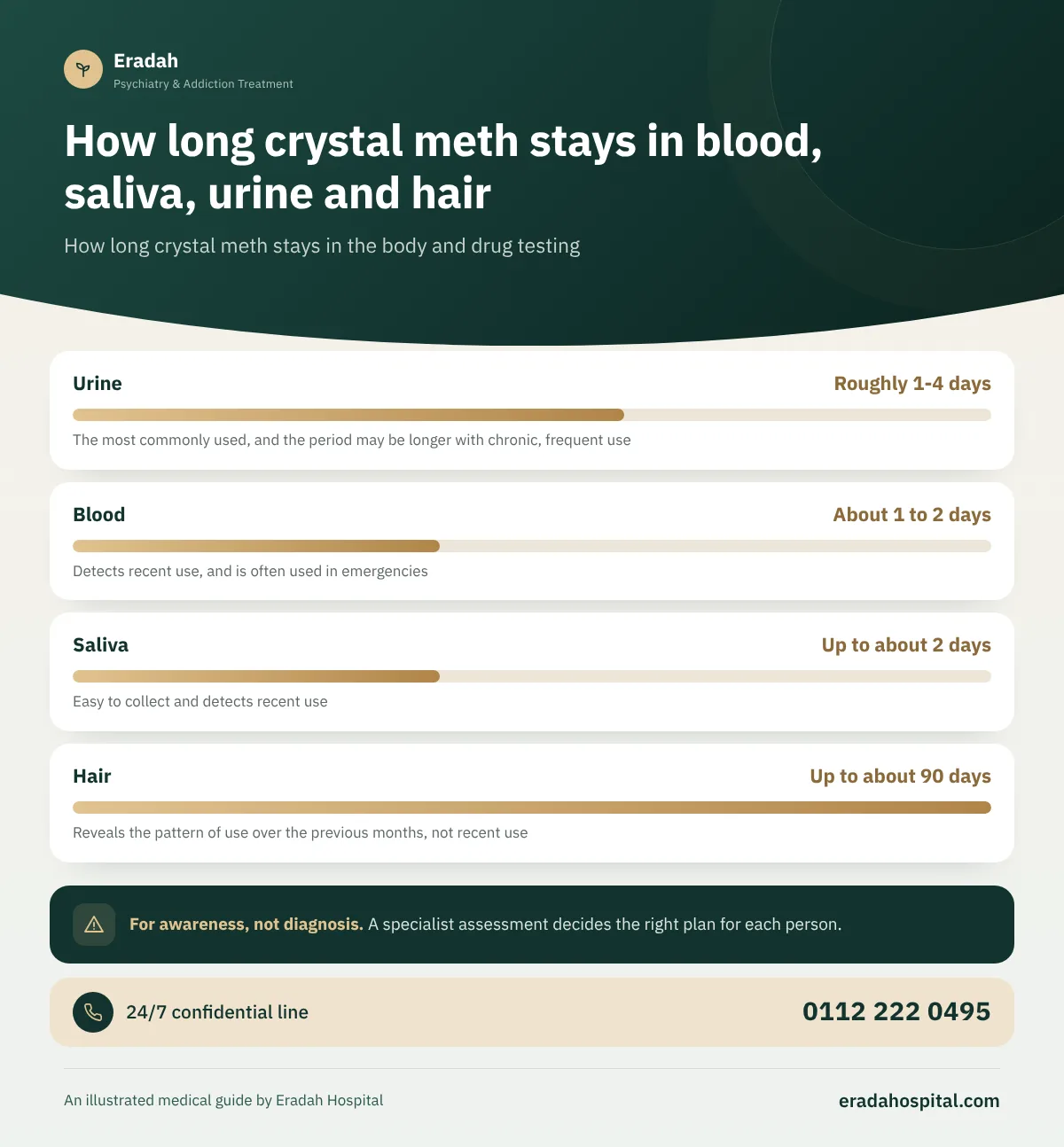
These times are approximate and vary with the sensitivity of the test and the laboratory. For an accurate interpretation of a specific result, consult a doctor or the laboratory.
How long does crystal meth stay in urine?
Urine testing is the most commonly used in hospitals, treatment centers and workplaces. Detection usually begins a few hours after use and typically stays positive for one to four days. With chronic, heavy use over long periods this window can stretch further.
A factor specific to stimulants is that urine acidity affects how fast they are cleared: alkaline urine slows the excretion of methamphetamine and lengthens its stay, while acidic urine speeds it up. This is scientific information for interpreting results, not a method anyone can rely on.
How long does crystal meth stay in blood, hair and saliva?
- Blood: A relatively short window, roughly one to two days, useful for knowing whether a person is under the influence right now, especially in emergencies and accidents.
- Saliva: Detects use in roughly the previous two days, and is used in some roadside tests because it is easy.
- Hair: Holds traces of the substance as it grows, so it detects use over roughly the previous three months in head hair, but it does not detect use in the last few days.
What factors affect how long crystal meth stays in the body?
- Frequency and duration of use: Chronic use in successive binges lengthens the detection time compared with a single use.
- Amount and purity: These are usually unknown with illicit crystal meth.
- Kidney and liver function: Weakness in either slows the clearance of the substance and its metabolites.
- Urine acidity: It clearly affects how fast stimulants are excreted.
- Age, metabolism and general health.
- Sensitivity of the test: The threshold each laboratory counts as positive differs.
What is the difference between a screening test and a confirmatory test?
| Type | How it works | Accuracy |
|---|---|---|
| Screening test (strip or cassette) | Detects the amphetamine group by a rapid immune reaction | Fast and cheap, but may give false positive results |
| Confirmatory laboratory test | Identifies the substance precisely using separation and spectroscopy instruments | Very accurate, and distinguishes methamphetamine from others |
For this reason, any positive screening result, especially one that leads to important decisions, should be confirmed by a specialized laboratory test.
Why does a crystal meth test result differ from one laboratory to another?
Each laboratory or type of strip sets what is called a “cutoff,” the lowest concentration it counts as positive. If the concentration in the sample is below this threshold, the result comes back negative even if tiny amounts of the substance are present. This is why two laboratories can differ on samples taken on two consecutive days, especially near the end of the detection window.
The result is also affected by the timing of the sample, how concentrated the urine is, how the sample is stored and transported, and the quality of the strips used. This is why important medical and legal decisions rely on confirmatory testing in an accredited laboratory, with proper documentation of the sample.
Can exposure of a fetus or infant to crystal meth be detected?
Yes. In some cases doctors may request special tests for the mother or the newborn when they suspect the fetus was exposed to stimulants during pregnancy, in order to provide appropriate care for the child and monitor their development, not to punish. Stimulants also pass into breast milk, so a breastfeeding mother should discuss any use honestly with her doctor to protect the infant.
Can crystal meth show up on a test without having been used?
Yes. The screening test for amphetamines can react with some medications and give a false positive result, including some cold and decongestant medicines containing pseudoephedrine, some antidepressants such as bupropion, and selegiline, used to treat Parkinson's disease; prescribed stimulant ADHD medications also show up on the test.
What does a positive or negative test result mean?
A confirmed positive result means the person used crystal meth within the detection window for that type of test, but it does not say precisely when they used it or how much, and on its own it does not mean they are addicted. Addiction is a medical diagnosis based on a pattern of behavior and symptoms, not on a single laboratory result.
A negative result means the substance is not present at a concentration the test can detect at the time of sampling, and it does not rule out use before that. This is why the doctor interprets the result in light of the medical history and examination, not in isolation from them.
What is the role of testing in crystal meth treatment programs?
In stimulant treatment programs, periodic urine testing is used as a therapeutic tool, not a punitive one. In contingency management programs, for example, the patient receives a tangible reward for each negative result, which reinforces commitment and gives the patient and family concrete evidence of progress.
The treatment team agrees with the patient in advance on testing dates and how a positive result will be handled if it happens, so that it is a chance to review the plan, not a cause for conflict.
Are home crystal meth tests accurate?
Home strips are screening tests based on the same principle used in laboratories, so they can give false positive or false negative results, and a non-specialist may also misread them or collect the sample incorrectly. They are not advised as the basis for life-changing decisions or accusations within the family; any worrying result needs confirmation in a laboratory and an assessment by a doctor.
When are crystal meth tests requested?
- In emergencies when stimulant poisoning, agitation or unexplained psychosis is suspected.
- When starting an addiction treatment program, and during it to follow commitment; it is an essential part of contingency management programs.
- In some job, licensing, or legal procedures.