What is flakka?
Some years ago, videos spread of people running in the streets or behaving with incomprehensible violence, and they were linked to a new drug called flakka. Setting the hype aside, these images reflect a real and dangerous medical condition, and beyond that, a laboratory substance designed to be stronger than cocaine and cheaper.
The US National Institute on Drug Abuse (NIDA) explains that synthetic cathinones are stimulants made in laboratories, chemically close to the substances found in the khat plant, and commonly known as “bath salts.” It adds that people may take them deliberately as a cheaper substitute for other drugs, or unknowingly when they are mixed with other drugs.
Flakka specifically is the substance α-PVP. A review published in 2018 in the journal Neuropharmacology explains that it is one of the “second generation” of these substances, which appeared after a closely related one called MDPV was banned, in an attempt to get around the laws, and that it was sold under misleading names such as “legal products” or “research chemicals.”
How does flakka affect the brain?
Flakka blocks the reuptake of dopamine and norepinephrine, so they build up in the brain, as cocaine does. A scientific review published in 2018 describes it as having a strong cocaine-like effect, a high ability to enter the brain and a high potential for misuse. According to another review published in 2020, the effect begins within about 10 minutes, peaks within 10 to 40 minutes, and lasts two to three hours.
- At first: euphoria, energy and excess confidence, rapid speech and overactivity.
- With larger amounts: anxiety, agitation and aggression, suspicion and hallucinations.
- In the body: a faster pulse and higher blood pressure, dilated pupils, and a rise in temperature and sweating.
- After the effect wears off: a comedown with exhaustion, depression and a strong urge to use again.
Forms of flakka and how it is used
Flakka usually appears as crystals or powder. The 2020 review notes that it can be swallowed, smoked, snorted or injected, and even vaporized in e-cigarette devices, and it warns that heating may expose the user to a mixture of the substance and its breakdown products with unpredictable effects.
Why did flakka spread?
Three reasons came together: low price, strong effect and misleading marketing. The 2018 review describes it as having spread as a substitute for cocaine, ecstasy and methamphetamine. The 2020 review reports that the United States saw more than 300 cases of use linked to it in the first three months of 2015, and that a single county in southern Florida recorded 18 deaths. The review also states that about 0.8% of US high school seniors used it in the previous year, according to estimates for 2016 and 2017.
Why is flakka called the “zombie drug”?
Because of a medical condition called excited delirium. The 2020 review describes its picture: strange behavior, anxiety, agitation, violence, confusion, muscle twitching and seizures, with a rapid pulse, high blood pressure, high body temperature, heavy sweating and dilated pupils. A person in this state is not deliberately causing harm; they have lost contact with reality, and their body is in real danger. You will find the details of this condition and what follows it in harms of flakka.
Flakka compared with shabu and cocaine
| Point of comparison | Flakka | Crystal meth (shabu) | Cocaine |
|---|---|---|---|
| Type | Synthetic cathinone | Synthetic amphetamine (methamphetamine) | A stimulant extracted from the coca plant |
| How they work | Blocks reuptake of dopamine and norepinephrine | Releases dopamine strongly | Blocks reuptake of dopamine |
| Detection in routine tests | Often not detected | Shows up with the amphetamines | Shows up in most basic tests |
| Main risk | Excited delirium and high temperature | Psychosis, dental damage and heart harm | Heart attacks and strokes |
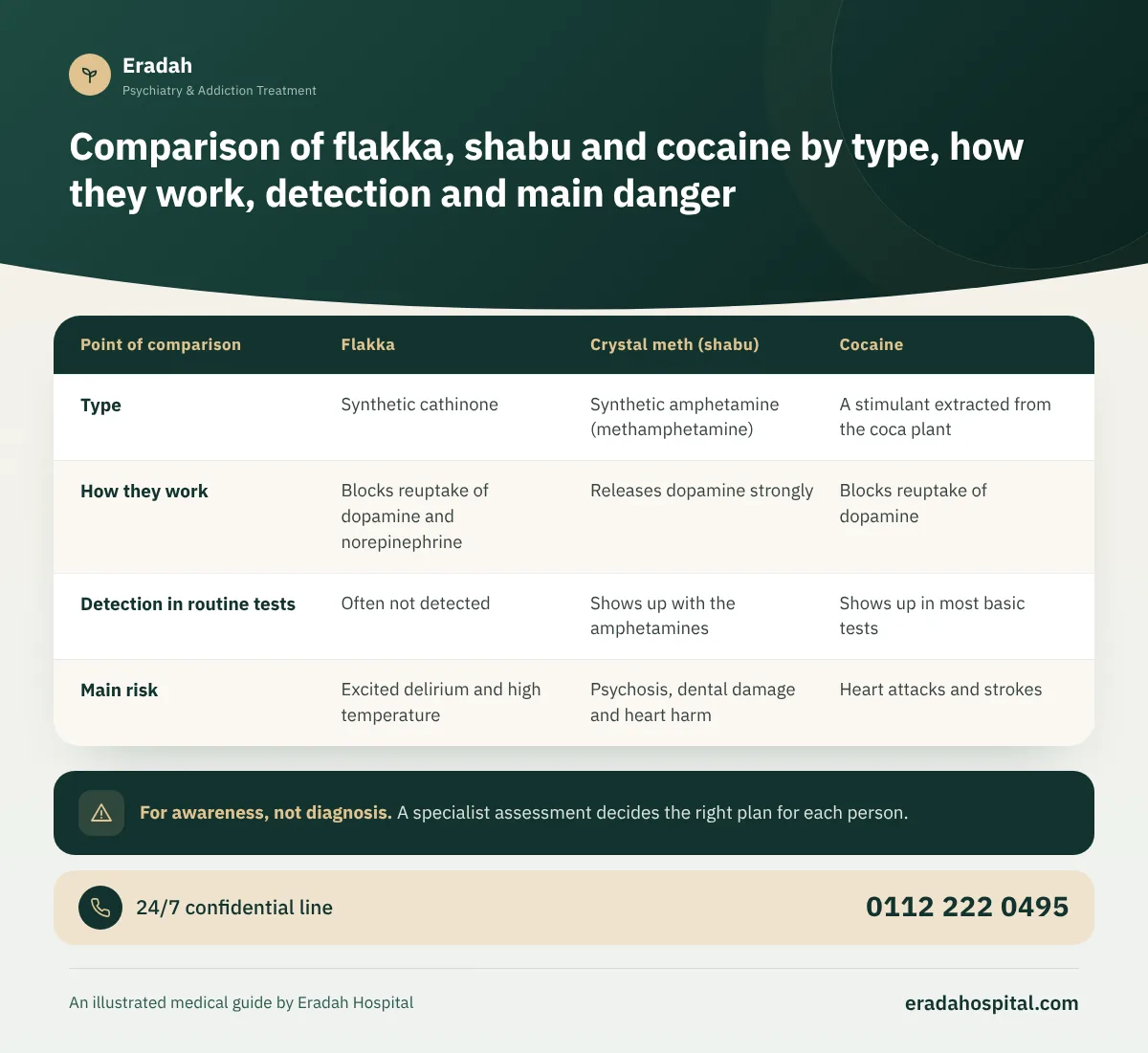
What they have in common is that they are all stimulants that can cause psychosis and addiction, and their treatment rests on the same foundations. What sets flakka apart is how hard it is to detect, the way what is sold under its name keeps changing, and the risk of being exposed to it without knowing. For comparison, see shabu.
The legal status of flakka
In March 2016, the United Nations Commission on Narcotic Drugs placed α-PVP under international control on the recommendation of the World Health Organization’s expert committee, according to the United Nations Office on Drugs and Crime. The 2020 review notes that the European Union imposed control measures on it in June 2016, and that the United States placed it in Schedule I in 2017. In Egypt it has no medical use and no registered medicine, and dealing in or possessing it outside any lawful framework exposes a person to legal liability. The Fund for Drug Control and Treatment of Addiction offers free, confidential treatment through hotline 16023.
This is general educational information and not legal advice.
Flakka in numbers
Sources: the European risk assessment of α-PVP as published by the United Nations Office on Drugs and Crime in 2016, the review by Daswani and colleagues (2024), and the review by Patocka and colleagues (2020).
Flakka in brief: harms, symptoms, treatment and how long it stays
- Harms: delirium with agitation and fever, muscle breakdown, psychosis that can last, and deaths, especially with other substances. Details in harms of flakka.
- Symptoms: overactivity, dilated pupils and sweating, then suspicion and hallucinations, and a repeating pattern of use followed by a comedown. Read symptoms of flakka use.
- Treatment and withdrawal: securing the acute state first, then withdrawal that resembles stimulant withdrawal, and behavioral and psychological therapy. See treatment of flakka addiction.
- How long it stays: routine tests often do not detect it, and it needs a specialized test. Details in how long flakka stays in the body.
Flakka guide: everything you need to know
We have gathered everything about flakka into 4 pages, each answering one question in detail. Choose what you are looking for:
Harms of flakka to the body and mind
What are the harms of flakka? Excited delirium, high temperature and muscle breakdown, its harm to the heart and brain, the psychosis that can last, the danger of mixing it with other substances, and whether it kills.
Flakka use symptoms and signs of addiction
How can you tell that someone is using flakka? The physical, behavioral and psychological signs of flakka use, the repeating pattern of use and comedown, the criteria for addiction, and when to call an ambulance.
Flakka addiction treatment: stages and duration
Treatment of flakka addiction, step by step: handling agitation and psychosis in the emergency room, flakka withdrawal symptoms and how long they last, the most effective behavioral therapy, how long treatment takes, and when residential care is needed.
How long flakka stays in the body and drug testing
How long does flakka stay in the body? What we know about how alpha-PVP and its breakdown products appear in urine, saliva and hair, why routine tests often do not detect it, and the importance of a confirmatory test.
Found out your child is using flakka? Start here
- If they are agitated, feverish or confused, do not argue with them; call an ambulance (123) and keep a safe distance.
- When they calm down, speak with concern rather than anger, and ask exactly what they took and where it came from; they may not know themselves.
- Watch for any suspicion, hallucinations or talk of self-harm after use, and ask for an urgent psychological assessment.
- Do not settle for a quick negative test; flakka often does not show up in routine tests.
- Ask for a specialized, confidential consultation to set a treatment plan that fits their condition.
Danger signs after flakka use: call an ambulance (123) immediately
- Severe agitation with a high temperature and heavy sweating, or hot skin
- Seizures or loss of consciousness
- Chest pain, or a very fast or irregular pulse
- Delirium and detachment from reality, with violence or no sensation of pain
- Talk of suicide or an attempt to harm themselves
Call an ambulance at 123 immediately, keep sharp objects and other people away from the person, speak calmly, and do not try to restrain them by force or press on their chest or back. Reduce noise and lighting and try to cool the room. If they lose consciousness but are breathing, place them on their side, stay close, and tell the paramedics everything you know about what they took.
Call the ambulance 123