What is hydro?
"Hydro" is a common trade name in Egypt for cannabis herb, meaning the dried flowering tops of cannabis varieties that are marketed as stronger than traditional bango. It is not a new chemical drug.
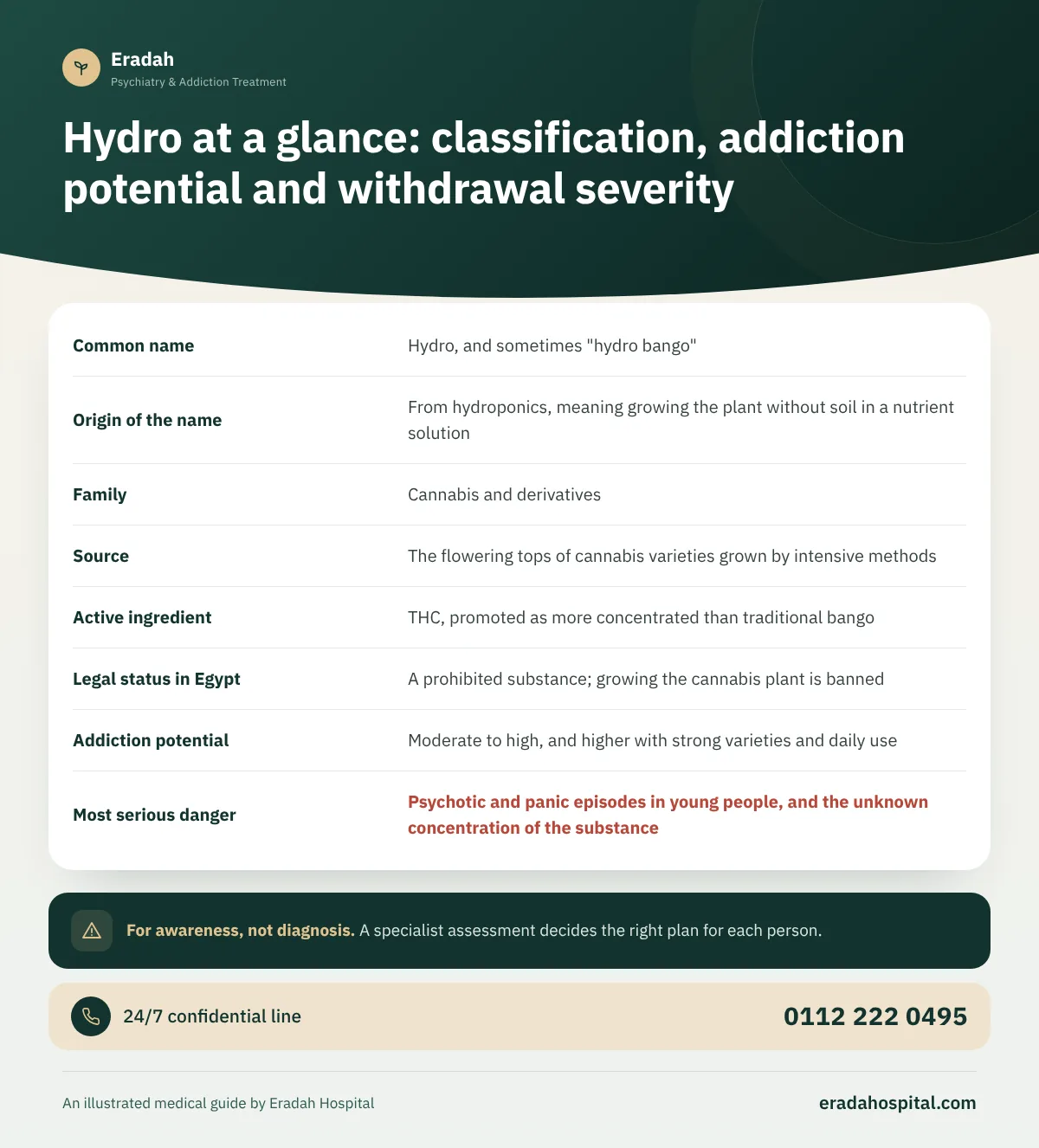
The name comes from the word "hydroponic", meaning growing in water, where the plant is grown without soil in a nutrient-rich solution under controlled lighting and temperature, often indoors. These intensive methods allow the production of dense flowering tops with a higher content of the active compound.
But the name on the market does not necessarily reflect how the plant was actually grown. In 2025, the Egyptian Ministry of Interior announced the seizure of extensive farms of what it described as "narcotic hydro plants" in desert areas, with tons of fully grown plants. In other words, "hydro" has become a marketing name for a variety sold as strong, more than an accurate description of how it was grown.
Is hydro really stronger than bango?
There are no published laboratory data on the concentration of the active compound in the hydro circulating in Egypt, so no precise figure can be given. But what we know from international research is that cannabis varieties grown by intensive methods, and unfertilized flowering tops in particular, usually contain higher THC levels than traditional herb, in which leaves, stems and seeds are mixed together.
| Point of comparison | Traditional bango | Hydro |
|---|---|---|
| Part used | Leaves and tops, and seeds and stems may be mixed in | Often dense flowering tops |
| Growing method | Traditional growing in soil | Intensive growing, hydroponic or in a controlled environment, or strong varieties marketed under this name |
| THC concentration | Varies widely | Promoted as higher, and no Egyptian figures are published |
| CBD | Varies | Often low in the strong hybrid varieties |
| Active ingredient | THC | The same THC |
British health sources note that strong varieties known as skunk combine high THC with low CBD, the compound that may reduce anxiety and suspicion, which is why they carry a greater risk to mental health. And a person using it cannot tell the concentration of what they hold by looking at it or smelling it.
What does hydro do in the brain?
With use, THC reaches the brain within minutes and binds to the cannabinoid receptors that regulate memory, mood, perception, movement and appetite. The higher the concentration, the faster and stronger the effect: altered sense of time and distance, impaired short-term memory and reaction time, and relaxation that can turn into severe anxiety, suspicion or panic.
With repeated use, the brain becomes less sensitive to this compound, so the person needs a larger amount or a stronger variety to get the same effect, and feels distress and irritability when it is not available. This is the biological beginning of dependence, and it happens faster with high-concentration varieties.
The danger of hydro is that it puts a high-concentration substance of unknown strength in the hands of a young person at an age when the brain is more vulnerable to harm, whatever it is called or however it was grown.
Why are doctors worried about high-potency cannabis?
A large European study published in The Lancet Psychiatry in 2019 showed that daily use of high-potency cannabis was associated with about five times the likelihood of a psychotic disorder compared with people who had never used cannabis. The European Union Drugs Agency also notes that health problems are more closely linked to high-potency products and to early, regular use.
These figures do not mean that everyone who uses it will develop psychosis, but they do mean that the risk is real and increases with potency, frequency, young age and a genetic predisposition. You will find the details on the page about the harms of hydro.
What is the difference between hydro, hashish and Strox?
| Substance | What it is | Main risk |
|---|---|---|
| Hydro | Cannabis tops from strong varieties marketed under this name | High, unknown concentration and a risk of psychosis |
| Bango | Dried cannabis leaves and tops | Varies from weak to strong, and may be sprayed with synthetic substances |
| Hashish | Compressed cannabis resin | High concentration on average |
| Strox | Manufactured chemicals sprayed onto herbs | Seizures, loss of consciousness and severe psychosis |
Who is most at risk from hydro?
A brain that is still developing, and a higher risk of addiction, psychosis and declining school performance.
A greater risk that an episode of suspicion or hallucinations becomes a chronic illness.
An added burden on the heart and irritation of the airways.
THC reaches the fetus and is linked to lower birth weight.
Common myths about hydro
| Common belief | The truth |
|---|---|
| "Natural and clean because it's grown in water" | The growing method does not change the effect of THC on the brain, and may even raise its concentration. |
| "Better than hashish because it's a plant" | Both come from the same plant, and the risk is determined by the strength of the substance and the pattern of use. |
| "It doesn't cause addiction" | Cannabis use disorder is real, and strong varieties raise its risk. |
| "It calms the nerves and helps with sleep" | It may mask anxiety temporarily, but with continued use it increases anxiety and sleep disturbance. |
Hydro under Egyptian law
Hydro, like bango and hashish, is a prohibited substance in Egypt under Law No. 182 of 1960 on drug control, and the law bans growing the cannabis plant in all its varieties, whatever the growing method. Security authorities treat hydro farms as cultivation of a narcotic plant.
On the other hand, the Fund for Drug Control and Treatment of Addiction offers free, confidential treatment to anyone who asks for it through hotline 16023, and seeking treatment does not expose the patient to legal liability.
This is general educational information and not legal advice.
The hydro guide: everything you need to know
We have gathered everything about hydro into 4 pages, each answering one question in detail. Choose what you are looking for:
Harms of hydro
The risk of psychosis and panic attacks with high concentrations, its effect on memory, studies, lungs and heart, and chronic vomiting syndrome.
Symptoms of hydro addiction
The signs a family notices during use, when it becomes addiction, and early warning signs of psychosis.
Hashish and bango withdrawal symptoms
Withdrawal is the same across all cannabis products because the substance is the same: irritability, insomnia, loss of appetite and cravings that ease within weeks.
Hashish and bango addiction treatment
Behavioral and motivational psychological therapy and family support, with treatment of any accompanying anxiety, depression or psychosis, and a relapse prevention plan.
Heard your son talking about "hydro": what do you do?
- Do not act in a moment of anger; take time to calm down and think about how to approach the conversation.
- Ask him calmly what he knows about it, and do not start with accusations or searching.
- Correct the false idea that it is "natural and safe" without long lectures.
- Watch for any change in sleep, mood or school performance, or unusual suspicion.
- If he shows hallucinations, intense suspicion or seizures, seek emergency care immediately.
- Seek a confidential specialist consultation for assessment and a plan suited to his age and condition.
When does a person who uses hydro need emergency care? Call ambulance (123) immediately
- A severe panic attack that does not settle, or hallucinations, intense suspicion, incoherent speech or aggression
- Chest pain, a strong pounding heartbeat or fainting
- Repeated vomiting that does not stop, with intense thirst, passing little urine and dizziness on standing
- Seizures, rigidity or sudden loss of consciousness, which are signs that the herbs may have been sprayed with a synthetic substance
- A child exposed to a cannabis product who seems very drowsy, unsteady or is having difficulty breathing
Call ambulance (123) and stay with the person in a quiet place. If they are vomiting or unconscious, place them on their side (recovery position) so they do not choke, and tell the paramedics honestly what was taken. Do not use any home remedies.
Call the ambulance 123