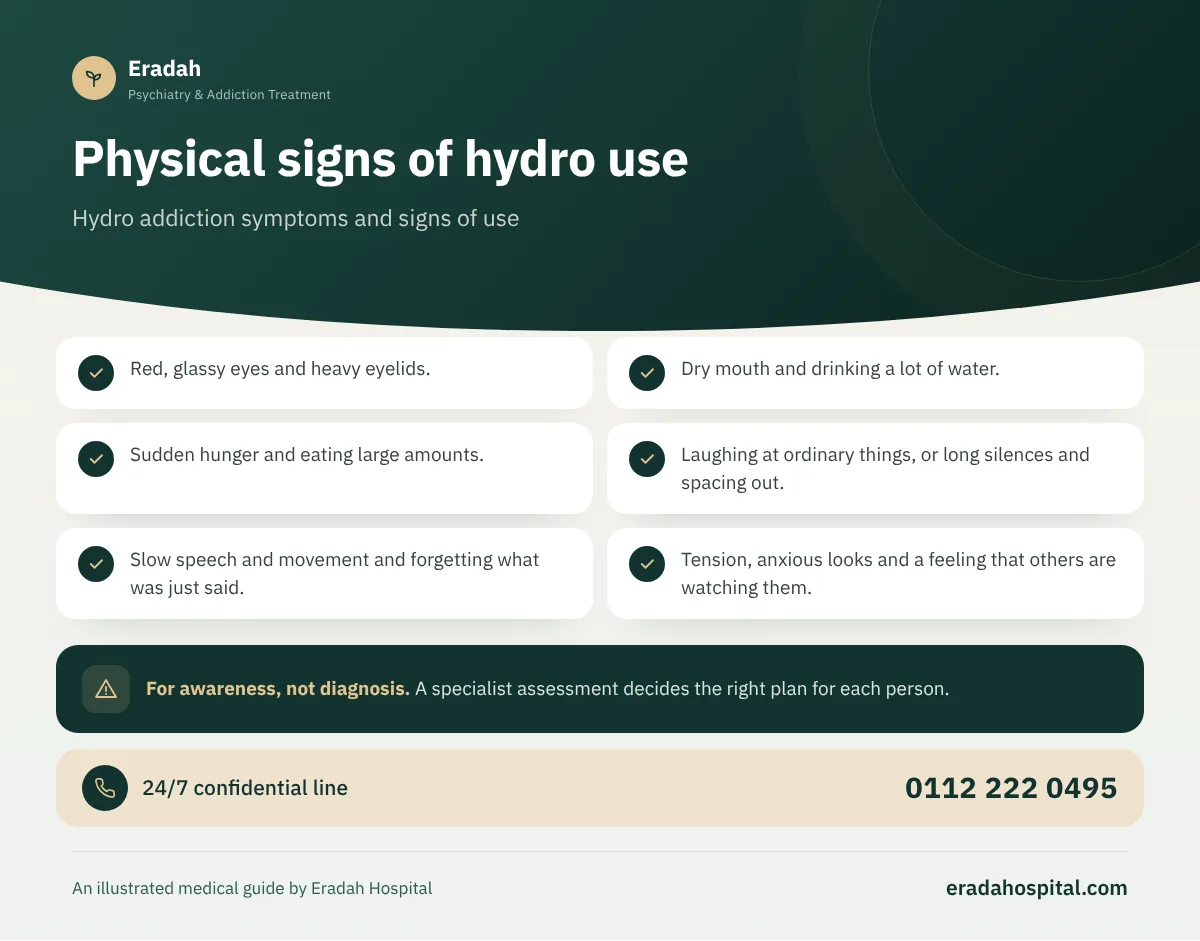
How can you tell that someone has used hydro?
The signs begin within minutes of use and last several hours, and they are clearer with strong varieties and in people who are not used to them:
- Red, glassy eyes and heavy eyelids.
- Dry mouth and drinking a lot of water.
- Sudden hunger and eating large amounts.
- Laughing at ordinary things, or long silences and spacing out.
- Slow speech and movement and forgetting what was just said.
- Tension, anxious looks and a feeling that others are watching them.
What might the family find?
The presence of any of these things does not prove use, but it calls for a calm conversation:
Crumbs of dense flower buds, green or brownish, in pockets, drawers or the car.
A strong herbal smell that clings to clothes, hair and the room.
Rolling papers, small airtight bags and herb grinders.
Excessive use of perfume, incense, eye drops and opening windows.
Behavioral changes that point to regular use
- A clear change in sleep schedule: staying up until dawn and sleeping until the afternoon.
- A decline in school or work, and forgotten responsibilities.
- A new circle of friends and meetups in unfamiliar places.
- Asking for money often or things disappearing from the home.
- Isolating in their room and closing the door for long periods.
- Losing interest in sports and old hobbies.
Psychological signs
- Irritability and quick temper when the substance is not available.
- Repeated anxiety or panic attacks with no clear reason.
- Lethargy and loss of motivation and interest in the future.
- Mood swings and depression in some people who use.
When are the signs a warning of psychosis?
Because hydro is promoted as a strong variety, families should know the early warning signs of psychosis and take them seriously:
A belief that others are plotting against them, watching them or talking about them.
Hearing voices or seeing things others do not see.
Strange ideas or jumping between unrelated topics.
Complete isolation, neglect of hygiene and food, and a clear change in personality.
Signs that may show up at school or work
- A sudden drop in grades or evaluations.
- Repeated absence or being late for morning commitments.
- Forgetting homework and tasks and difficulty concentrating during explanations.
- Lethargy and little enthusiasm for activities they used to enjoy.
- Problems with teachers or colleagues that were not usual.
Misconceptions about the signs of hydro use
| The common belief | The truth |
|---|---|
| "A person who uses hydro is always calm and relaxed" | Strong varieties can cause anxiety, suspicion and irritability instead of relaxation. |
| "Red eyes alone prove use" | It may be due to allergy or lack of sleep, and judgment should rest on a complete pattern of signs. |
| "As long as they go to school, they're fine" | Many people keep studying for a while despite regular use, and then decline suddenly. |
| "Suspicion and fear after use are normal and will pass" | It may be the start of a psychotic episode that needs urgent assessment. |
When is use an addiction? Diagnostic criteria
Doctors use the DSM-5 diagnostic criteria to diagnose cannabis use disorder, which include eleven criteria within a year, among them:
- Using larger amounts or for longer than intended.
- Failed attempts to cut down or stop.
- A strong craving to use.
- Neglecting school, work or home.
- Continuing despite obvious psychological or social problems.
- Tolerance, meaning the need for a stronger variety or a larger amount.
| Number of criteria | Level |
|---|---|
| 2 to 3 | Mild |
| 4 to 5 | Moderate |
| 6 or more | Severe |
How do you tell hydro from Strox?
| Point of comparison | Hydro | Strox |
|---|---|---|
| Nature | Natural cannabis, often of high potency | Chemicals sprayed on herbs |
| Intensity of effect | Strong but relatively predictable | Violent, sudden and unpredictable |
| Distinctive signs | Red eyes, hunger, laughter or anxiety | Rigidity, seizures, loss of consciousness and aggression |
| Duration | Hours | May be shorter but more intense |
The two cannot be told apart by looking at the herbs themselves; the difference shows in how strong and how fast the effect is, and specialist testing is what settles it.
A sign of tolerance: looking for a stronger variety
An important sign a family may hear in a young person's conversations, or see the effects of, is a constant search for a "stronger" or "cleaner" variety, and dismissing ordinary bango because it "doesn't work anymore." This usually means the brain has adapted to the substance and tolerance has begun, which is one of the criteria for cannabis use disorder. Constant talk about varieties, their names and their sources also shows that use has become an important part of their life.
How do you talk to someone who uses hydro?
- Choose a quiet time when they are not under the influence.
- Start with your concern, not an accusation: "I've noticed you seem tense and tired and you aren't sleeping well."
- Do not argue with them that it is "natural"; focus on the changes you see in their life.
- Offer a clear step: seeing a doctor or a confidential consultation.
- Keep the conversation open even if they refuse the first time.
For the symptoms that appear after stopping, see the page on hashish and bango withdrawal symptoms, because the active substance is the same.
When does a person who uses hydro need emergency care? Call ambulance (123) immediately
- A severe panic attack that does not settle, or hallucinations, intense suspicion, incoherent speech or aggression
- Chest pain, a strong pounding heartbeat or fainting
- Repeated vomiting that does not stop, with intense thirst, passing little urine and dizziness on standing
- Seizures, rigidity or sudden loss of consciousness, which are signs that the herbs may have been sprayed with a synthetic substance
- A child exposed to a cannabis product who seems very drowsy, unsteady or is having difficulty breathing
Call ambulance (123) and stay with the person in a quiet place. If they are vomiting or unconscious, place them on their side (recovery position) so they do not choke, and tell the paramedics honestly what was taken. Do not use any home remedies.
Call the ambulance 123