Stages of khat addiction treatment
“I want to quit, but I don't know what to do at 3 in the afternoon.” This sentence sums up khat treatment: the hardest part is the daily hours, the friends, and the habit built around the substance, more than the substance itself.
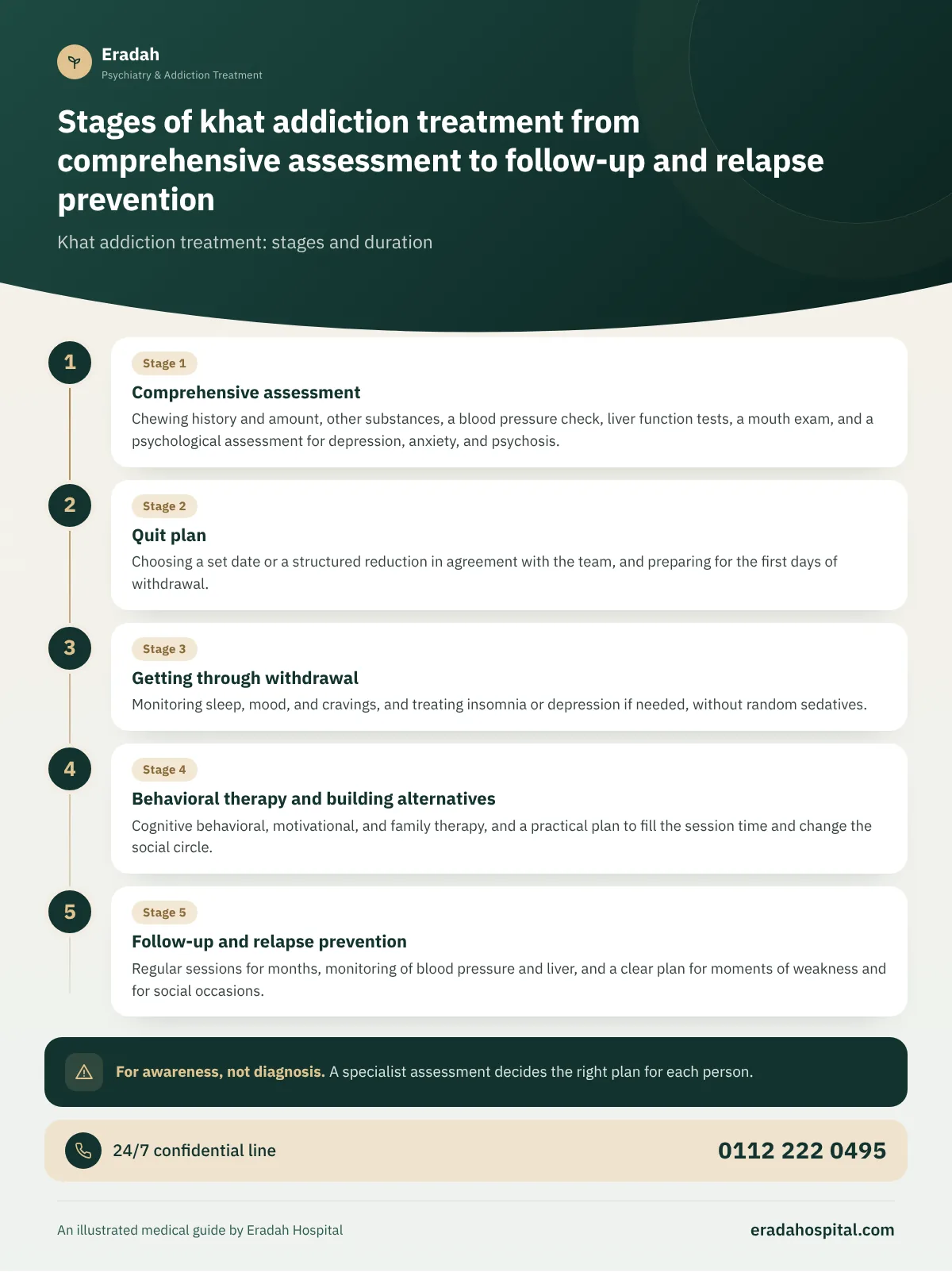
- Stage 1Comprehensive assessment
Chewing history and amount, other substances, a blood pressure check, liver function tests, a mouth exam, and a psychological assessment for depression, anxiety, and psychosis.
- Stage 2Quit plan
Choosing a set date or a structured reduction in agreement with the team, and preparing for the first days of withdrawal.
- Stage 3Getting through withdrawal
Monitoring sleep, mood, and cravings, and treating insomnia or depression if needed, without random sedatives.
- Stage 4Behavioral therapy and building alternatives
Cognitive behavioral, motivational, and family therapy, and a practical plan to fill the session time and change the social circle.
- Stage 5Follow-up and relapse prevention
Regular sessions for months, monitoring of blood pressure and liver, and a clear plan for moments of weakness and for social occasions.
What does the assessment at the start of treatment include?
- Heart and blood pressure: because khat is linked to high blood pressure, and a person may have it without knowing.
- Liver: liver function tests, especially after long years of chewing.
- Mouth and teeth: checking the white patches where leaves are stored, with referral to a specialist when needed.
- Mental health: assessing depression, anxiety, episodes of mania or psychosis, and any thoughts of self-harm.
- Other substances: smoking, stimulants, sedatives, and alcohol, since each changes the plan.
Stopping suddenly or reducing in a structured way?
No studies settle which of the two approaches is better for khat specifically, and the approach is chosen according to the person and their circumstances:
| Aspect | Stopping on a set date | Structured reduction |
|---|---|---|
| Suits | People who can stay away from the session and its friends | People whose work or surroundings are tied to the sessions and who need time to arrange things |
| Withdrawal | Clearer in the first days, then eases | Milder but longer |
| Main risk | Giving in at the time of the first session | “Reduction” turning into permanent continued use |
| Key to success | A ready alternative for session time | A written schedule with a clear deadline |
Psychological and behavioral therapy
According to the US National Institute on Drug Abuse, there is no approved medication for any stimulant use disorder, but behavioral therapies are effective, the most studied being the incentive system, alongside cognitive behavioral therapy, motivational interviewing, and support groups. These methods are adapted to khat as follows:
Understanding what drives the person to the session, such as boredom, stress, or loneliness, and learning alternative ways of coping with it.
Helps people who see khat as an ordinary habit discover their own reasons for change.
Tangible rewards for adherence and negative tests, the most studied approach in stimulant addiction.
Rearranges the family's time and creates a circle of support to replace the session circle.
Are there medications for khat addiction?
There is no approved medication that treats dependence on khat itself. A review published in 2026 in the Journal of Addiction Medicine describes evidence-based treatments for khat as still incompletely developed. But the doctor has an important role in treating what accompanies it: insomnia, depression, anxiety, high blood pressure, and any psychotic symptoms. Do not start or stop any medication without a doctor, and we do not list any doses here.
Why does khat treatment need a plan for the session itself?
The Toxins review explains that continued khat use is driven by deep cultural roots in addition to the stimulant effect. In an Ethiopian study of 400 users, only about a third of those with khat use disorder had sought help, mostly from friends and relatives. In practical terms, a person who stops loses a social place and daily time, and if they find no alternative they return to both. For this reason treatment includes concrete planning for the afternoon hours, new friends and activities, and a way to decline sessions without confrontation.
Treating accompanying psychiatric disorders
Khat may be an indirect way of escaping depression, anxiety, or loneliness, and stopping may reveal a disorder that was hidden behind the sessions. Someone who has had episodes of mania or psychosis may also need psychiatric follow-up for longer. This is treated in a single plan under the concept of dual diagnosis.
How long does khat addiction treatment take?
| Stage | Approximate duration |
|---|---|
| Assessment and tests | One day to several days |
| Stopping and getting through withdrawal | Often one to two weeks |
| Behavioral therapy and building alternatives | Several weeks to a few months |
| Follow-up and relapse prevention | Several months, and it may extend to a year |
The duration is longer with many years of chewing, with other substances or a psychiatric disorder, or with difficulty staying away from the session circle.
Does khat treatment require a residential stay?
Many khat cases are treated through outpatient treatment, especially with good family support and clear motivation. Residential treatment is advised when there are psychotic symptoms, severe depression, or thoughts of self-harm, when other stimulants or sedatives are used with khat, or when repeated outpatient attempts have failed.
Relapse prevention after quitting khat
- Know your triggers: session time, particular friends, holidays and occasions, exhaustion, and boredom.
- Prepare a ready reply for declining sessions, and a plan for what you will do instead.
- Keep treating depression or anxiety if present, and do not stop its medication without a doctor.
- Monitor your blood pressure and have your mouth examined regularly; seeing improvement is a motivation to continue.
- If a slip happens, contact your team right away before it turns into a full return.
Choosing a hospital for khat addiction treatment
Khat is an unfamiliar condition for many addiction centers, because chewing is tied to long social sessions more than to solitary use, and its harms are spread across blood pressure, heart, mouth, liver, sleep, and mood. So it is not enough for a place to carry an “addiction treatment” sign; what matters is that it understands that quitting khat means rebuilding the whole afternoon and evening.
| The need | How to check it |
|---|---|
| A physical exam at the start | Ask whether blood pressure is measured, liver tests are requested, and the mouth is examined at the first visit |
| A plan for session time | Ask the therapist to explain how the chewing hours will be filled with realistic alternatives |
| Accompanying smoking | Make sure cigarettes or shisha are part of the plan, not a postponed detail |
| Mood and sleep | Are sadness and insomnia monitored after stopping, and is any suspicion or hallucination assessed? |
| Flexibility of care format | Is outpatient follow-up available for a stable case, with residential care when needed? |
Eradah brings together psychiatry and addiction treatment under the supervision of Dr. Mahmoud El-Sawy, with psychologists who deliver cognitive behavioral therapy individually and in groups, and a doctor who sets the medication plan for insomnia or depression if needed. Most khat cases begin with outpatient follow-up, and then a relapse prevention plan is built that takes account of the occasions and seasons when sessions become frequent. To find out what you may feel after stopping, see khat withdrawal symptoms.
If you would like an opinion on your own situation or a relative's, the first consultation is free and confidential at 01122220495 by phone or WhatsApp at any time, noting that residential treatment is available to men only. You can also leave your details through the call-request page so the team can call you back.