How is khat processed inside the body?
Khat differs from most substances in that a large part of it enters the body directly through the lining of the mouth. In a study published in 2003 in the British Journal of Clinical Pharmacology, the lining of the mouth absorbed about 59% of the cathinone and 84% of the cathine, and only about 9% of the active compounds remained in the chewed leaves.
Cathinone is then rapidly converted in the body into two weaker compounds, cathine and norephedrine, and the Toxins review notes that less than 7% of it is excreted unchanged in urine. That is why precise tests look for all three compounds together, not cathinone alone.
The most potent and the fastest to disappear; its presence indicates recent chewing.
Weaker in effect and slower to disappear, and it comes from the leaves and from the conversion of cathinone.
Another main metabolite, and it stays in urine longer than cathinone.
A comparison of khat compounds in the body
| Point of comparison | Cathinone | Cathine |
|---|---|---|
| Its role | Mainly responsible for the stimulant effect | A weaker stimulant |
| Half-life in the blood | About 1.5 hours in one study | About 5 hours |
| Detection in urine by confirmatory test | Up to about 26 hours | Up to the last sample at 80 hours |
| Stability in the leaves | Breaks down after picking | More stable |
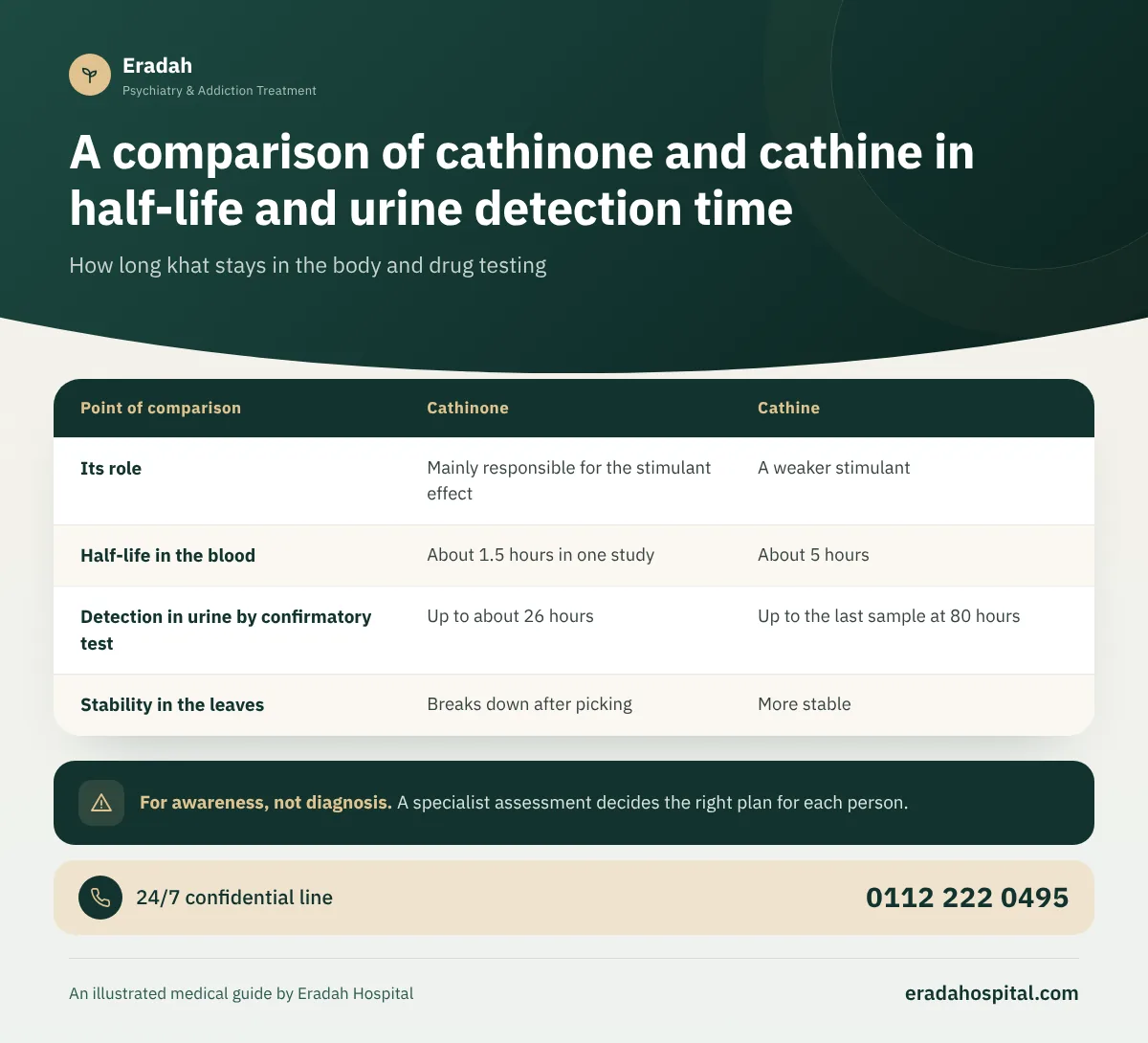
The Toxins review also pools the results of other studies in which the half-life of cathinone was about 4 hours, meaning the figures vary between studies and methods of calculation, but they agree that cathinone disappears faster than its metabolites.
How long khat stays, by type of sample
| Sample | What we know |
|---|---|
| Urine | The most commonly used sample; cathinone was detected for up to about a day, and its metabolites for at least 3 days after brief chewing. |
| Blood | Cathinone peaks about two hours after chewing and then disappears quickly, so blood reflects very recent use. |
| Saliva and hair | We did not find enough data in the sources we relied on to determine how long khat can be detected in them. |
These times are taken from small studies in which volunteers chewed less than a normal session, and they may be longer with daily chewing and large amounts. To interpret a particular result, consult the doctor or the laboratory.
Does khat show up in a standard drug test?
Not reliably. In a study published in 2002 in the journal Clinical Chemistry, one amphetamine immunoassay gave negative results after khat chewing, while another rapid strip gave a positive result on the first day only, and confirmatory testing by gas chromatography and mass spectrometry was the most accurate and detected it for the longest. A review published in 2017 explains that cathinone can cross-react with amphetamine immunoassays, and that confirmation requires chromatographic methods.
The practical bottom line: a negative result on a rapid strip does not rule out khat chewing, and a positive amphetamine result in someone who chews khat needs a confirmatory test before it is relied on. An explanation of the types of tests is in drug testing.
Factors that affect how long khat stays in the body
- Amount and length of the session: long sessions and large amounts lengthen the detection time.
- Frequency of chewing: daily chewing means a constant build-up of metabolites.
- Freshness of the leaves: fresh leaves are richer in cathinone than old ones.
- Liver and kidney function: weaker function slows metabolism and excretion.
- Other medications: some medications and substances may affect the result of the initial test or its interpretation.
How long khat's effect lasts compared with how long it stays in the body
According to the Toxins review, khat's stimulant effect lasts about three hours after starting within roughly half an hour of chewing, followed by lethargy and insomnia. Khat's metabolites, however, stay in the urine for days. This means the effect wearing off does not mean the substance has left the body, and its appearance in a test does not mean the person was under its influence at the moment the sample was taken.
Can the result be misleading?
Yes, in both directions: a rapid test may miss khat entirely, and an amphetamine test may give a positive result for other reasons, including some medications. Norephedrine, one of khat's metabolites, is also known as phenylpropanolamine, a name that appears in the title of the study mentioned. That is why a good laboratory always asks about the medications and substances the person has taken, and the details are in medications that show up in drug tests.
What does a positive result mean, and what is the next step?
- Make sure the result came from a confirmatory test, not only a rapid strip.
- Review with the doctor all the medications and substances the person has taken.
- The result does not determine the amount of khat or the number of sessions, and it is not enough on its own to diagnose addiction.
- If use is confirmed, make it the start of a conversation and an assessment, not an occasion for punishment, and you can start from khat addiction treatment.
Testing during treatment: a tool for support, not punishment
In treatment programs, periodic tests are used for follow-up and building trust, and negative results may be linked to rewards within an incentive system. A positive result means the plan needs adjusting, and opens an honest conversation about the timing of the session, friends, and moments of weakness.