What is khat?
"It's not a drug, it's just a get-together with friends." That is how many people describe a khat session. Khat is in fact an evergreen shrub with the scientific name Catha edulis, which grows in Yemen and the Horn of Africa. Its fresh leaves are chewed in long sessions: they are gathered in one side of the mouth and chewed slowly, in what is known as "storing" (takhzin).
Fresh leaves contain three stimulant compounds: cathinone, which is the strongest and responsible for most of the initial effect, cathine, and norephedrine. According to a scientific review published in the journal Toxins in 2022, more than 20 million people chew khat daily in the Arabian Peninsula and East Africa, and the review estimates that 60% of men and 35% of women in Yemen chew it daily.
Cathinone is an unstable compound that breaks down after picking into weaker substances, which is why khat is sold as bundles of twigs and leaves wrapped to keep them fresh. From this same compound an entire family of laboratory stimulants was later derived, called "synthetic cathinones", the best known of which is flakka.
Does khat have any medical use?
Khat and cathinone have no approved use in modern medicine. The Toxins review notes that the oldest known pharmaceutical description of khat dates back to the eleventh-century book "Al-Saydana fi al-Tibb", so interest in its effect is old, but that does not mean it is a treatment for anything.
Ironically, the cathinone family includes an approved medication, bupropion, which is used to treat depression and to help with quitting smoking, as the US National Institute on Drug Abuse points out. But a shared chemical family does not make khat a medicine, just as the existence of opioid medications does not make heroin a treatment.
How does khat affect the brain?
Cathinone works in a way close to amphetamine: it stimulates the release of dopamine and norepinephrine in the brain, and laboratory research indicates that it also inhibits the enzyme that breaks them down. The lining of the mouth absorbs most of the compound, which is why people who use it prefer chewing and storing to swallowing. According to the Toxins review, the stimulant effect begins about 30 minutes after chewing and lasts about 3 hours.
- In the first hours: elation, energy and alertness, a lot of talking and excess confidence, and less sense of hunger and tiredness.
- On the body: a faster pulse and higher blood pressure, sweating, and cold extremities in some people.
- After the effect ends: lethargy and loss of energy, disturbing dreams, a slight tremor, low mood, and often difficulty sleeping at night.
Forms and names of khat
Khat is mostly used in its natural form: fresh leaves and twigs that are chewed. The Toxins review notes that it is sometimes steeped like tea and rarely smoked. It is known worldwide by names such as Qat, Chat and Miraa, and the word "takhzin" (storing) is used in Arab countries to describe the way leaves are kept in the mouth for hours.
Why do people turn to khat?
- The social nature of the session, and the feeling that it is part of custom and not drug use.
- The wish to stay up and concentrate for long hours of work or study.
- The belief that anything plant-based must be safe, a belief the UK's FRANK service warns against explicitly.
- Escape from boredom, pressure or loneliness, especially among people living abroad.
- Appetite suppression and a temporary feeling of energy.
The Toxins review explains that continued khat use is driven by two forces together: the stimulant effect that rewards the brain, and the deep cultural roots of the session. That is why talking about harms alone is not enough to help a person stop; they need a real alternative to the session itself.
Khat compared with other stimulants
| Point of comparison | Khat | Amphetamine | Flakka |
|---|---|---|---|
| Active ingredient | Cathinone and cathine | Amphetamine | Alpha-PVP (α-PVP) |
| Source | A natural plant that is chewed | Manufactured, with pharmaceutical forms by prescription | Manufactured in illegal labs |
| Strength of effect | Weaker and slower | Strong | Very strong and unpredictable |
| Main risk | Blood pressure, mouth patches and psychological dependence | Heart problems, psychosis and addiction | Excited delirium and high temperature |
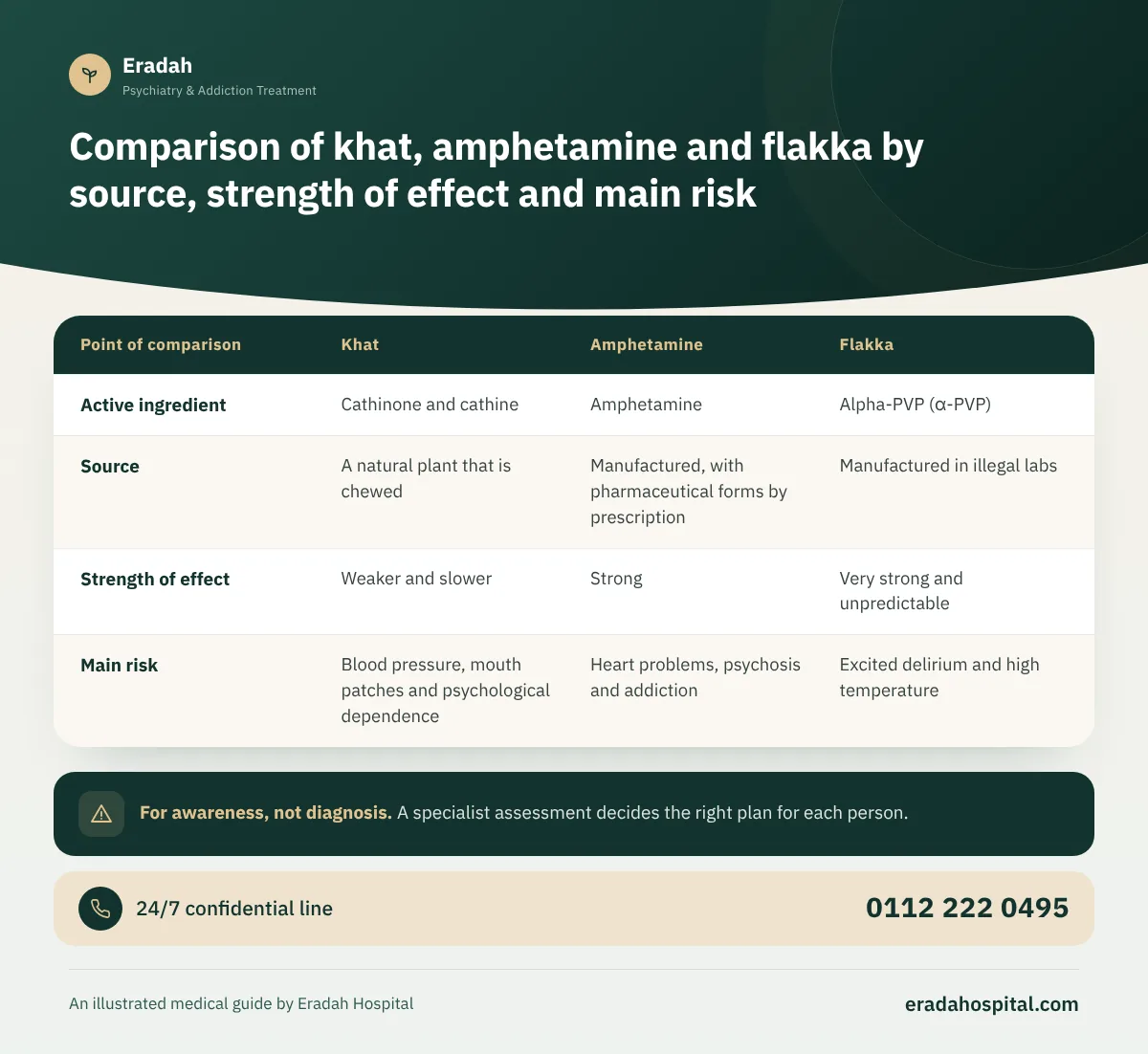
The UK's FRANK service describes the effects of khat as similar to those of amphetamine and synthetic cathinones but weaker. This is a difference of degree, not of kind, which is why the foundations of treating khat dependence are similar to treating Captagon addiction and other stimulants.
The legal status of khat in Egypt and abroad
Khat is a prohibited substance in Egypt. In 2026 the newspaper Sada El Balad quoted a researcher at the National Center for Social and Criminological Research as saying that Egypt criminalizes khat in all its forms, both the plant itself and substances extracted from it, and that it is listed in Table 1 of narcotic substances. Egyptian Customs also regularly announces seizures of attempts to smuggle it. The Fund for Drug Control and Treatment of Addiction offers free, confidential treatment through hotline 16023.
Outside Egypt the situation differs: according to the Toxins review, cathinone has been controlled in the United States since 1993, and khat is controlled in many countries in Europe, Asia and North America, while it remains legal in most East African countries, to the point that it became Ethiopia's largest export after coffee. In the United Kingdom it was classified as a Class C drug in 2014.
This is general educational information and not legal advice.
Khat in numbers
Sources: the review by Silva and colleagues in Toxins in 2022, and the pooled analysis by Moloro and colleagues in BMC Cardiovascular Disorders in 2025.
Khat in brief: harms, symptoms, withdrawal and treatment
- Harms: the main ones are high blood pressure and a fast pulse, white patches where it is stored, gastritis and constipation, and reports of liver damage. Details are in harms of khat.
- Symptoms and signs: long daily sessions, a lot of talking then lethargy and insomnia, and spending that comes at the expense of the household. Read symptoms of khat addiction.
- Withdrawal: mostly psychological; lethargy, depression, disturbing dreams and a slight tremor. See khat withdrawal symptoms.
- Treatment: mainly psychological and behavioral, along with treatment for insomnia and depression and quitting any accompanying smoking. Details are in khat addiction treatment.
The khat guide: everything you need to know
We have gathered everything about khat into 5 pages, each answering one question in detail. Choose what you are looking for:
Harms of khat to the body and mind
What are the harms of khat? The effect of storing khat on blood pressure and the heart, white patches in the mouth, the stomach and liver, sleep and mental health, and whether the harms go away after stopping.
Khat addiction symptoms and signs of use
How do you tell that someone chews khat or has become addicted? Signs of use during and after the session, physical and behavioral signs, the criteria for diagnosing khat addiction, and when to ask for help.
Khat withdrawal symptoms and how long they last
What are khat withdrawal symptoms, when do they begin and how long do they last? Lethargy, depression, disturbing dreams and tremor, whether khat withdrawal is dangerous, and how to get through the first days without relapse.
Khat addiction treatment: stages and duration
How is khat addiction treated? The stages of treatment from assessment to cessation and behavioral therapy, whether there are medications, how to fill the time of the sessions, how long treatment takes, when residential care is needed, and relapse prevention.
How long khat stays in the body and drug testing
How long does khat stay in the body? The half-life of cathinone and cathine in the blood, how long khat can be detected in urine, whether rapid tests detect it, and why detecting it needs specialist confirmatory testing.
Do you chew khat, or does someone in your family? Start here
- Do not start the conversation during the session or right after it, but at a calm time.
- Talk about the effect of khat on health, the household and money in the language of concern, not accusation.
- Offer a blood pressure measurement and a mouth and dental check as a concrete first step.
- Plan together what will fill the time of the session: a visit, exercise, work, a family activity.
- If unfounded suspicions, hallucinations or severe depression appear, ask for a psychological assessment without delay.
- Save the ambulance number (123) for any chest pain, severe palpitations or agitation.
Danger signs after using khat: call ambulance (123) immediately
- Chest pain or tightness, or a very fast or irregular heartbeat
- A sudden severe headache, weakness or numbness on one side of the body, or difficulty speaking
- Severe agitation or suspicions and hallucinations that push the person to harm themselves or others
- Fainting or seizures
- Thoughts of suicide or self-harm after stopping or during depression
Call ambulance (123) immediately. If the person is unconscious but breathing, place them on their side so they do not choke on vomit. Stay with them and do not leave them alone, do not give them food, drink or any medicine from the house, and tell the paramedics everything they took, especially if khat was taken with stimulants or other medications.
Call the ambulance 123