Harms of khat during and after a session
Khat does not wait years to leave its mark; some of its harms appear in the session itself and partly fade afterward, then return the next day with the next session. This daily repetition is what turns a passing effect into chronic harm.
- A rapid heartbeat and raised blood pressure while chewing.
- Sweating, palpitations, and cold extremities, as the Toxins review notes.
- Loss of appetite and delayed stomach emptying, then constipation.
- Insomnia and difficulty sleeping at night, followed by exhaustion in the morning.
- Anxiety, irritability, and mood swings after the effect ends.
Khat's harms to the heart and blood pressure
High blood pressure is khat's clearest cardiac harm. An analysis published in 2025 in BMC Cardiovascular Disorders pooled data from 15 studies with 12,409 participants and found that the odds of high blood pressure in khat chewers were about 2.4 times higher than in others. The Toxins review also points to evidence of an increased risk of heart attack and abnormal heart rhythm, and cites an Ethiopian study in which combining khat chewing with smoking was linked to a clear rise in diastolic pressure.
Harms of holding khat in the mouth, to the mouth and teeth
Khat leaves contain the astringent substance tannin, and the Toxins review links it to inflammation of the esophagus and stomach and keratinization of the lining of the mouth, noting that about half of khat chewers develop white keratotic patches where they hold it. A pooled analysis published in 2026 in the journal Public Health confirmed a strong association between khat and white patches in the mouth, while it found no consistent relationship with oral or esophageal cancer, describing the evidence on that as inconclusive.
The British FRANK service adds that khat can cause inflammation of the mouth and tooth damage, with concern about a long-term risk of oral cancer. That is why khat chewers are advised to have regular dental checkups and to see a dentist right away for any patch or sore that does not go away. A comparison with other chewing habits is found in tombak and naswar.
Khat's harms to the body's systems
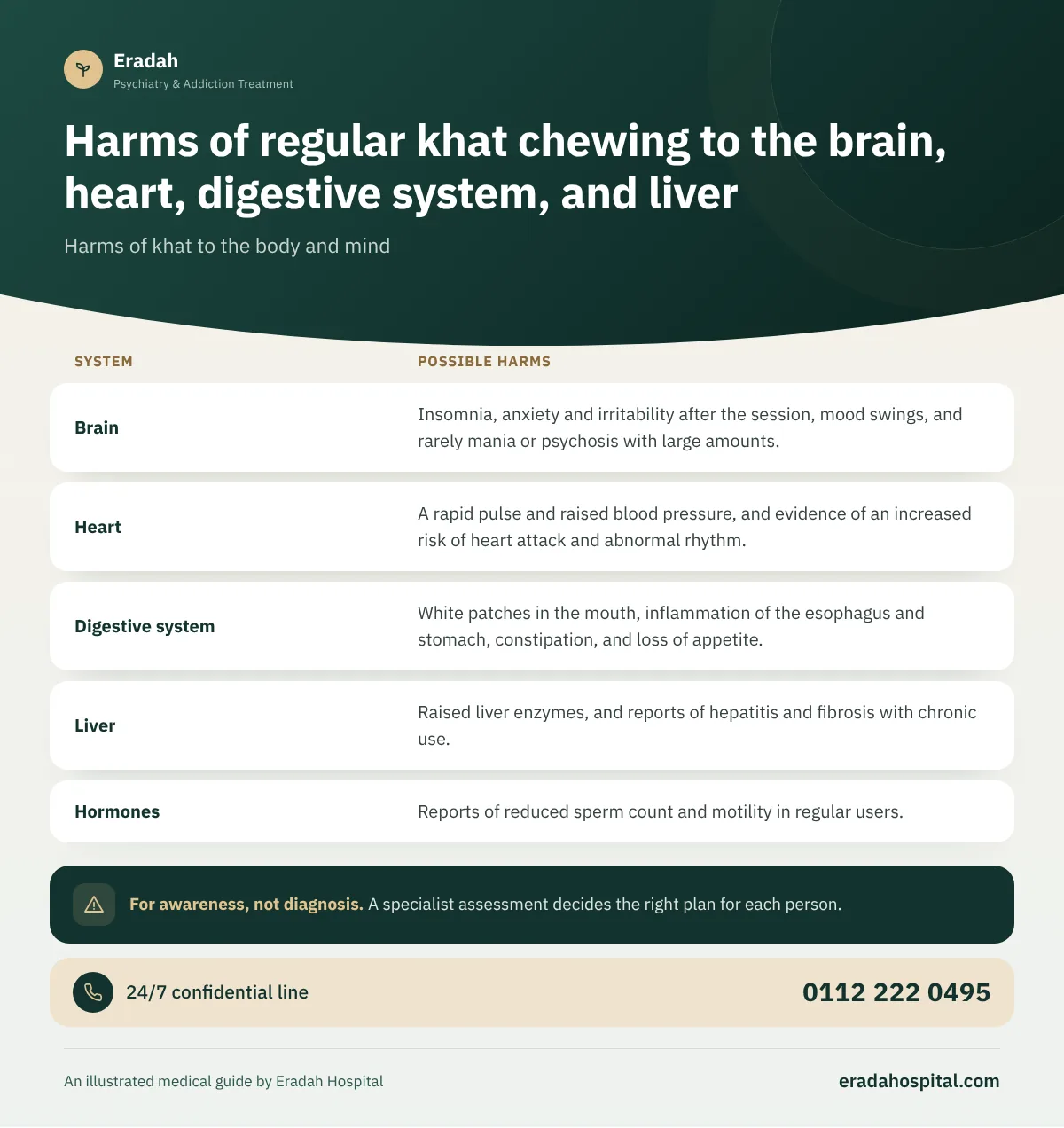
| System | Possible harms |
|---|---|
| Brain | Insomnia, anxiety and irritability after the session, mood swings, and rarely mania or psychosis with large amounts. |
| Heart | A rapid pulse and raised blood pressure, and evidence of an increased risk of heart attack and abnormal rhythm. |
| Digestive system | White patches in the mouth, inflammation of the esophagus and stomach, constipation, and loss of appetite. |
| Liver | Raised liver enzymes, and reports of hepatitis and fibrosis with chronic use. |
| Hormones | Reports of reduced sperm count and motility in regular users. |
Khat's harms to the liver
The Toxins review notes that long-term use may be linked to acute and chronic liver disease, up to inflammation and fibrosis, and the FRANK service describes the risk of severe liver damage as small but potentially life-threatening. In a case-control study published in 2026 in Somaliland, current khat chewing was associated with raised liver enzymes and bilirubin, and the association grew with more years of use, while the results of those who had stopped did not differ from non-users. The study is observational and does not prove causation, but it gives one more reason for a regular khat chewer to have a liver function test.
Khat's harms to mental health and sleep
According to the Toxins review, large amounts of khat can cause manic-like episodes with grandiose ideas or psychosis with persecutory ideas. The symptoms stop quickly in most cases when khat is stopped and antipsychotics are used, but the chance of their return rises if the person goes back to chewing. The FRANK service adds that khat can cause insomnia, brief episodes of confusion, anxiety, and aggression, and make existing psychological disorders worse.
The risk is greater in people predisposed to bipolar disorder or schizophrenia. If unjustified suspicions or hallucinations appear, this is a condition that needs an urgent psychological assessment, as we explain in drug-induced psychosis.
Harms of mixing khat with smoking and medications
| The mix | The risk |
|---|---|
| Khat + smoking | A doubled burden on the heart and blood pressure, and greater harm to the mouth. |
| Khat + some antibiotics | Absorption of ampicillin and amoxicillin may be reduced if taken close to a session. |
| Khat + blood pressure medications | Khat's raising of blood pressure may weaken the effect of treatment. |
| Khat + other stimulants | Added strain on the heart and worse insomnia and anxiety. |
| Khat + anesthesia | The review notes delayed recovery from anesthesia in people who chewed it hours before surgery. |
The Toxins review also notes that in a study of volunteers khat inhibited a liver enzyme that breaks down many medications, which may raise their levels in the blood. The practical rule: always tell your doctor and your anesthesiologist that you chew khat.
Khat's harms to pregnant women and young people
The Toxins review reports adverse effects of khat on pregnancy, so it is not considered safe in any amount for a pregnant woman, and a woman who chews it needs frank medical follow-up. As for young people, the review notes that chewing often starts at a young age and then becomes a regular, long-term pattern, and the earlier it starts, the more years of exposure to the stimulant.
Do khat's harms go away after stopping?
Many of them improve: sleep and mood regain their balance gradually, psychotic symptoms usually recede with stopping and treatment, and the liver enzymes of those who had stopped in the study mentioned were close to those of non-users. White patches in the mouth need examination by a doctor, who may decide to take a sample, and high blood pressure needs follow-up even after stopping. The most important step to protect the body is to start now with a clear plan, which you will find in khat addiction treatment.
Danger signs after using khat: call ambulance (123) immediately
- Chest pain or tightness, or a very fast or irregular heartbeat
- A sudden severe headache, weakness or numbness on one side of the body, or difficulty speaking
- Severe agitation or suspicions and hallucinations that push the person to harm themselves or others
- Fainting or seizures
- Thoughts of suicide or self-harm after stopping or during depression
Call ambulance (123) immediately. If the person is unconscious but breathing, place them on their side so they do not choke on vomit. Stay with them and do not leave them alone, do not give them food, drink or any medicine from the house, and tell the paramedics everything they took, especially if khat was taken with stimulants or other medications.
Call the ambulance 123
19Social and financial harms