Why do khat withdrawal symptoms happen?
“The first two days without khat, it was like I had no soul.” This is what many people say when they stop. The reason is that the brain has grown used to a daily surge of dopamine and norepinephrine released by cathinone, and when it suddenly goes missing, the person feels the exact opposite: dullness, heaviness, and flatness.
A scientific review published in the journal Toxins in 2022 explains that under ordinary conditions khat causes moderate psychological dependence without clear physical dependence, and that psychological dependence and withdrawal symptoms together are the reason for long-term continued use. The UK's FRANK service describes khat as not physically addictive, but confirms that some users are dependent on it.
What are the symptoms of khat withdrawal?
Heaviness in the body and a wish to sleep during the day, and difficulty starting any task.
Sadness, flatness, or mild depression, and loss of pleasure in usual things.
Nightmares and troubling dreams mentioned by the Toxins review and FRANK.
A mild shaking of the hands during the first days.
Repeated thoughts about the session, intensifying at its usual time and with the same friends.
A short temper and distraction, as in stimulant withdrawal in general.
Khat withdrawal timeline
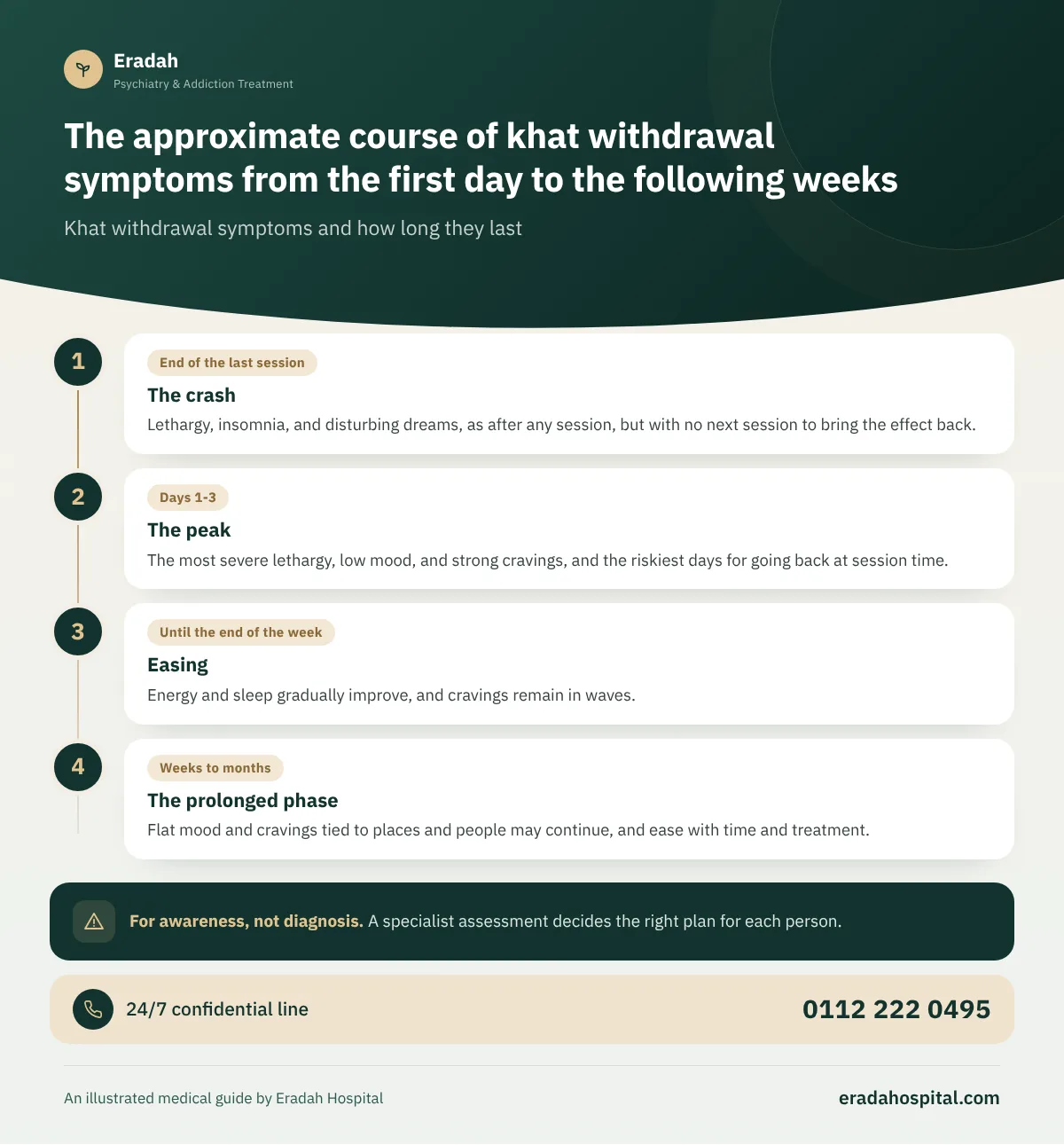
No published studies have tracked khat withdrawal day by day, so we rely on what is known about stimulant withdrawal in general. The US National Institute on Drug Abuse states that its symptoms peak after two to three days and may last a week, after which low mood, anxiety, and cravings may remain for months. The following course is approximate:
- End of the last sessionThe crash
Lethargy, insomnia, and disturbing dreams, as after any session, but with no next session to bring the effect back.
- Days 1-3The peak
The most severe lethargy, low mood, and strong cravings, and the riskiest days for going back at session time.
- Until the end of the weekEasing
Energy and sleep gradually improve, and cravings remain in waves.
- Weeks to monthsThe prolonged phase
Flat mood and cravings tied to places and people may continue, and ease with time and treatment.
Does everyone who stops khat go through withdrawal?
Not necessarily, but it is common among regular chewers. The Toxins review cites a study of khat chewers in which 94% reported withdrawal symptoms, and a Yemeni study of 270 chewers found that men reported more dependence symptoms than women. The likelihood and severity of withdrawal rise with daily chewing, longer sessions, and more years of use.
Is khat withdrawal dangerous?
Khat withdrawal alone is usually not considered physically dangerous, but it is not without risks:
- Depression: it may deepen in some people into despair or thoughts of self-harm, and here help must be sought immediately through the mental health support line 16328 or emergency services.
- Switching to another substance: using sedatives, sleeping pills, or alcohol to “make up for” the flatness may start a new, more dangerous dependence.
- Accompanying substances: if the person uses sedatives or alcohol along with khat and stops them suddenly, withdrawing from them may need medical supervision.
- Relapse: returning to a long session after a break can cause a sudden rise in blood pressure and pulse in people with heart disease.
Stopping khat and smoking together
Many khat sessions are inseparable from cigarettes or shisha, so the person finds themselves facing two withdrawals at once. For some it may be easier to stop both at the same time because the session was their shared trigger, while others prefer to taper. The doctor decides the most suitable way, and you will find smoking treatment options in a separate guide.
How do you cope with khat withdrawal symptoms?
- Set a date to stop, and tell someone you trust so they can support you in the first days.
- Fill the usual session time with an activity planned in advance: exercise, a visit, work, the mosque, or a club.
- Keep fixed sleep and wake times, and get light and movement in the morning to fight lethargy.
- Eat regular meals; appetite returns gradually after stopping.
- Stay away from the session places and its friends for a while.
- Do not start or stop any medication without a doctor, and do not use sedatives or sleeping pills on your own.
When do you need medical help during withdrawal?
- Severe depression or thoughts of self-harm at any time.
- Severe insomnia that continues despite regular sleep habits, or anxiety that disrupts daily life.
- The appearance of suspicions or hallucinations, or a previous history of mental illness.
- Use of other substances with khat, or previous attempts to stop that failed more than once.
- High blood pressure or heart problems that need monitoring while stopping.
In these cases a specialist assessment helps set a safe plan, and you will find the details in khat addiction treatment.
How can the family support someone who is stopping khat?
- Understand that lethargy and irritability are part of withdrawal and are not aimed at you.
- Help fill the session time with a family activity or an outing together.
- Do not give any medication from home to ease the symptoms.
- Watch for signs of severe depression or talk of hopelessness, and contact a specialist right away.
- Celebrate every week that passes without khat, and do not let any slip undo what has been achieved.
Danger signs during khat withdrawal: call ambulance (123) immediately
- Thoughts of suicide or self-harm, or talk of hopelessness and that life is pointless
- Severe agitation or suspicions and hallucinations that push the person to harm themselves or others
- Chest pain or severe palpitations, especially if they went back to chewing a large amount
- Seizures or severe confusion, especially if they use sedatives or alcohol and stopped them suddenly
- Fainting or difficulty breathing
Call ambulance (123) immediately, or the mental health support line 16328 if there is talk of self-harm, stay with the person and do not leave them alone, remove any medications or dangerous objects, do not give them sedatives from home, and tell the paramedics everything they have been using.
Call the ambulance 123