How is morphine processed in the body?
Morphine is broken down mainly in the liver, where it is attached to a substance that makes it water-soluble. This produces two main metabolites that leave the body through the kidneys in the urine; one of them is active and contributes to pain relief and to side effects. Morphine itself has a half-life of roughly two hours in the blood after an injection, but its metabolites stay in the body longer.
Clears from the blood within hours, and most of it is metabolized in the liver.
Leave through the kidneys. In people with kidney failure they build up, so they stay longer and the risk increases.
Heroin is converted into morphine, and part of codeine is converted into morphine, which complicates the interpretation of a test.
How long morphine stays in the body, by type of test
Urine
Blood
Saliva
Hair
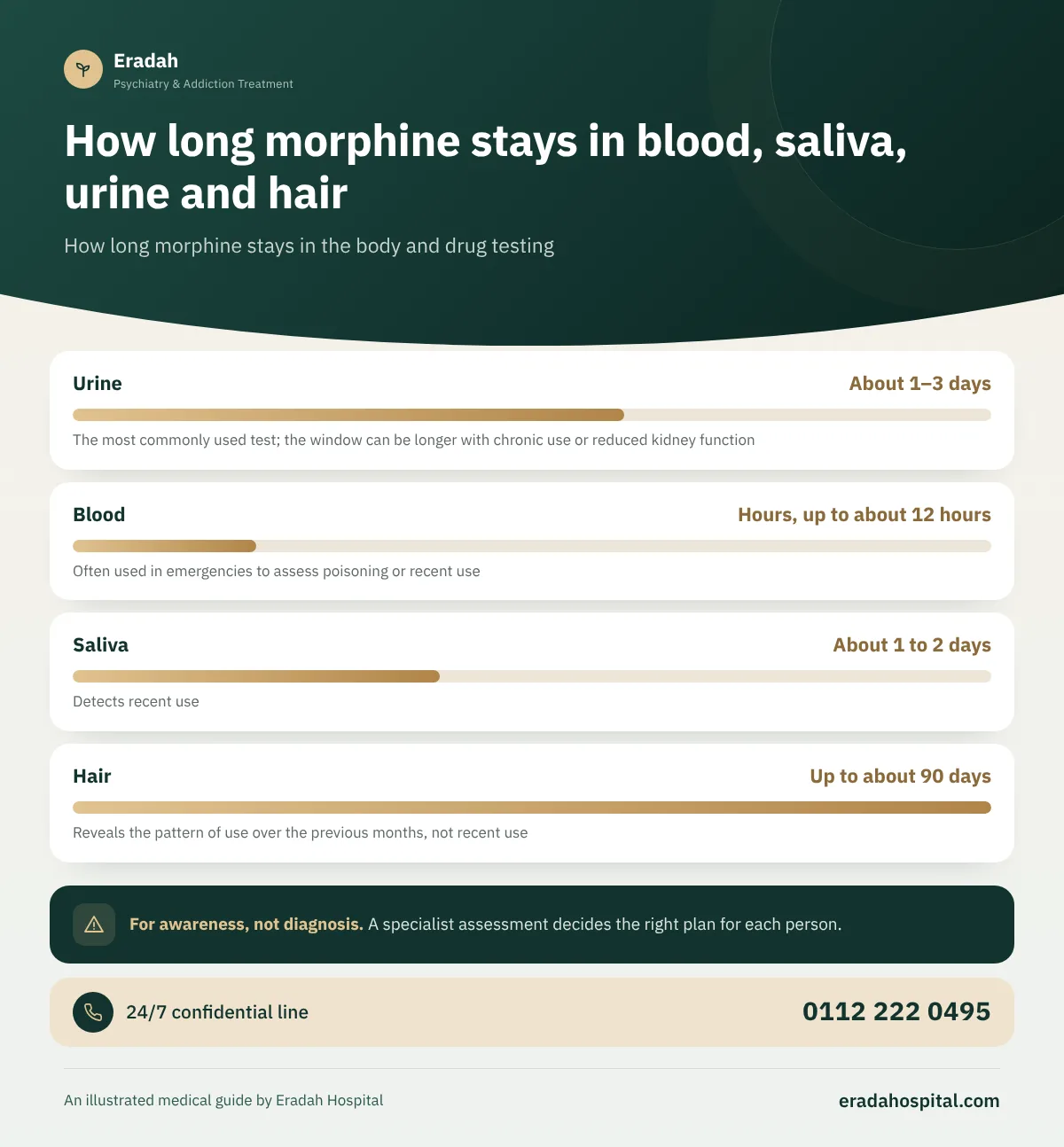
These time frames are approximate and vary with the laboratory, the sensitivity of the test and the cutoff level used. For an accurate interpretation of a specific result, consult a doctor or the laboratory.
Does morphine show up on a standard drug test?
Yes. The standard rapid “opiates” test is designed mainly to detect morphine, codeine and heroin, so morphine usually shows up clearly. This is unlike some synthetic opioids, such as tramadol and fentanyl, which need tests designed specifically for them.
Factors that affect how long morphine stays in the body
- Frequency and duration of use: Chronic use lengthens the detection window compared with a single use.
- Form of the medicine: Extended-release tablets stay in the body longer than fast-acting forms.
- Amount: larger amounts take longer to clear.
- Kidney and liver function: Reduced kidney function in particular clearly prolongs the time morphine metabolites stay in the body.
- Age and general health: Elimination is usually slower with advancing age and with chronic illness.
Can a test be positive without taking morphine?
Yes, and this is relatively common with morphine in particular. The initial screening test cannot always tell the sources of morphine apart, and it may come back positive in the following situations:
| Cause | Explanation |
|---|---|
| Medicines containing codeine | Part of codeine is converted into morphine in the liver, as with some cough medicines and painkillers. |
| Poppy seeds | Eating foods that contain poppy seeds can make morphine appear on the initial screening test. |
| Prescribed morphine | Proper medical use in a hospital or with a prescription. |
| heroin use | Heroin is converted into morphine, and testing for a heroin-specific metabolite helps tell the two apart. |
The difference between a screening test and a confirmatory test
| Type of test | What it does | Limitations |
|---|---|---|
| Rapid initial screening test | Detects opiates above a certain level within minutes | Does not identify the substance or its source precisely |
| Confirmatory test | Identifies the substance and its metabolites precisely, using specialized laboratory equipment | More accurate, but slower and more expensive |
This is why an unexpected positive result should be confirmed with a confirmatory test before it is relied on for a medical, legal or professional decision.
If you take morphine by prescription and are asked to take a test
A positive result is expected and does not mean addiction. Keep the prescription or the hospital report, and tell whoever is requesting the test in advance. Do not suddenly stop your medicine before a test out of fear of the result; discuss it with your doctor instead.
People with kidney disease and older adults
Because morphine metabolites leave the body through the kidneys, they stay longer in people with kidney disease and in older adults. This does not only lengthen the detection window; it also raises the risk that active metabolites build up and cause severe drowsiness or suppressed breathing, which is why the doctor adjusts the treatment plan for these patients carefully.
Morphine testing in the emergency room
When a person arrives in the emergency room unconscious or breathing slowly, doctors do not wait for a test result before starting first aid. They support breathing and give naloxone immediately if needed. The test is useful afterward for identifying the substances involved, especially when opioids are suspected of being mixed with sedatives or other substances.
The detection window cannot be relied on to determine exactly when morphine was used or how much was used. The test mostly tells you that the substance is present above a certain level, not the details of use.
When are morphine tests requested?
- In emergencies, when an overdose or unexplained loss of consciousness is suspected.
- When starting an addiction treatment program, and during it to follow adherence.
- In people with chronic pain, to monitor adherence to the prescribed medicine.
- In some job, licensing, or legal procedures.
Why don’t we mention ways to get around the test?
In a treatment setting, testing is a way to protect the patient and follow their recovery, not a form of punishment. Attempts to quickly “clean” the body can be dangerous. If you genuinely want to stop, the safe route is withdrawal under medical supervision.