Why does morphine cause addiction?
It releases dopamine in the reward circuits, so the brain links morphine with relief from every physical or psychological pain.
The same amount has less effect with repetition, so the person tends to increase it.
The body adapts to its presence, so withdrawal symptoms appear on sudden stopping.
It temporarily eases anxiety and sadness, which attracts those in psychological distress.
Morphine relieves physical pain effectively, but when it is used to relieve psychological pain it turns from a treatment into a problem.
Physical dependence is not addiction
One of the most important things families should know is that there is a big difference between physical dependence and addiction, especially with chronic pain and cancer patients:
| Aspect | Physical dependence | Addiction |
|---|---|---|
| Meaning | A normal adaptation of the body to the medicine | A disease in which the person loses control over use |
| Who it affects | May happen to any patient who takes morphine for a period | Happens in some of those who misuse it |
| Behavior | Adherence to the prescribed dose | Self-increasing the dose, using it for reasons other than pain, and continuing despite harm |
| Management | Gradual stopping under the doctor's supervision | Comprehensive addiction treatment |
The medical path: from hospital to dependence
Some people begin their journey with morphine after surgery, an injury or a painful illness. In most cases they stop without a problem, but the risk rises when:
- Use continues for a long time without regular review.
- The patient notices that the medicine improves his mood or sleep, not only his pain.
- He has a previous history of addiction or a psychiatric disorder.
- The medicine is stopped suddenly, and he looks for another source to escape withdrawal.
That is why doctors continually review the need for morphine and plan gradual stopping when the cause of the pain ends.
Why are some health care workers at risk?
People working in hospitals and pharmacies may be closer to opioid medicines than others, and sometimes face intense work pressure, long shifts, exhaustion and constant exposure to suffering. It may begin with a belief that medical knowledge protects against addiction, which is not true. Seeking help early protects both the person's health and his professional future.
Mental health conditions and dual diagnosis
Some people find in morphine relief from psychological suffering that has not yet been diagnosed, and the temporary relief turns into dependence and then addiction. Among the disorders most linked to opioid addiction:
- Depression and anxiety disorders.
- Post-traumatic stress disorder (PTSD).
- Chronic insomnia.
- Personality disorders.
Some people living with chronic pain that has not been well treated may also turn to raising their morphine on their own in search of relief, so their real need for pain relief becomes mixed with loss of control over the medicine. Blame solves nothing here; what is needed is a specialist assessment that treats the pain and the dependence together.
Genetic and biological factors
Genetics explains an important part of susceptibility to addiction, and the risk is higher in those who have a parent or sibling with addiction. There is no specific "addiction gene"; there is a group of factors affecting how the brain responds to opioids and its ability to control impulses and cope with stress.
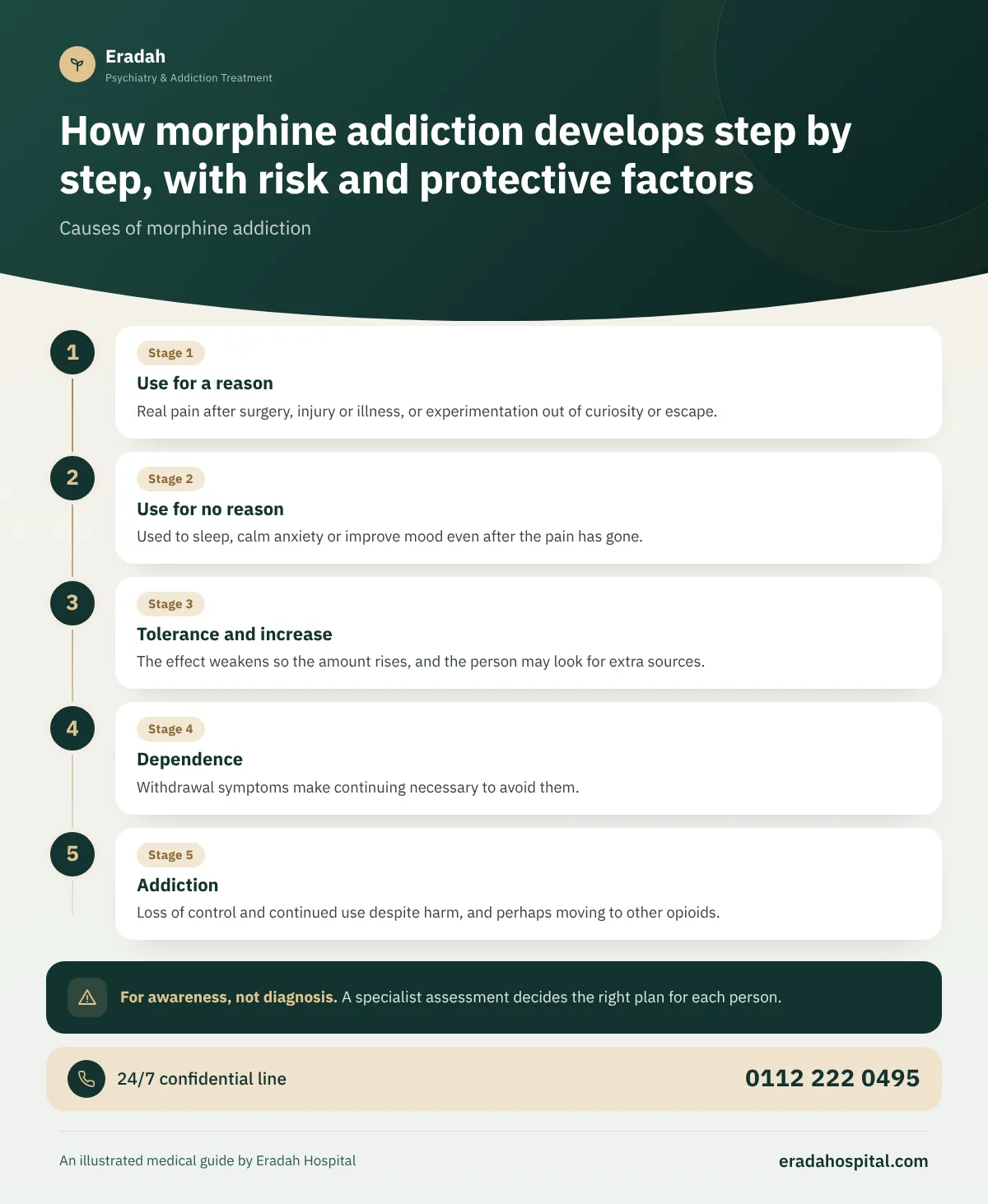
How does morphine addiction develop?
- Stage 1Use for a reason
Real pain after surgery, injury or illness, or experimentation out of curiosity or escape.
- Stage 2Use for no reason
Used to sleep, calm anxiety or improve mood even after the pain has gone.
- Stage 3Tolerance and increase
The effect weakens so the amount rises, and the person may look for extra sources.
- Stage 4Dependence
Withdrawal symptoms make continuing necessary to avoid them.
- Stage 5Addiction
Loss of control and continued use despite harm, and perhaps moving to other opioids.
Environment and social factors
- Easy access: The medicine being at home without supervision, or in the workplace.
- Constant stress: Financial, family or work pressure, and caring for a patient over a long period.
- Starting use at an early age: The adolescent brain is more vulnerable to addiction.
- Loneliness and lack of support: And weak communication within the family.
Morphine at home: a danger many do not notice
When morphine is prescribed to a patient at home, especially for cancer pain and palliative care, it may become available to other members of the family. A teenager may try it out of curiosity, an exhausted caregiver may use it to sleep or ease tension, or it may remain in the house after the patient's death without being disposed of. That is why it must be kept in a locked place, the remaining amount always known, and what is left disposed of in the way the pharmacist or hospital directs.
Risk factors and protective factors
| Area | Risk factor | Protective factor |
|---|---|---|
| Medicine | Long use without review, or medicine available at home without supervision | A prescription with a defined duration, regular follow-up and safe storage |
| Mental health | Untreated depression, anxiety or trauma | Early diagnosis and treatment, and skills for handling stress |
| Work | Easy access with constant pressure and exhaustion | Supportive professional oversight and assistance programs for workers |
| Family | Family history of addiction or lack of dialogue | Open communication and emotional support |
How can you reduce the risk of morphine addiction?
- Use morphine only by prescription and in the way the doctor specifies.
- Review with your doctor regularly the need for the medicine and the plan for stopping.
- Tell the doctor about any previous history of addiction or depression before it is prescribed.
- Keep the medicine in a locked place, and do not share it with anyone.
- Ask for help early if you notice you are using it for reasons other than pain.