“Hashish clears my head.” “Tramadol lets me work and keeps me strong.” “The pill helps me study.” Young people repeat these lines with confidence, and some rest on half of a medical truth. The problem is that this half-truth is used to justify substance use that has nothing to do with medicine. Here we separate the two.
Why do myths about the benefits of drugs spread?
- A real but short-lived effect: the feeling of relaxation or energy does happen at first, and it looks like proof of benefit.
- Confusion with medicine: hearing that “hashish is used in medicine” or that tramadol is “a pharmacy drug.”
- Personal experience: “I tried it and nothing happened to me” is treated as if it were scientific evidence.
- Hiding the real cause: many people use drugs to ease pain, anxiety or sleeplessness that has never been treated.
Does hashish have medical benefits?
According to the US Food and Drug Administration, the cannabis plant itself has not been approved as a treatment for any disease. The agency has, however, approved specific medicines: one made from purified cannabidiol to treat seizures in two rare forms of childhood epilepsy, Lennox-Gastaut syndrome and Dravet syndrome, and medicines containing synthetic THC or a similar compound to treat chemotherapy-related nausea and appetite loss and weight loss in people with AIDS. These medicines are dispensed by prescription only, at calculated doses and with medical follow-up.
This is entirely different from the hashish sold on the street: its potency is unknown and is higher in some types such as hydro, it is often smoked with tobacco, and it is not subject to any oversight. In a large European study, daily use of high-potency cannabis was linked to roughly a fivefold increase in the likelihood of a psychotic disorder.
Common myths about the benefits of hashish
| The myth | The truth |
|---|---|
| “It focuses and opens up the mind” | It impairs attention, memory and learning, according to the US National Institute on Drug Abuse. |
| “It treats anxiety and insomnia” | It may calm you briefly, then tolerance develops, and when use stops, insomnia and irritability appear as part of withdrawal symptoms. |
| “It’s natural, so it’s safe” | Being a plant does not prevent addiction or psychosis, and it may be sprayed with more dangerous synthetic substances. |
| “It doesn’t cause addiction” | It can lead to cannabis use disorder, and the chance rises with an early start and daily use. |
Does tramadol have benefits?
Yes, one clear benefit: relief of moderate to severe pain when a doctor prescribes it and monitors the patient, as the UK’s National Health Service notes. Even in that setting it carries warnings about addiction, slowed breathing and seizures. What is said about it on the street is something else:
- “It gives me energy for work”: this belief is common among people in physically hard jobs, but tramadol is an opioid that causes tolerance and dependence, and the temporary energy ends in a need for a larger amount.
- “It boosts sex”: long-term opioid use is linked to lower testosterone, with reduced desire and performance, which is the exact opposite of what is rumored.
- “A pharmacy drug is safe”: smuggled high-strength tablets are not licensed medicine, and they are linked to seizures and poisoning, as we explain in the harms of tramadol.
Does Captagon have benefits?
Captagon is an old brand name for fenethylline, a stimulant originally developed for therapeutic use and later withdrawn. A systematic review published in 2025 describes how its production turned into a large illicit trade across the Middle East. Researchers acknowledge that it temporarily increases alertness, concentration and physical capacity, but they link long-term use to heart and blood vessel complications, nerve damage and addiction.
- “It helps me study”: staying up late and brief concentration are followed by a crash, exhaustion, and worse memory and sleep, and dependence forms quickly.
- “It makes me slim”: loss of appetite with stimulants means malnutrition and strain on the heart, not healthy slimness.
- “It makes me strong”: there is no medical basis for this, and stimulants strain the heart and blood pressure.
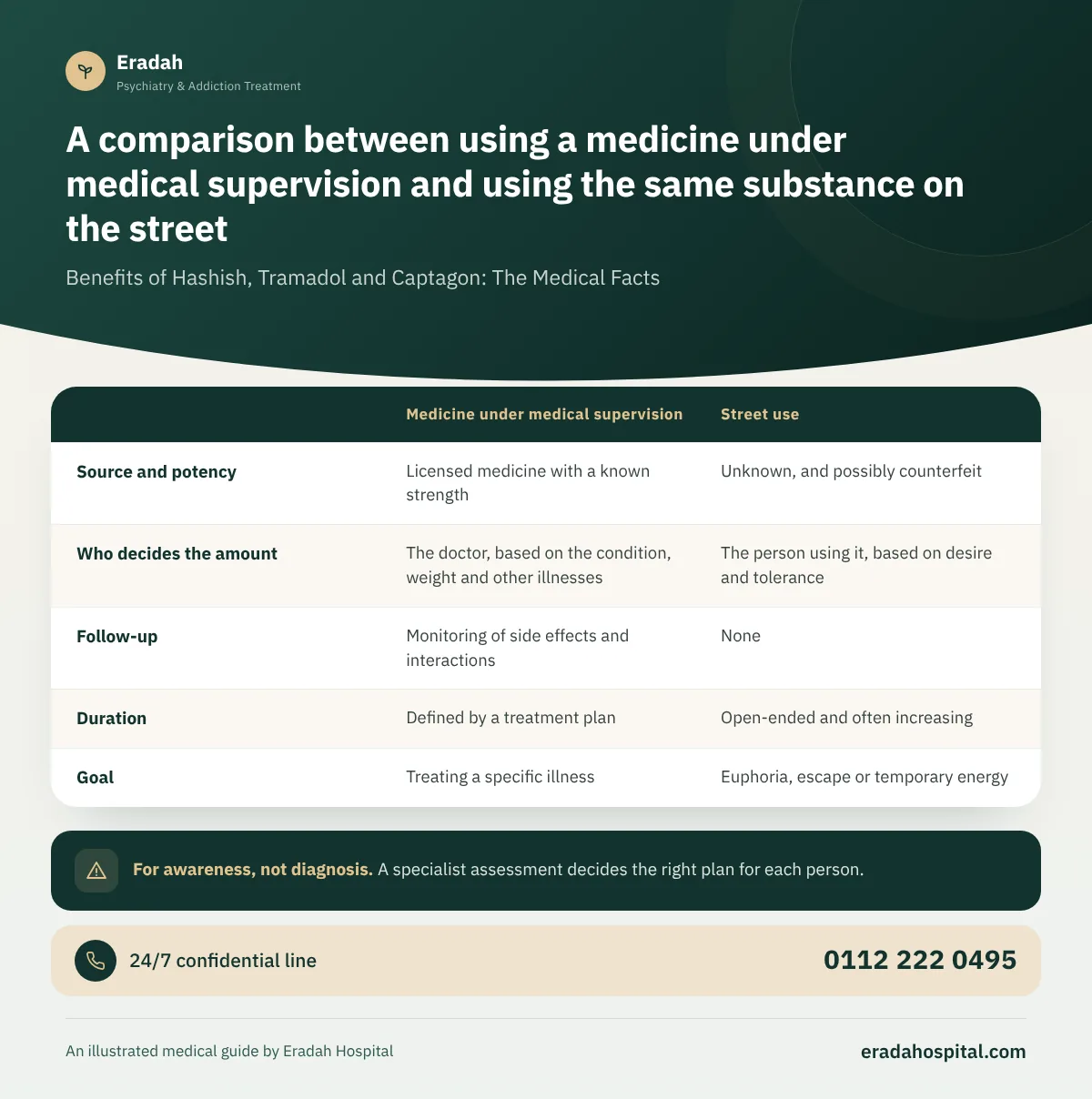
Medicine under supervision vs street use
| Medicine under medical supervision | Street use | |
|---|---|---|
| Source and potency | Licensed medicine with a known strength | Unknown, and possibly counterfeit |
| Who decides the amount | The doctor, based on the condition, weight and other illnesses | The person using it, based on desire and tolerance |
| Follow-up | Monitoring of side effects and interactions | None |
| Duration | Defined by a treatment plan | Open-ended and often increasing |
| Goal | Treating a specific illness | Euphoria, escape or temporary energy |
If there is a real reason behind the use
Often the “benefit” a person is looking for is a sign of a problem that deserves treatment: chronic pain, which has safer treatments chosen by a doctor, or persistent anxiety, or insomnia, or poor concentration that may be undiagnosed ADHD. Treating the cause removes the need for the substance, and you do not have to pay for it later.
When should you ask for help?
If you find yourself defending the “benefits” of a substance you need every day, or needing more of it for the same effect, or failing to stop, these are signs of dependence that deserve an assessment. You can start with a confidential consultation and then a treatment plan that suits you, whether through outpatient treatment or an inpatient program.