How does the body get rid of nalbuphine?
Nalbuphine reaches the blood directly because it is given by injection, so its effect starts within minutes. The body then begins to clear it: the FDA label states that its metabolic pathway has not been precisely determined but is most likely in the liver, and that it leaves through the kidneys.
The half-life of nalbuphine in plasma is about 5 hours according to the label, meaning its blood concentration falls by roughly half every 5 hours. In a Korean study published in 1995 on urine samples from users, nalbuphine and its metabolites, including nornalbuphine, were detected, and a large part of it was bound to glucuronic acid before it was excreted.
How long nalbuphine acts and how long it stays in the body
| Measure | Value |
|---|---|
| Onset of effect after an intravenous injection | 2 to 3 minutes |
| Onset of effect after an injection into muscle or under the skin | Less than 15 minutes |
| Duration of pain relief | 3 to 6 hours |
| Half-life in plasma | About 5 hours |
When you stop feeling the effect, it does not mean the substance has left the body; the drowsiness may pass while amounts that sensitive laboratory methods can detect remain for longer. That is why driving or operating machinery after the injection is not permitted until the doctor is sure its effect has worn off.
Does nalbuphine show up on a drug test?
American Family Physician explains that the routine opiate test was designed to detect morphine metabolites and that it often misses other opioids, so the doctor needs an expanded panel or a confirmatory test. Nalbuphine is not one of the substances targeted by common rapid tests, and testing authorities in South Korea had to develop special methods to measure it when its misuse spread, according to a report published in 2005.
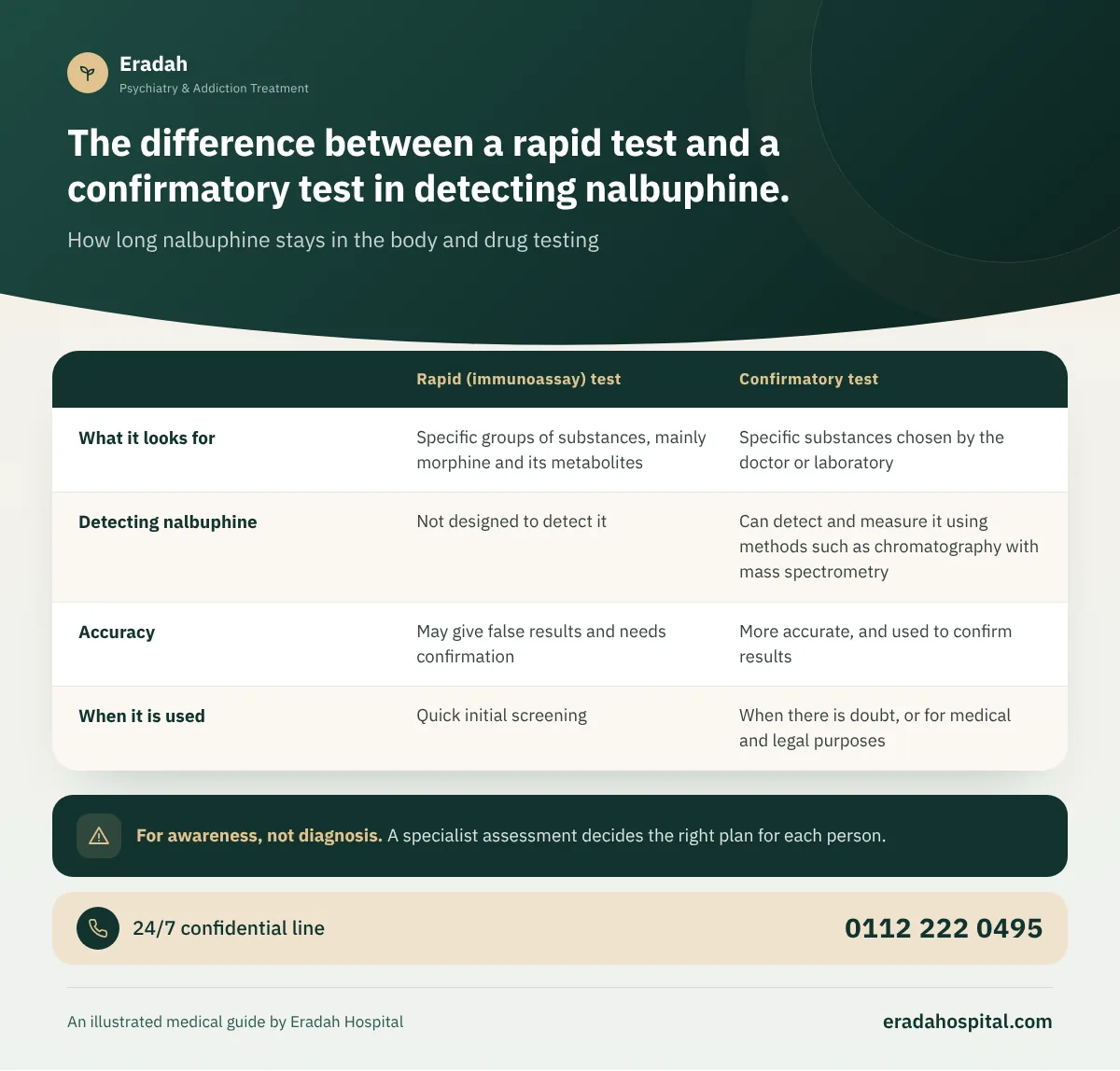
| Rapid (immunoassay) test | Confirmatory test | |
|---|---|---|
| What it looks for | Specific groups of substances, mainly morphine and its metabolites | Specific substances chosen by the doctor or laboratory |
| Detecting nalbuphine | Not designed to detect it | Can detect and measure it using methods such as chromatography with mass spectrometry |
| Accuracy | May give false results and needs confirmation | More accurate, and used to confirm results |
| When it is used | Quick initial screening | When there is doubt, or for medical and legal purposes |
Hair testing and nalbuphine
MedlinePlus notes that a hair test can show long-term opioid use. In a case published by a French study in 2007, blood and urine results were inconclusive in a nurse suspected of using nalbuphine, but analysis of her 6-centimeter hair sample found nalbuphine in all three segments, indicating repeated use. The researchers concluded that hair provides a historical record that blood or urine cannot.
What affects how long nalbuphine stays in the body?
- Kidney and liver function: The FDA label calls for caution and reduced amounts in people with kidney or liver disease, because the liver metabolizes it and the kidneys excrete it.
- Number and frequency of injections: Repeated injections through the day keep the substance in the blood for longer.
- Age and general health: The speed at which medicines are cleared differs from person to person.
- Type of sample and sensitivity of the method: Blood reflects the last few hours, while hair reflects much longer periods.
In an experiment on rats within the Korean study, 93% of the nalbuphine was excreted in urine within 6 hours, and none was detected between 24 and 48 hours. But these are animal results that cannot be transferred directly to humans, and they are not suitable for estimating the detection time in a specific person.
What if you receive nalbuphine by prescription?
If you received nalbuphine in the hospital or by prescription, tell the doctor and the laboratory before any test, and keep proof of it. MedlinePlus advises telling those running the test about all prescription and non-prescription medicines, because some medicines can affect results, and notes that a positive result on a rapid test usually needs confirmation. Also learn about medicines that affect drug tests.
Why is a nalbuphine test requested?
A doctor may request it to follow a patient receiving opioid painkillers, in the emergency room to explain severe drowsiness or slow breathing, as part of an addiction treatment program to monitor recovery, or in healthcare workplaces when ampoule diversion is suspected. In every case the test remains a supporting tool, not a substitute for assessment.
Why don’t we publish ways to hide a test result?
Because the aim of testing in a treatment setting is safety: knowing what is in the body before giving a medicine that may interact with it, or finding a problem early. Someone looking for a way to hide a result usually needs help, not a trick. If you are worried about your own use of nalbuphine, start by reading about nalbuphine addiction treatment or ask for a confidential consultation.