What is paper drug?
“It’s just a normal letter from home.” That is how a letter may look to whoever opens it, while its pages carry a drug with no color and no obvious smell. This is the idea behind paper drug: hiding the drug inside something that raises no suspicion.
Paper drug is a popular name for sheets of paper that are soaked in a solution of a narcotic substance and left to dry, so they return to the look of ordinary paper. The substance most often detected in these papers is synthetic cannabinoids, the same family that Strox, Chemical and Spice belong to.
The European Union Drugs Agency (EUDA) explains that soaking paper, such as letters and pictures, and even clothing, is a common way of smuggling synthetic cannabinoids into prisons, and that these items are then smoked or vaped. The agency records that in 2021 Hungary discovered a site producing paper soaked in synthetic cannabinoids.
Names and forms of paper drug
There is no single fixed name, and the naming changes from country to country. In foreign sources it is usually called “spice paper” or paper soaked in synthetic cannabinoids, and the Lebanese newspaper Annahar quoted a doctor as saying that among its street names are “the Joker” and “drug paper.” Its forms are the usual forms of paper:
This is the form most often detected in prisons, and it usually arrives by mail.
Specific pages are soaked and the rest of the book is left normal.
These include greeting cards and drawings that look completely innocent.
Arabic press reports described them as roughly the size of a postage stamp.
What is in paper drug?
The best information we have comes from forensic tests of papers seized in European and American prisons, not from the Arab street, so the results should be read as an indication and not as a precise description of what may be sold in another country:
- In Scotland, a study published in 2020 analyzed 354 paper samples from 168 seizures in three prisons and found at least one synthetic cannabinoid in 41% of them, and more than one compound in 23% of those positive papers. The dominant compound changed more than once during the monitoring period.
- In the same study, the concentration of the substance varied greatly within a single sheet, reaching in its highest parts about five times that of its lowest, so you cannot predict what any piece cut from it carries.
- In Germany, analysis of a soaked letter sent to a prisoner in 2021 revealed a new synthetic opioid alongside two types of synthetic cannabinoid, and the researchers said it was the first time a synthetic opioid had been detected on paper seized in a prison.
- In the United States, tests of seized paper strips found synthetic cannabinoids and opioids from the benzimidazole family, the family that includes the nitazenes.
Why has paper drug been linked to prisons?
Because paper enters prisons every day in the form of letters and documents, and it is hard to tell a soaked sheet by eye. That is why many prisons use rapid scanning devices that test mail for traces of drugs, and a Scottish study published in 2021 found that the results of one such device agreed with precise laboratory analysis in up to 95% of 392 samples of paper and cards, provided the list of substances it looks for is constantly updated.
Researchers see monitoring of papers seized in prisons as an early warning of new compounds before they spread on the street, because the compounds in circulation change quickly.
Paper drug in the UAE, the Gulf and the Arab world
There are no published figures on how common paper drug is in Egypt or the Arab countries, but scattered cases show that the method has reached the region. In Dubai, the newspaper Emarat Al Youm published in 2022 the details of a case of a parcel from a European country that contained two white sheets, and forensic examination confirmed they were soaked in a manufactured narcotic substance listed in the drug schedule. In Lebanon, the newspaper Annahar asked in a press investigation whether this method had reached the country, and quoted a specialist saying that laboratory analysis is the decisive way to confirm the presence of the substance on paper.
The absence of figures does not mean the absence of danger; the method itself can travel anywhere, and synthetic cannabinoids are in circulation in Egypt under many names such as Strox and Voodoo.
The difference between paper drug and LSD blotter paper
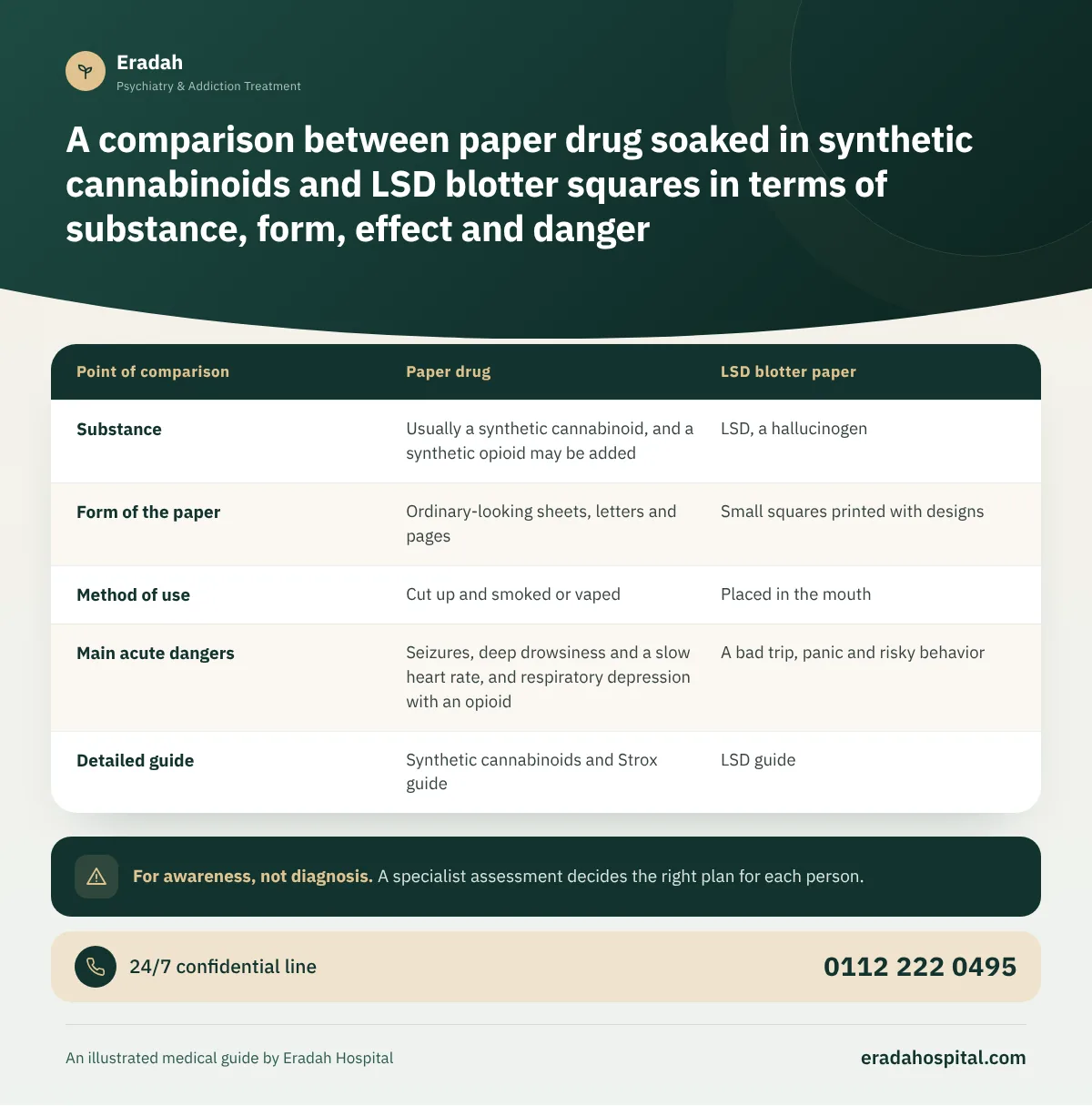
The word “paper” is sometimes used on the street for two different things, and confusing them misleads both the family and the doctor. The UK’s FRANK service explains that LSD is usually sold as small paper squares printed with designs, and it is a hallucinogen from a completely different family from synthetic cannabinoids:
| Point of comparison | Paper drug | LSD blotter paper |
|---|---|---|
| Substance | Usually a synthetic cannabinoid, and a synthetic opioid may be added | LSD, a hallucinogen |
| Form of the paper | Ordinary-looking sheets, letters and pages | Small squares printed with designs |
| Method of use | Cut up and smoked or vaped | Placed in the mouth |
| Main acute dangers | Seizures, deep drowsiness and a slow heart rate, and respiratory depression with an opioid | A bad trip, panic and risky behavior |
| Detailed guide | Synthetic cannabinoids and Strox guide | LSD guide |
How does paper drug affect the body?
Its effect is the effect of the substance it carries. The clearest evidence we have here is a case series published in 2024 in JAMA Network Open about 18 men, inmates of a US prison, who were taken to the emergency department after exposure to soaked paper strips:
- Central nervous system depression, meaning deep drowsiness and poor responsiveness, appeared in 17 of them, and a slow heart rate in 11.
- Six developed agitation and 4 had seizures, and two needed a breathing tube.
- One patient died of brain damage caused by lack of oxygen.
The researchers believed most of these symptoms were linked to the synthetic cannabinoids in the papers, and that a slow heart rate with deep drowsiness is a sign of severe poisoning. This does not mean every sheet will cause the same symptoms, but it shows why there is no “safe paper.”
Does paper drug show up in a drug test?
Paper drug is, in the end, a synthetic cannabinoid, so it usually does not show up on the usual rapid hashish test, but specialized laboratory tests can detect it, and any opioid mixed with it may show up if the test covers it. You will find the full details, from testing the paper itself to how long the substance stays in urine, blood and hair, on the page does paper drug show up in a drug test.
The legal status of paper drug in Egypt
The paper itself is not prohibited, of course, but the substance it carries is what counts. Synthetic cannabinoids and their analogues are listed in the schedules of the Drug Control Law No. 182 of 1960 and its updates, so papers soaked with them are treated the same as the drug itself. The Fund for Drug Control and Treatment of Addiction offers free, confidential treatment through hotline 16023.
This is general educational information and not legal advice.
Harms, withdrawal and treatment of paper drug
Because paper drug is one form of synthetic cannabinoid, the details of its harms, withdrawal and treatment are explained in the Strox guide, with an added risk if the paper contains an opioid:
- Harms: on the heart, kidneys, brain and mental health, in Strox harms.
- Withdrawal: when it starts and how long it lasts, in symptoms of Strox withdrawal. If the person was also exposed to an opioid along with the paper, opioid withdrawal symptoms may appear that need a medical assessment.
- Treatment: assessment, detox, psychological treatment and relapse prevention, in treatment of Strox addiction.
Paper drug guide: everything you need to know
We have gathered everything about paper drug into 4 pages, each answering one question in detail. Choose what you are looking for:
Harms of Strox to the body and mind
Learn about Strox harms to the heart, kidneys, brain and nervous system, the risk of seizures, psychosis and sudden death, and its harm to teenagers, pregnancy and social life.
Strox and Voodoo withdrawal symptoms
When do Strox and Voodoo withdrawal symptoms begin and how long do they last? The withdrawal timeline, physical and psychological symptoms, when it is dangerous, and why it needs medical supervision.
Strox and Voodoo addiction treatment
How are Strox and Voodoo addiction treated? The stages of treatment from assessment and safe detox to cognitive behavioral and family therapy and relapse prevention, and the duration of each stage.
Does paper drug show up in drug tests?
Does paper drug show up in a drug test? Why the rapid strip often does not detect it, how laboratories detect synthetic cannabinoids and a mixed-in opioid, and how long it stays in urine, blood and hair.
How should a family respond to paper drug?
- If you notice papers or letters cut in a strange way, or paper that seems heavier or different in texture from its counterpart, do not taste it and do not try it.
- If someone shows danger signs after smoking or vaping paper, call an ambulance (123) immediately and tell the paramedics an opioid may be present.
- Talk to him at a time when he is not under the influence, with concern and not accusation.
- Ask for a specialist assessment; the situation may need supervised detox or residential treatment, depending on the case.
Danger signs after using paper drug: call an ambulance (123) immediately
- Deep drowsiness or loss of consciousness, with no response to calling
- Slow or irregular breathing, or blue lips
- A very slow or very fast pulse, or chest pain
- Seizures
- Severe agitation, panic or hallucinations
Call ambulance (123) immediately. If the person is unconscious but breathing, place them on their side so they do not choke on vomit. Stay with them and do not leave them alone. Do not give them food or drink, and tell the paramedics everything they took or used, and the amount and time if you know them.
Call the ambulance 123