Does drug-soaked paper show up on a standard drug test?
“The test came back clean, so he isn't using.” This sentence reassures many families, but with drug-soaked paper it can be misleading, because the standard rapid test strip was never designed to detect the substance the paper usually carries.
Drug-soaked paper is usually paper impregnated with synthetic cannabinoids, while the rapid hashish test looks for the metabolites of natural THC, which is a chemically different substance. For this reason, the US National Institute on Drug Abuse (NIDA) notes that synthetic cannabinoids are often not picked up by routine urine tests, and that this is one reason some people turn to them.
Immunoassays made specifically for synthetic cannabinoids do not always solve the problem. In a German study published in 2017 in Clinical Chemistry and Laboratory Medicine, precise testing showed synthetic cannabinoid use in 8% of 549 patients, even though all of their samples were negative on two immunoassays. In a second study in the same paper, the combined sensitivity of the two assays did not exceed 2%. The researchers attributed this to the assays' poor recognition of the compounds currently in circulation and their high detection thresholds.
What exactly does a test detect: the paper or the person?
Many people confuse two different questions: Does this paper contain a drug? And has this person used a drug? Each question calls for a different method:
| Point of comparison | Testing the paper itself | Testing a body sample |
|---|---|---|
| The question it answers | Is the paper soaked with a drug? | Was the person recently exposed to the substance? |
| Where it is done | Screening devices in prisons and border points, then a forensic lab | A medical or forensic lab |
| Tools | Rapid trace-detection devices, with mass spectrometry for confirmation | Immunoassays for screening, with mass spectrometry for confirmation |
| Main limitations | The concentration of the substance is uneven across the paper, and the libraries of target substances need constant updating | May miss new compounds, and the detection window is limited |
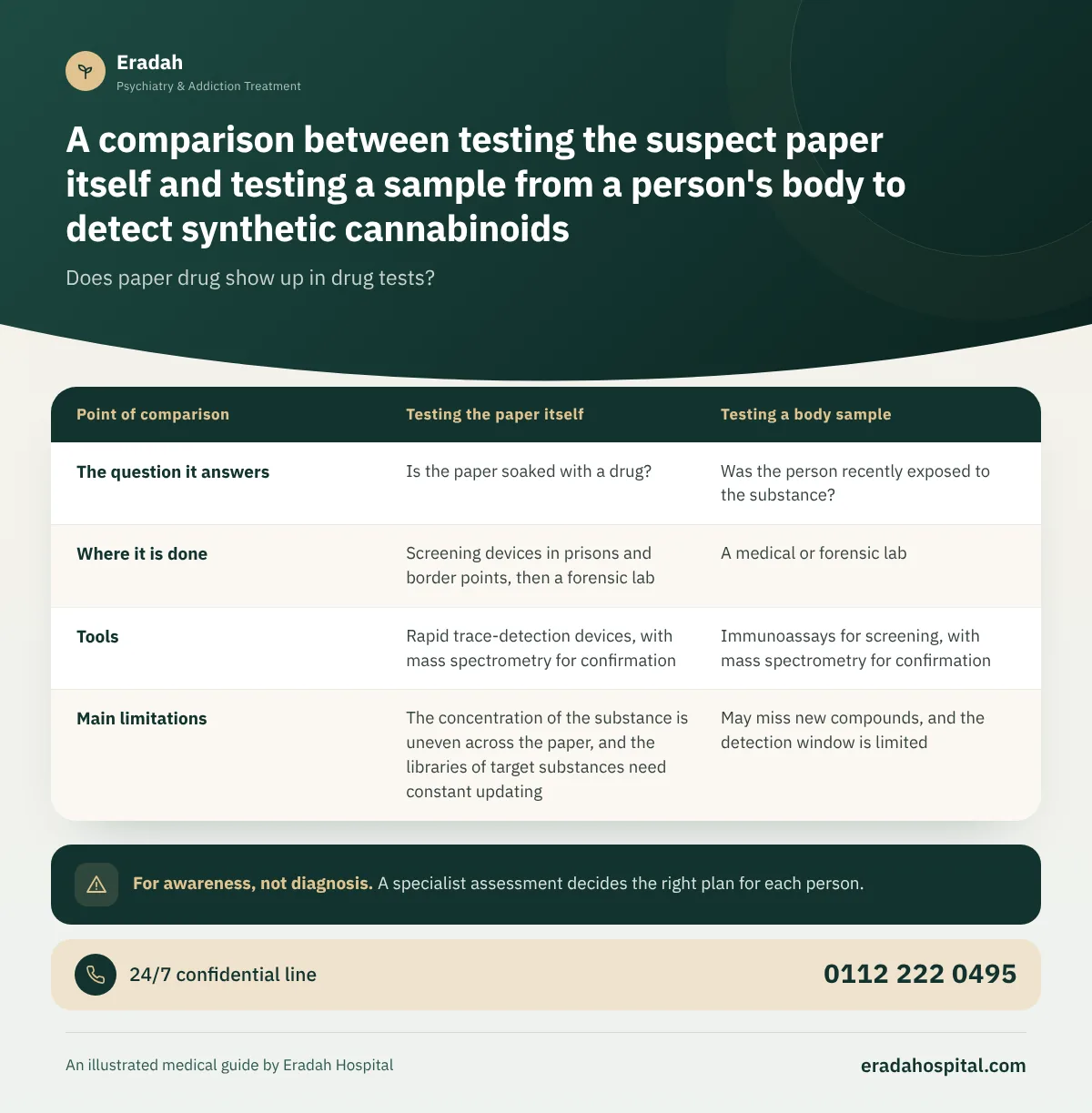
In a Scottish study published in 2021, the results of rapid detection devices used in prisons agreed with precise laboratory testing in up to 95% of 392 samples of paper and cards, provided the library of target substances was kept up to date. But finding the substance on a piece of paper in someone's possession does not by itself prove that the person used it, and the reverse is also true.
How long does drug-soaked paper stay in urine?
After smoking or vaping, the lungs absorb the substance quickly, and the liver then converts it into metabolites that leave the body mainly in urine. This is why urine tests look for the metabolites, not the original substance. There are no studies on how long “drug-soaked paper” specifically stays in the body, because the compound carried on the paper keeps changing, but studies of synthetic cannabinoids in general give a rough picture.
In a Norwegian study published in 2015 that followed five people, urine samples remained positive for a metabolite of one older synthetic cannabinoid for between 20 and 43 days, and the period was shorter in those who had used it once or a few times. The researchers noted that these long periods only appear with highly sensitive tests. Because the sample was small and the compound was an old one, the figures cannot be used to estimate a specific duration for any individual.
Drug-soaked paper in blood, saliva and hair
| Sample type | What it detects | Notes |
|---|---|---|
| Blood | Recent exposure | Often used in emergencies. In a US case series of inmates exposed to paper strips, blood testing confirmed the presence of synthetic cannabinoids and their metabolites |
| Urine | Exposure in the preceding days, which may extend to weeks with heavy use | Depends on whether the metabolite is on the lab's panel |
| Saliva | Very recent exposure | Limited availability for these substances |
| Hair | Pattern of use over the preceding months | According to StatPearls, head hair usually reflects about 3 months and does not detect very recent use |
Details of how long synthetic cannabinoids can be detected in each type of sample are also explained in how long Strox stays in the body, because the active ingredient in both cases comes from the same family.
If the paper contains an opioid: does it show up on a test?
Tests on papers seized in US and German prisons found new synthetic opioids alongside synthetic cannabinoids, including opioids from the nitazene family. This raises a second problem: according to StatPearls, the rapid “opiates” test specifically detects morphine, so it cannot reliably detect synthetic opioids such as fentanyl and methadone.
This means that a negative result in the opiates box does not rule out a synthetic opioid, and detecting one requires a laboratory test that the doctor requests by name. This matters especially in emergencies, where the medical team treats the symptoms directly without waiting for the test result.
Factors that affect how long drug-soaked paper can be detected
- The type of compound on the paper: each compound breaks down at a different rate and produces different metabolites.
- The part of the paper the person used: concentration varies from one spot to another on the same sheet.
- How often and for how long it was used: long-term daily use extends the detection time.
- Body fat percentage: some of these substances dissolve in fat and are released slowly.
- Liver and kidney function: reduced function slows the clearance of metabolites.
- Test sensitivity and how up to date its panel is: a test only detects what it is looking for.
Why can a test come back negative despite drug use?
A false negative result is more common with drug-soaked paper than a false positive, for reasons that include: the rapid strip does not cover synthetic cannabinoids at all, the immunoassay does not recognize the new compound, or the sample was taken after the detection window had closed. So if there are clear signs of drug use but the test is negative, it is better to consult a doctor who can choose the appropriate test and interpret the result, rather than relying on a home strip. You can find the types of tests and how to read them in the guide to drug testing.
Testing during treatment for drug-soaked paper addiction
In treatment programs, periodic testing is used as a support tool, not a tool of accusation. It helps track progress and catch relapse early so the plan can be adjusted, and it is agreed with the patient clearly from the start. You can find the stages and length of treatment in Strox addiction treatment, the program closest to that for drug-soaked paper, which can begin through outpatient treatment or residential care depending on the severity of the condition.
As for attempts to quickly “flush” the body with large amounts of fluids or various substances, we do not offer them, because they do not serve recovery and may harm the heart and kidneys, two of the organs most affected by synthetic cannabinoids. The safe route for anyone who wants to stop is a medical assessment and supervised detox.