Physical signs of tapentadol use
These signs appear while the drug is active, and may vary with the amount, the length of use and the presence of other substances:
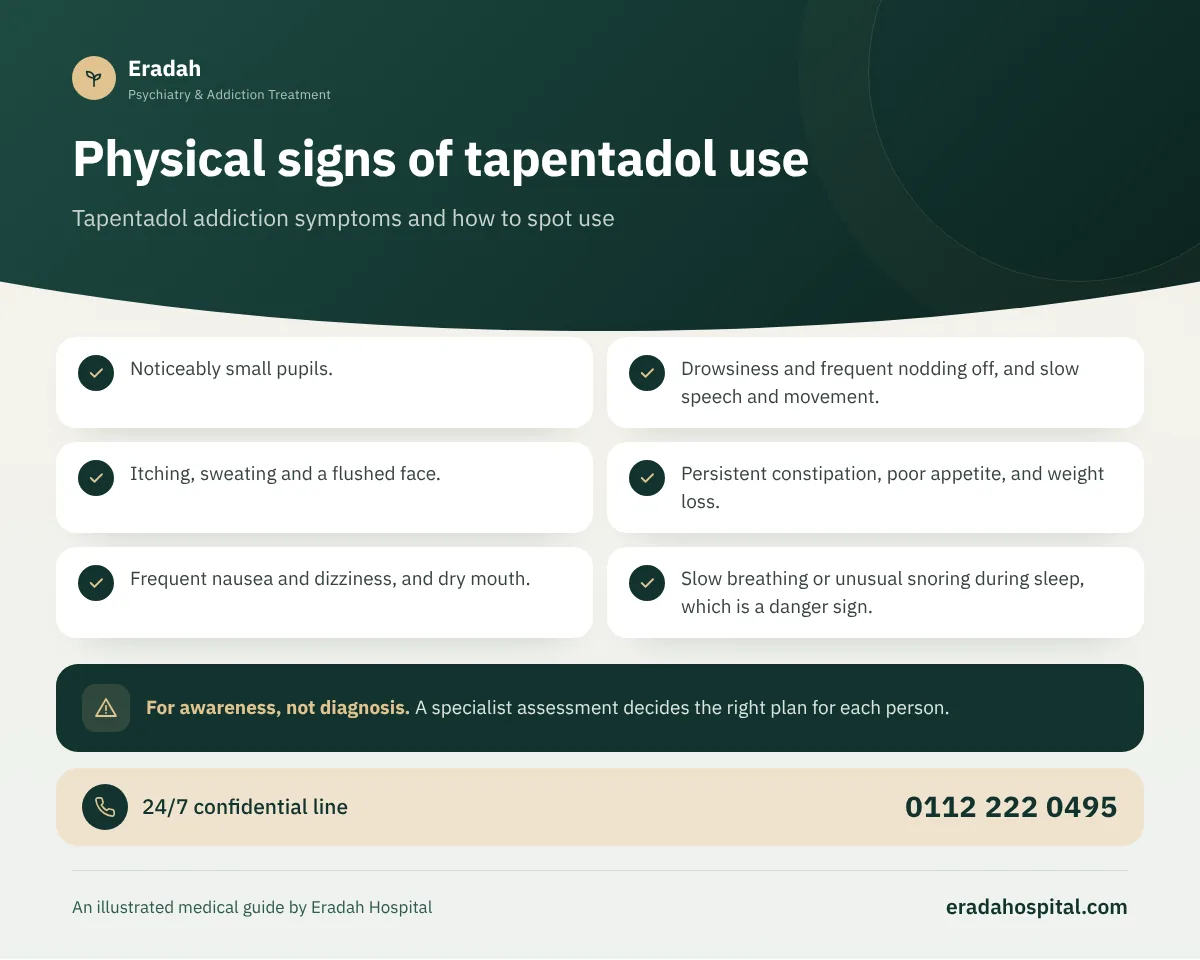
- Noticeably small pupils.
- Drowsiness and frequent nodding off, and slow speech and movement.
- Itching, sweating and a flushed face.
- Persistent constipation, poor appetite, and weight loss.
- Frequent nausea and dizziness, and dry mouth.
- Slow breathing or unusual snoring during sleep, which is a danger sign.
Behavioral signs
Behavioral changes are often noticed by relatives and coworkers before the physical signs:
- Getting prescriptions from several doctors, or moving between more than one pharmacy.
- Running out of pills before the expected date and asking for more early.
- Stashing tablets in different places, or a large number of empty blister strips.
- Asking for money often, or spending that you cannot explain.
- Exaggerating pain to get the medication.
- Neglecting work, school or family, and changing the usual friends.
Psychological signs
- Mood swings between excessive calm and relaxation and irritability and distress.
- Quick temper, especially near the time of the next tablet.
- Loss of interest in hobbies and relationships.
- Restlessness that does not settle, trouble concentrating, and poor memory.
Signs you may notice at work or school
- Marked ups and downs in performance and repeated lateness.
- Dozing off or zoning out at work or while driving.
- Unusual mistakes in work the person is skilled at.
- Suddenly staying away, especially on the days when the tablets run out.
- Declining grades or attendance in students.
What might catch the family's eye among their belongings?
Some of what you may find among a person's belongings deserves attention, although it does not prove use on its own: blister strips under an unfamiliar name, tablets with no packaging, packs written in a foreign language that are not normally sold in pharmacies, or multiple prescriptions from different doctors.
What is the difference between the signs of tapentadol and the signs of other substances?
The signs of some substances are similar, but there are differences that help with observation, bearing in mind that confirmation comes only through medical assessment and the appropriate test:
| Substance | Pupils | Activity | Distinguishing sign |
|---|---|---|---|
| Tapentadol | Constricted | Drowsiness and excessive calm | Itching, constipation and nodding off |
| Tramadol | Constricted | Drowsiness or excess energy | Tremor and sometimes seizures |
| Pregabalin | Usually normal | Unsteadiness and dizziness | Slurred speech and loss of balance |
| Stimulants | Dilated | Hyperactivity and severe insomnia | Loss of appetite, irritability and staying up late |
A patient taking tapentadol by prescription: when should we worry?
Taking tapentadol does not necessarily mean addiction, since many patients take it for real pain under a doctor's supervision. But some signs show that use has slipped out of control:
- Continuing to take it after the pain has gone or after the period the doctor set has ended.
- Raising the amount or taking it more often without going back to the doctor.
- Using it to improve mood or sleep rather than to relieve pain.
- Or getting it from outside the pharmacy and without the knowledge of the treating doctor.
Signs that call for emergency care immediately
Deep sleep from which they do not respond to calling or touch, with slow or irregular breathing.
Blue lips and fingernails, cold skin and a slow pulse.
A high temperature with heavy sweating, stiffness and confusion may mean serotonin syndrome.
If any of this appears, do not hesitate: call the ambulance on 123 immediately, and give them all the information you have about the substances they took.
Signs specific to teenagers and young adults
The signs of painkiller use in teenagers may blend in with normal changes of that age, but some signals deserve attention if they occur together:
- Long sleep at unusual times, or nodding off during conversation or studying.
- A sudden drop in grades and attendance.
- New friends the parents do not know, and excessive secrecy about the phone and room.
- Medications disappearing from the home medicine cabinet, especially painkillers.
- Asking for money with repeated excuses, or selling personal belongings.
Common misconceptions about signs of substance use
| The common belief | The truth |
|---|---|
| “Someone using pills always looks asleep” | Some people look normal most of the time, and the signs show up as a repeating pattern, not a single moment. |
| “As long as he goes to work, there is no problem” | Many people keep working for a while despite dependence, and then their condition suddenly deteriorates. |
| “The medicine is prescribed, so he can't become addicted” | A prescription does not prevent addiction if the amount rises or the period lengthens without follow-up. |
When does use become addiction? Diagnostic criteria
The medical diagnosis of opioid use disorder relies on the DSM-5, which sets out eleven criteria assessed over a year, examples of which include:
- Taking it in larger amounts than the person intended, or over a longer period than planned.
- A persistent wish to cut down, or repeated unsuccessful attempts.
- Spending a great deal of time trying to obtain the drug.
- Intense craving and an inner urge to take it.
- Falling short on work duties or home responsibilities.
- Continuing even though health or social problems have become obvious.
For a patient who takes the medication under proper medical follow-up, increased tolerance and withdrawal symptoms are not counted among the criteria, since they are an expected physical response that does not in itself indicate addiction.
| Number of criteria | Level |
|---|---|
| 2 to 3 | Mild |
| 4 to 5 | Moderate |
| 6 or more | Severe |
How do you open the conversation with someone who is misusing tapentadol?
- Choose a calm moment when they are alert and away from the effect of the drug.
- Begin with your concern and love for them, and avoid accusations: “I noticed you seem tired and you're sleeping a lot, and I'm worried about you.”
- Do not argue that it is “just a medicine”; focus on the changes you notice.
- Offer a clear step: an appointment with a doctor or a confidential consultation.
- Do not push them to stop the medication suddenly on their own, especially if they take it with other substances.
And remember that the goal of the conversation is to open the door to help, not to extract a confession. A person who feels safe and respected is more ready to accept a medical assessment than one who feels accused and cornered.
To learn about the symptoms that appear after stopping, see the page on tapentadol withdrawal symptoms.
Signs of tapentadol overdose: call an ambulance (123) immediately
- Very slow, shallow or stopped breathing, or unusual snoring during sleep
- Pupils that are extremely small, like pinpoints
- Extreme drowsiness and difficulty waking, or loss of consciousness and no response to being called
- Blue lips and nails, cold skin and a slow pulse
- Seizures, or agitation with fever, heavy sweating and shaking if it was mixed with drugs that raise serotonin
Call an ambulance on 123 immediately, place the person on their side (recovery position) so they do not choke, give them nothing by mouth, stay with them until help arrives, and keep the medication box. Emergency doctors use naloxone to reverse the respiratory depression caused by opioids.
Call the ambulance 123