Why does tapentadol cause addiction?
Tapentadol has properties that make it capable of causing addiction, like other strong opioids:
It binds to opioid receptors without needing to be converted, and so releases dopamine in the brain's reward circuits.
It relieves physical pain and eases tension for a while, so the brain links the tablet with relief.
The same amount has less effect over time, so the person increases the amount and the risk rises.
The person goes through physical and psychological symptoms when they stop, so they turn to the tablet again to get rid of them.
US authorities classify it as Schedule II among controlled substances, the category set aside for drugs with a high potential for misuse, and this alone is enough to refute the idea that it is a “safe painkiller.”
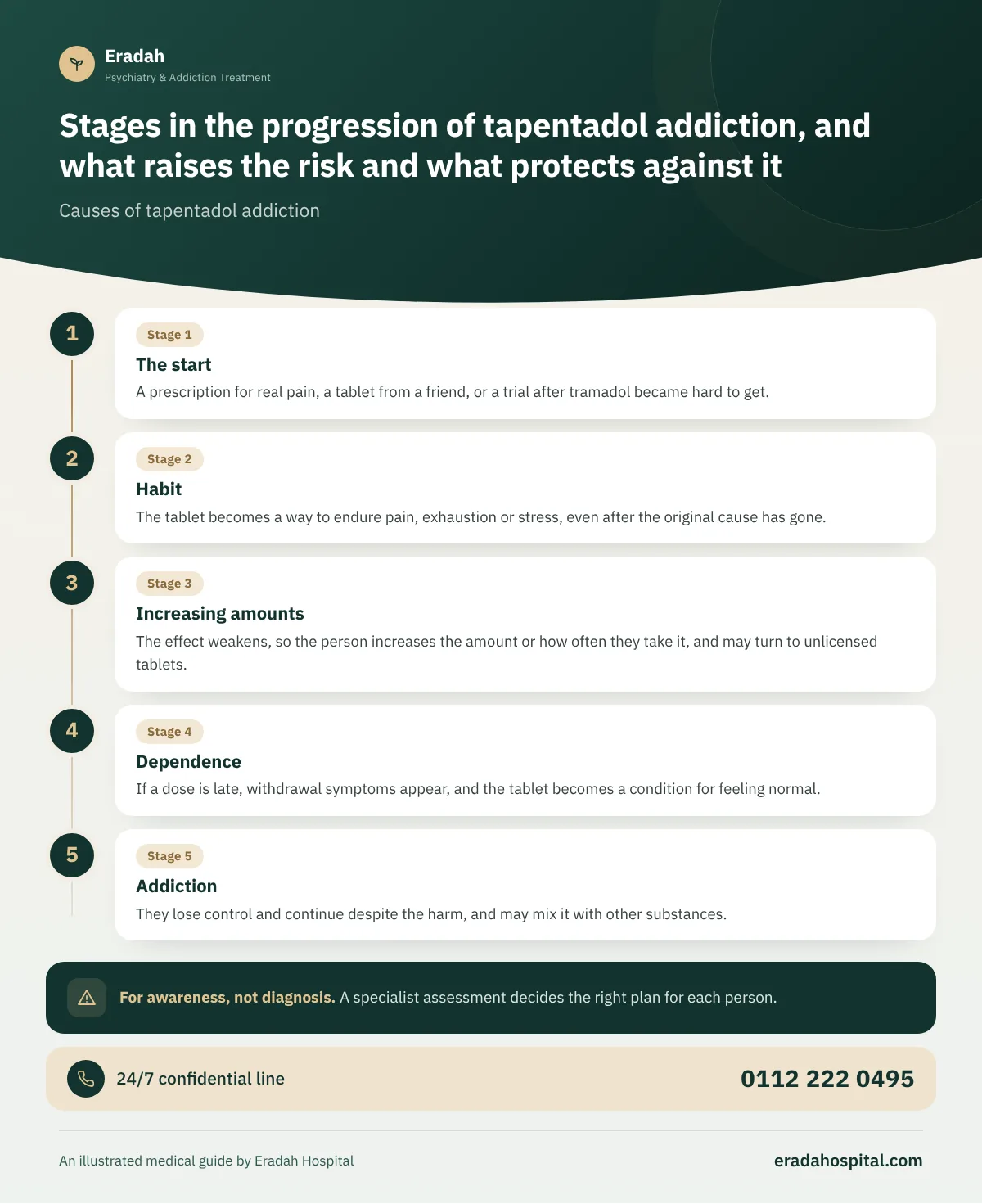
How does tapentadol addiction develop?
- Stage 1The start
A prescription for real pain, a tablet from a friend, or a trial after tramadol became hard to get.
- Stage 2Habit
The tablet becomes a way to endure pain, exhaustion or stress, even after the original cause has gone.
- Stage 3Increasing amounts
The effect weakens, so the person increases the amount or how often they take it, and may turn to unlicensed tablets.
- Stage 4Dependence
If a dose is late, withdrawal symptoms appear, and the tablet becomes a condition for feeling normal.
- Stage 5Addiction
They lose control and continue despite the harm, and may mix it with other substances.
Does tightening controls on tramadol push people toward tapentadol?
One pattern noted by the International Narcotics Control Board is that tightening control over one substance pushes some of those dependent on it toward a close substitute. This has indeed happened in West African countries, where smuggled tapentadol tablets replaced tramadol after it was restricted.
Someone who was dependent on tramadol and then moved to tapentadol has not recovered; they have transferred their dependence to a substance with a stronger effect on opioid receptors. That is why real treatment for tramadol dependence is the kind that protects against this switch, not a search for a substitute.
When a chronic pain medication turns into dependence
Some patients need opioid painkillers for long periods because of severe chronic pain, such as back pain and nerve pain. It is important here to distinguish between two situations:
A normal physical response to the medicine that can happen to any patient who uses it for a period of time, which the doctor handles by tapering it gradually under their supervision.
The person loses control, raises the amount on their own, uses it for purposes other than pain, and continues despite harm.
So a chronic pain patient should not stop their medication or change the dose on their own, and should go back to their doctor if anything worries them, as there may be alternatives that suit their condition better.
Mental health conditions and dual diagnosis
Some people find in tapentadol relief from psychological suffering that has not yet been diagnosed, not just from physical pain. The conditions most often linked to opioid misuse include:
- Depression and anxiety disorders.
- Post-traumatic stress disorder (PTSD).
- Chronic insomnia.
- Attention-deficit/hyperactivity disorder (ADHD), if untreated.
Genetic and biological factors
Genetic factors play an important part in vulnerability to addiction in general, and the risk rises when there is a family history of addiction. Starting use at an early age also raises the risk, because the parts of the brain responsible for planning and impulse control do not finish developing until roughly the mid-twenties.
Environment and social factors
- Easy access: unlicensed tablets circulating among friends and coworkers or online.
- Social acceptance: when it is treated as a “painkiller” and not a “narcotic,” the sense of its danger weakens.
- Work and life pressures: looking for a quick way to cope with exhaustion and stress.
- People who use drugs in the close circle: friends or family, which makes use seem normal.
False beliefs that pave the way to tapentadol addiction
| Common belief | The truth |
|---|---|
| It is milder than tramadol | Its opioid effect is stronger and more direct, and it is classified among the strong opioids. |
| A medicine from the pharmacy must be safe | Relatively safe only under medical supervision, and unlicensed tablets have unknown strength. |
| You can stop it at any time | After regular use, opioid withdrawal appears and drives many people to go back. |
| It treats tramadol addiction | Switching to it transfers the dependence; it is not a treatment for it. |
Why do some young people try tapentadol?
Some young people start opioid painkillers out of curiosity or to copy friends, or because they have heard that they “calm the nerves” or help them endure late nights and pressure. A young person may not know that the tablet they got is a strong opioid, or that mixing it with pregabalin or alcohol can stop their breathing.
The risk rises when there are people around the young person who use drugs, or when they struggle with anxiety, depression or family problems with no one to listen to them. That is why prevention starts at home: honest, calm conversation, knowing your children's friends, and noticing any change in sleep, studies or money.
Risk factors and protective factors
| Area | Risk factor | Protective factor |
|---|---|---|
| Medicine | Long-term use without follow-up, or unlicensed tablets | A prescription for a set period with regular medical reviews |
| Mental health | Untreated depression, anxiety or trauma | Early detection and treatment, and learning ways to cope with stress |
| History | Previous dependence on tramadol or other opioids | Full treatment of the earlier dependence and follow-up afterward |
| Family | No communication within the family or a family member with an addiction | Open conversation, emotional support and clear rules |
How do you protect yourself and your family?
- Do not take tapentadol without a doctor's prescription, and do not give it to anyone else.
- Ask your doctor about using non-opioid painkillers whenever that is possible.
- Tell any doctor about your history with tramadol or opioids before they prescribe any painkiller.
- Do not put off seeking treatment for depression, anxiety or insomnia.
- When your course of treatment ends, dispose of any leftover tablets as the pharmacist advises.