Why does a hashish test come back negative with Voodoo?
The common hashish test relies on detecting THC breakdown products. Voodoo contains no THC at all, but synthetic compounds that are chemically different, so the test does not recognize them. Medical references confirm that routine hospital urine tests do not detect synthetic cannabinoids.
This point has caused a great deal of misunderstanding: a young person may believe Voodoo is "safe" because it does not show up, and a family may be wrongly reassured by a negative result. The truth is that difficulty of detection says nothing about safety, and that there are tests designed for these substances.
Which test detects Voodoo?
Tests that look for breakdown products of known families of these compounds, and that must be requested by name.
Based on chromatographic separation with mass spectrometry, it identifies the compound precisely.
Looks for a wide range of substances and is useful when a mix of several substances is suspected.
Because hundreds of compounds from this family have appeared, each test detects only what is on its list. It therefore helps to have the test done at a specialized laboratory that updates its lists continually.
How long does Voodoo stay in the body, by sample type?
Urine
Blood
Saliva
Hair
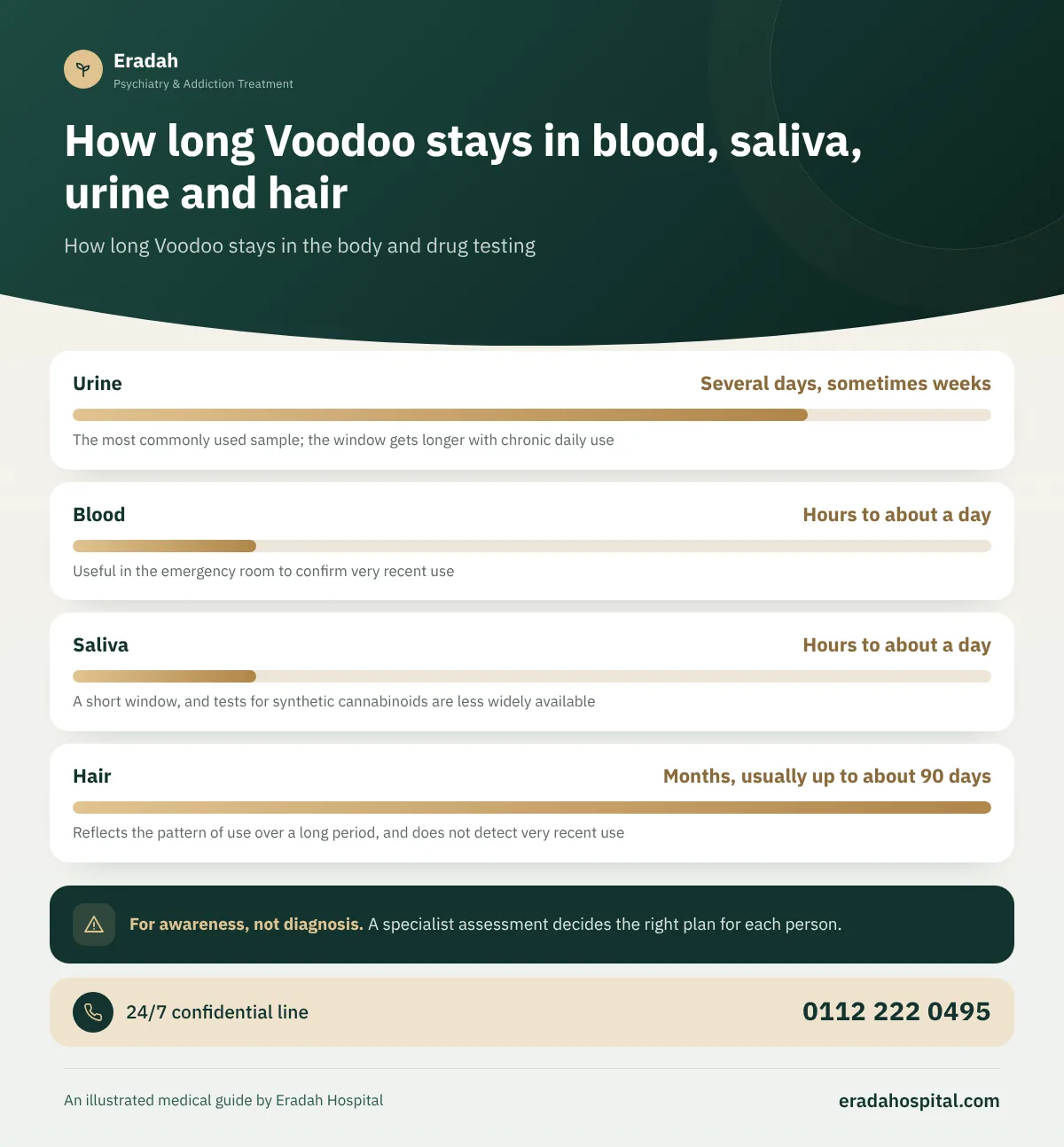
The timeframes are approximate and vary with the compound, the sensitivity of the test and the laboratory. A study published in 2015 documented a synthetic cannabinoid breakdown product remaining in the urine of some users for more than six weeks using highly sensitive tests; these are special cases that do not apply to everyone.
What happens to Voodoo inside the body?
The lungs absorb the substance quickly, and then the liver converts it into multiple breakdown products that leave mainly in the urine. The European Union Drugs Agency explains that the parent compound is rarely found in urine, which is why tests target its breakdown products. Because some of these compounds dissolve in fat, they may be released slowly from body tissues in heavy users.
What makes the detection time longer or shorter?
| Factor | Possible effect |
|---|---|
| Frequency and duration of use | Daily use over a long period clearly lengthens the window |
| The compound in the bag | Each compound breaks down at a different rate, and it is often unknown |
| Body fat percentage | May prolong the stay of some compounds |
| Liver and kidney function | Impaired function slows the clearance of breakdown products |
| Test sensitivity | Newer tests detect smaller amounts and for longer |
How can a family understand a test result?
- Negative result: may mean no use, or that the test does not cover the compound, or that the use was outside the detection window.
- Preliminary positive result: needs a confirmatory test before any important decision.
- Confirmed positive result: proves use, but on its own does not determine whether there is addiction or how severe it is.
- In every case: the result is interpreted together with symptoms and medical history, not apart from them.
In the emergency room: does the doctor wait for the test?
No. Results of specialized synthetic cannabinoid tests can take time, while acute poisoning needs immediate intervention. So the medical team starts treatment based on symptoms and vital signs, and benefits greatly from frank information from family or friends about what the person took and when. Honesty here does not harm the patient; it protects them.
Does a home test strip detect Voodoo?
Usually not. Most home strips detect a limited number of substances and do not include synthetic cannabinoids, or include very few of them. Relying on them can give a family false reassurance or lead to inaccurate accusations. When in doubt, it is better to consult a doctor who will choose the right test and interpret it in the context of the case.
When does a doctor order a Voodoo test?
- When a young person arrives at the emergency room with a seizure, agitation, psychosis or kidney injury with no clear explanation.
- At the start of a treatment program, and then periodically to track progress and support commitment.
- When there are clear signs of use but a negative hashish test.
- In some workplace procedures or legal proceedings.
How is Voodoo testing used during treatment?
In a synthetic hashish treatment program, periodic specialized tests are agreed with the patient from the start. We use testing so that the patient and their team can see progress clearly, and so that any relapse is caught early and the plan adjusted before things get worse, not for surveillance or punishment. Negative results may be linked to positive incentives that encourage commitment, an approach shown to be helpful in treating substance use disorders.
Why don't we explain ways to hide use from a test?
Because testing during treatment is a tool for protection and follow-up, not punishment. And because the quick "cleansing" methods people circulate can be harmful to the kidneys and heart, which are among the organs most affected by Voodoo to begin with. For anyone who truly wants to stop, the safe route is a medical assessment and a clear treatment plan.