Where do Voodoo's harms come from?
When someone uses bango, they are exposed to a relatively known substance. With Voodoo, they are exposed to three layers of risk at the same time:
A synthetic cannabinoid that activates cannabis receptors at full strength, producing effects that do not usually occur with hashish.
Parts of the bag may be far more saturated with the chemical than others.
Other substances may be mixed in without the user's knowledge, some of them toxic in themselves.
That is why medical references note that synthetic cannabinoid poisoning can be more severe than cannabis intoxication and may need more intensive treatment.
What can happen in the first hours after using Voodoo?
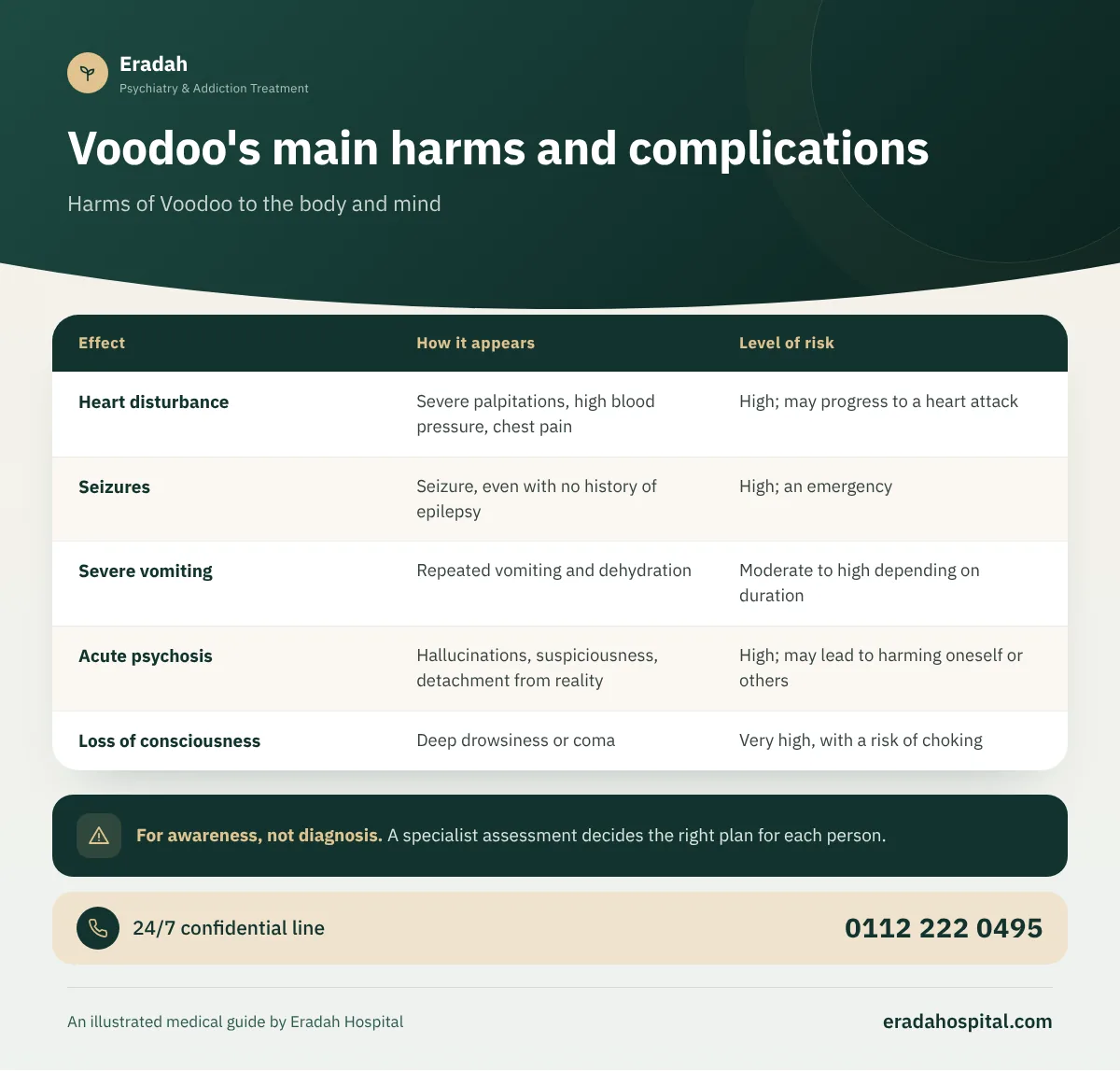
| Effect | How it appears | Level of risk |
|---|---|---|
| Heart disturbance | Severe palpitations, high blood pressure, chest pain | High; may progress to a heart attack |
| Seizures | Seizure, even with no history of epilepsy | High; an emergency |
| Severe vomiting | Repeated vomiting and dehydration | Moderate to high depending on duration |
| Acute psychosis | Hallucinations, suspiciousness, detachment from reality | High; may lead to harming oneself or others |
| Loss of consciousness | Deep drowsiness or coma | Very high, with a risk of choking |
How does Voodoo harm the heart, kidneys and muscles?
The US Centers for Disease Control and Prevention list heart attacks, rapid pulse, high blood pressure, stroke, kidney failure and muscle damage among the harms of synthetic cannabinoids. These harms are linked to one another: agitation and high body temperature can cause muscle breakdown, and the products of muscle breakdown, together with dehydration from vomiting, strain the kidneys.
Kidney injury often begins with signs that can be mistaken for a "cold" or a "stomach bug": nausea, vomiting and pain in the side or lower back. Any young person who shows these signs after using Voodoo needs a medical examination.
Voodoo and mental health
The psychological effect of Voodoo may be the first thing those around the person notice, and it can outlast the period of the drug's effect itself:
- Panic attacks: sudden intense fear with a feeling of suffocation or impending death.
- Acute psychosis: hallucinations and paranoid thoughts that can last for days and need psychiatric treatment.
- Mood swings: irritability, quick temper and depression, especially between episodes of use.
- Thoughts of self-harm: noted by the US Centers for Disease Control and Prevention among the effects of these substances, and requiring immediate intervention.
- Poor concentration and memory: with repeated use, affecting school and work.
The risk of psychosis is higher still in people with a personal or family predisposition, which calls for integrated treatment of both conditions as part of dual diagnosis.
Are Voodoo's harms the same as bango's?
The two share some psychological harms, such as impaired memory and concentration, and dependence, but Voodoo adds acute harms that rarely occur with bango, such as seizures, heart attacks, acute kidney injury and severe psychosis. So someone who moves from bango to Voodoo jumps to a different level of risk, and it is wrong to see it as an "upgrade."
What happens when Voodoo is mixed with alcohol or pills?
Mixing Voodoo with other substances makes the outcome harder to predict and more dangerous to treat. Alcohol and sedative pills deepen drowsiness and increase the likelihood of loss of consciousness and choking on vomit, while stimulant pills add strain on the heart and raise body temperature. The emergency team may also face a complicated picture of unknown origin, so telling them everything that was taken helps save time.
Does Voodoo harm pregnant women and the fetus?
Direct research is limited, but what Voodoo causes in the mother, including palpitations, high blood pressure, seizures, repeated vomiting and dehydration, is a direct risk to the pregnancy. A pregnant woman who uses any synthetic hashish needs urgent medical follow-up and a safe plan to stop, set by her doctor, not stopping alone without supervision.
Why are teenagers more harmed by Voodoo?
Colorful packaging, attractive names and the marketing of it as "herbs" put Voodoo within easy reach of teenagers in particular. The teenage brain is still building its capacity to control impulses and assess risk, so teens are more prone to psychosis, panic and reckless behavior under the influence, and more likely to develop addiction if use is repeated.
How does Voodoo affect daily life?
- Declining performance at school or work because of poor concentration, absences and sleep disturbance.
- Strained family relationships after angry outbursts or strange behavior.
- Accidents and injuries while under the influence, especially while driving or on the street.
- Legal consequences for possessing a prohibited substance.
- Financial pressure, lying and borrowing money as use continues.
Does the body recover from Voodoo's harms?
Most acute complications, such as dehydration, muscle breakdown and acute kidney injury, often improve with prompt hospital treatment, and sleep, mood and concentration improve gradually after stopping. Complications such as stroke or injuries from accidents, however, can leave a lasting effect. Stopping early with specialized treatment is the best protection.
Signs of acute Voodoo poisoning: call an ambulance (123) immediately
- A seizure or violent involuntary movements
- Loss of consciousness or no response to calling out or touch
- Complaining of chest pain, or a very fast, irregular pulse
- Severe agitation or aggression, or talking about things that are not there
- Very high body temperature, or confusion with heavy sweating
Call an ambulance on 123 immediately and do not wait for him to "come around on his own". Do not restrain him by force or put anything in his mouth, and move away anything that could hurt him. If he loses consciousness or the seizures stop, place him on his side in the recovery position, stay beside him, and tell the paramedics he used Voodoo and any other substances.
Call the ambulance 123