Stage 1: Comprehensive assessment
Treatment of zolpidem addiction depends on the story: someone who takes one prescribed tablet every night for two years is not like someone taking dozens of tablets a day in search of euphoria, and each needs their own plan.
The 2025 guidelines of the Brazilian Academy of Neurology, among the most recent guidelines dedicated to Z-drug dependence, recommend that any discontinuation be preceded by an assessment of mental state, sleep disorders and accompanying conditions, and the degree of dependence. In practice, the doctor asks about:
- The actual daily dose and its timing, and whether it is used during the day.
- Alcohol, opioid painkillers, and other sedatives.
- A history of any seizures or earlier withdrawal symptoms.
- Accompanying disorders such as generalized anxiety or depression.
Stages of zolpidem addiction treatment
- The startAssessment and choosing the setting
A comprehensive examination, and deciding whether outpatient treatment suits the patient or a short residential stay is needed.
- The first weeksTapering or switching
Gradual tapering, or a temporary switch to a longer-acting sedative that is then reduced slowly, as decided by the doctor.
- In parallelBehavioral treatment of insomnia
Cognitive behavioral therapy for insomnia, and acceptance and commitment therapy may be added.
- After stoppingTreating the causes
Treating anxiety, depression and other sleep disorders with medications that do not cause dependence.
- The following monthsRelapse prevention
Regular follow-up and a clear plan for difficult sleepless nights.
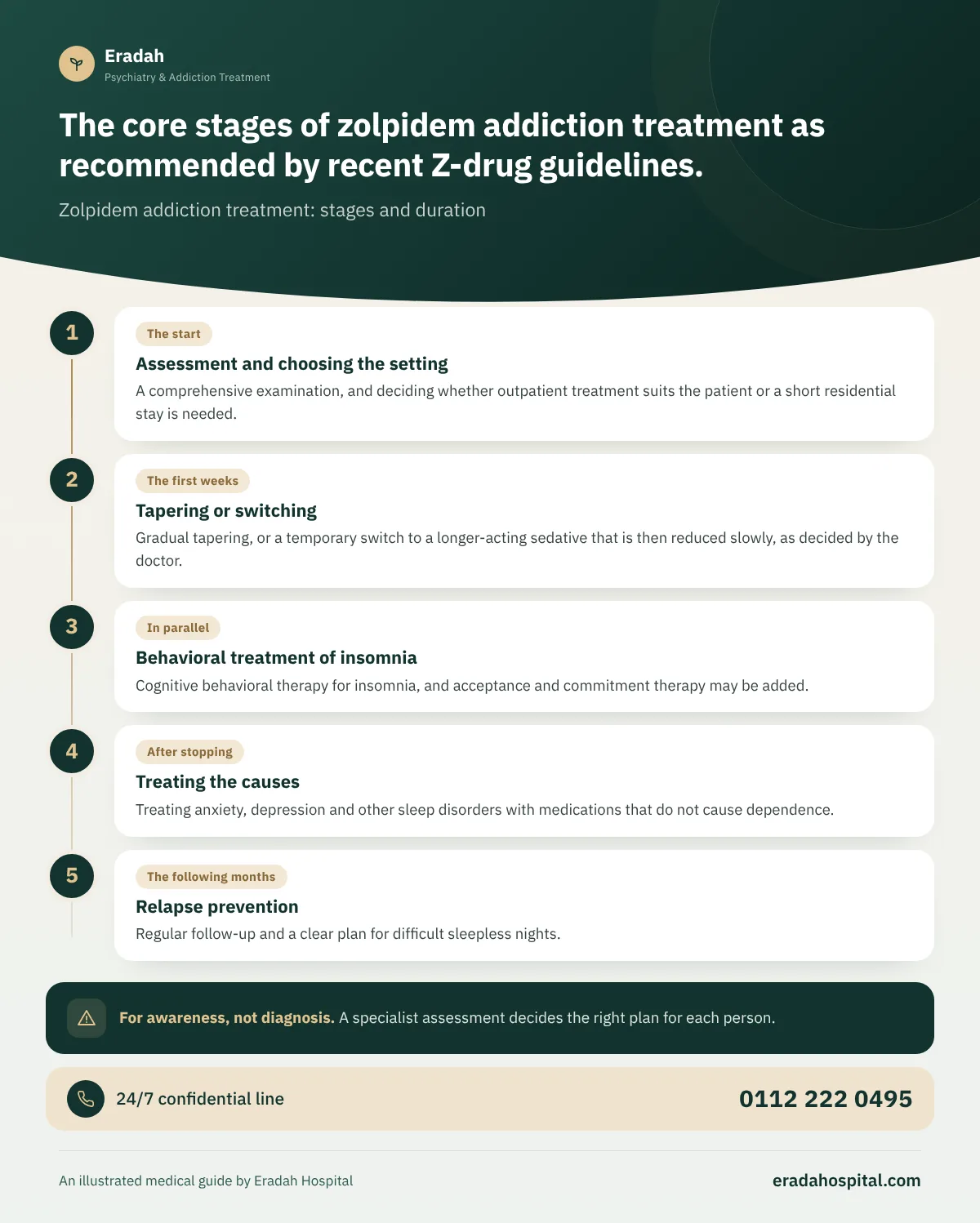
The durations are approximate and vary with the dose, the length of use and any other substances involved.
Gradual tapering or switching to a longer-acting sedative?
Because zolpidem is very short-acting, its blood level drops quickly between doses, which makes direct tapering difficult for people taking high doses. For this reason the Brazilian guidelines recommend that stopping be gradual, and when stopping Z-drugs they suggest using an intermediate- or long-acting benzodiazepine and then tapering it, while not recommending short-acting benzodiazepines or immediate-release melatonin for this purpose.
In a case published in 2024, a woman who had reached very high doses of zolpidem was treated successfully during a 13-day stay by combining a switch to diazepam, treatment of anxiety, and mindfulness-based cognitive therapy, and she remained off the drug at a three-month follow-up. It is a single case that cannot be generalized, but it shows what integrated treatment looks like.
Are there medications that help treat zolpidem addiction?
There is no medication approved specifically for treating zolpidem addiction. But the Brazilian guidelines note that the doctor may optionally, depending on the case, use certain antidepressants with a sedating effect, or other medications to treat accompanying anxiety or insomnia. The choice of any of them and its dose is for the doctor alone after assessment, and there is no "substitute drug" that suits everyone.
Psychological and behavioral therapy
Cognitive behavioral therapy for insomnia is the first-line treatment, because it restores the patient's confidence in their ability to sleep without a tablet. The Brazilian guidelines allow adding acceptance and commitment therapy. Because the evidence that behavioral therapy alone raises the rate of complete discontinuation is still uncertain according to a 2026 systematic review, it is used as part of a plan that combines medical supervision and psychological support, not as a replacement for them. Someone for whom zolpidem was a way to escape anxiety also needs that anxiety treated as part of a dual diagnosis.
Does zolpidem treatment require a residential stay?
| The situation | Most suitable setting |
|---|---|
| A dose close to the prescribed one, with no other substances | Outpatient treatment with regular follow-up |
| Doses far above therapeutic, or daytime use | A short residential stay to start tapering safely |
| A history of seizures or severe withdrawal | Medically supervised detox |
| Mixing with alcohol or opioids | A comprehensive residential program |
How long does zolpidem addiction treatment take?
The duration varies widely: the tapering phase may take weeks for someone using therapeutic doses, and longer for someone who has reached very high doses or uses other substances. Then comes the phase of treating insomnia and anxiety, which lasts months. More important than how fast you reach "zero" is reaching it safely and staying there.
Relapse prevention after zolpidem treatment
- Do not keep any sleeping pill at home "for emergencies."
- Fix your wake-up time every day; it is the strongest regulator of sleep.
- Agree on a written plan with your doctor for sleepless nights.
- Avoid alcohol completely; it ruins sleep and brings relapse closer.
- Keep up treatment for anxiety or depression even after your sleep improves.
You will find details on handling slips in the relapse guide.
Zolpidem addiction treatment at Eradah
At Eradah the journey begins with a free, confidential first consultation with a psychiatrist, in which the real dose, any accompanying substances and the right treatment setting are determined. Mild cases are treated in outpatient clinics, while cases with high doses or mixing are admitted to the psychiatric hospital for men, where tapering takes place under round-the-clock monitoring with a program to treat insomnia and anxiety.