What is zolpidem?
"I took it to sleep, then I found that if I stayed awake after it, I felt a strange sense of pleasure." Doctors hear this remark often, and it sums up the two faces of zolpidem: an effective, fast sleeping pill, and behind that speed an effect that may draw some people to use it for something other than sleep.
Zolpidem is a sleep-inducing substance from the imidazopyridine family. Doctors classify it among the "Z-drugs", together with eszopiclone, found in Night Calm, and zaleplon. One of its best-known brand names is "Stilnox", and in the United States it is known as "Ambien". It is one of the most widely used sleeping pills in the world, which is why most of what we know about the risks of Z-drugs came from experience with it.
Chemically, zolpidem does not belong to the benzodiazepines like Xanax, but it acts on the same receptor. That is why the United States places it in Schedule IV of controlled substances alongside them, and why on our site it falls within the family of sedatives and sleeping pills.
When does a doctor prescribe zolpidem?
Zolpidem is prescribed to treat insomnia for short periods, especially difficulty falling asleep. The MedlinePlus encyclopedia states that sleep should improve within 7 to 10 days of starting, and if it does not, the condition should be reassessed. Recent Brazilian guidelines on Z-drugs recommend that their use not exceed four weeks, to reduce the risk of dependence and withdrawal, though this recommendation is often ignored in practice.
How does zolpidem affect the brain?
The drug label explains that zolpidem binds more to GABA-A receptors containing a subunit called alpha-1. This subunit is mainly responsible for inducing sleep, while other subunits are tied to muscle relaxation and preventing seizures. That explains why zolpidem is a strong sleeping pill but weaker than the benzodiazepines at relaxing muscles. It reaches its peak blood concentration in about an hour and a half, and its half-life is about two and a half hours.
- Fast sleep: this is the reason for its popularity, and it is delayed if taken after a meal.
- Forgetfulness: for what happens between taking the tablet and falling asleep, and it can last longer if the person fights off sleep.
- Altered perception: in people who stay awake after taking it, a feeling of relaxation, euphoria or hallucinations may appear, and this is the gateway to misuse.
- Morning effect: less than with long-acting sleeping pills, but it increases with higher doses and in women and older adults.
Forms and names of zolpidem
MedlinePlus notes that zolpidem is available worldwide as regular tablets, extended-release tablets, tablets that dissolve under the tongue, and an oral spray, and the available forms differ from country to country. Its brand names include Stilnox and Ambien, and there are other names depending on the manufacturer. All forms carry the same warnings, and extended-release forms are more likely to leave an effect in the morning.
Why is zolpidem misused?
- Seeking the feeling of relaxation or "floating" when it is taken without sleeping.
- Raising the dose after its sleep-inducing effect weakens over the weeks.
- Using it in the daytime to calm anxiety or escape stress.
- Mixing it with alcohol or painkillers to strengthen the effect.
- Believing it is "safe" because it is not a benzodiazepine.
In France, zolpidem featured heavily in forged prescriptions, which led the health authorities in 2017 to subject it to part of the dispensing rules for narcotic drugs. According to a study by the French addictovigilance network, forged prescriptions fell sharply after the decision, but the share of problematic cases among reports rose from 43.6% to 59.3%. In other words, people who had actually become dependent did not stop simply because dispensing was tightened.
Zolpidem compared with Night Calm and lorazepam
| Zolpidem | Night Calm (eszopiclone) | Lorazepam | |
|---|---|---|---|
| Family | Z-drug sleeping pills | Z-drug sleeping pills | Benzodiazepine |
| Main use | Short-term insomnia | Insomnia: falling asleep and staying asleep | Anxiety and calming |
| Approximate half-life | About 2.5 hours | About 6 hours | About 12 hours |
| Muscle relaxation and seizure prevention | Weak | Limited | Marked |
| Main official warning | Complex behaviors during sleep | Complex behaviors during sleep | Addiction, withdrawal and danger with opioids |
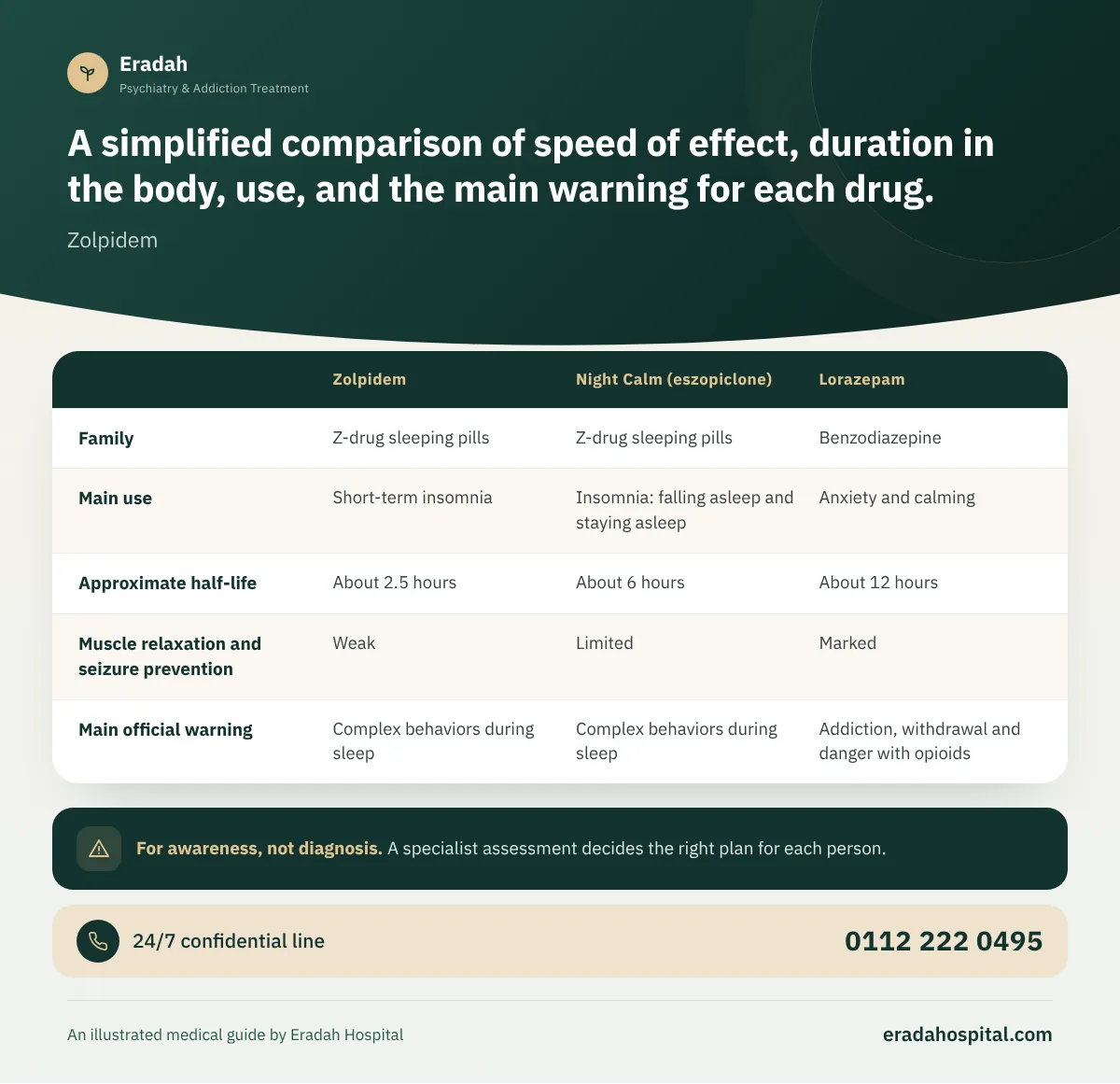
These differences explain why a doctor chooses one drug over another, but they do not make any of them "safe" without a prescription. You will find details on the other two drugs in the guides to Night Calm and lorazepam.
The legal status of zolpidem in Egypt
Zolpidem is a medicine dispensed from pharmacies by prescription only, and trading in or selling it outside the medical framework is a violation. Internationally, its US label classifies it in Schedule IV of controlled substances, and countries such as France tightened its dispensing rules after forged prescriptions spread. Anyone who needs help can contact the Fund for Drug Control and Treatment of Addiction on hotline 16023.
This is general educational information and not legal advice.
Zolpidem in numbers
Sources: RAPS's report of the US Food and Drug Administration 2019, the US label for zolpidem, and a 2023 study by the French addictovigilance network.
The US agency explains zolpidem's predominance in cases of complex behaviors by the fact that it is the most prescribed of the Z-drugs, not necessarily that it is the most dangerous of them.
Zolpidem in brief: harms, symptoms, withdrawal and treatment
Complex behaviors during sleep, forgetfulness and falls, and a clearer morning effect in women and older adults.
Taking it without sleeping or in the daytime, escalating doses, and prescriptions from more than one doctor.
Rebound insomnia, anxiety, nausea and cramps, and seizures after very high doses.
Assessment, then gradual reduction under medical supervision with treatment of any accompanying insomnia and anxiety.
Each topic has a detailed page: harms of zolpidem, signs of zolpidem addiction, zolpidem withdrawal symptoms, zolpidem addiction treatment, and how long zolpidem stays in the body.
Zolpidem guide: everything you need to know
We have gathered everything about zolpidem into 5 pages, each answering one question in detail. Choose what you are looking for:
Harms of zolpidem to the body and mind
Learn about the harms of zolpidem: complex behaviors during sleep and forgetfulness, the morning effect on driving, the risk of falls in older adults, and the danger of mixing it with opioids and alcohol.
Zolpidem addiction symptoms and signs of use
What are the signs of zolpidem or Stilnox addiction? The physical, behavioral and psychological signs, using it without sleeping to chase euphoria, and how a family can tell treatment from addiction.
Zolpidem withdrawal symptoms and how long they last
Zolpidem or Stilnox withdrawal symptoms: when they begin and how long they last, from rebound insomnia and anxiety to seizures after high doses, and why reduction needs medical supervision.
Zolpidem addiction treatment: stages and duration
How is zolpidem or Stilnox addiction treated? Assessment, gradual reduction or switching to a longer-acting sedative, behavioral therapy for insomnia, and when a patient needs a residential stay.
How long zolpidem stays in the body
How long does zolpidem stay in the body? Its half-life, how long it can be detected in urine, blood, saliva and hair, why it does not show on the usual test strips, and what lengthens its stay.
Found that a family member is misusing zolpidem?
- Notice when they take it: if it is in the daytime or without going to sleep, this is a sign of misuse, not treatment.
- Look for traces of the night: food that has been eaten, an open door, or messages they do not remember sending.
- Keep car keys away at night if they take it, as driving while asleep is documented.
- Talk to them calmly in the daytime, and ask for an assessment by a psychiatrist rather than suddenly taking the medicine away.
- If they mix it with an opioid painkiller or alcohol, learn the emergency signs and keep the ambulance number 123.
Danger signs after taking zolpidem: call an ambulance (123) immediately
- Deep drowsiness or a coma the person cannot be roused from.
- Slow or irregular breathing, or blue lips and limbs.
- Low blood pressure or a weak or irregular pulse.
- Taking it with an opioid painkiller, alcohol, or another sedative.
- A seizure or severe confusion after suddenly stopping high doses.
Call ambulance (123) immediately and do not wait for them to “sleep it off.” If the person is unconscious but breathing, place them on their side in the recovery position, stay with them and watch their breathing until the paramedics arrive, and do not give them any sedative, stimulant or food. Tell the paramedics what they took, the approximate amount and the time, bring the medicine box if you find it, and tell them if the person also drank alcohol or took an opioid painkiller.
Call the ambulance 123