Is there a single cause of autism?
The first question parents often ask after a diagnosis is: “Did we do something wrong?” The scientific answer is clear and reassuring: autism is not caused by a parenting mistake or by any one moment, but by many genetic factors interacting with factors during pregnancy and birth that affect how the brain develops.
The World Health Organization says the available evidence points to many factors, environmental and genetic, that make autism more likely, and that its exact causes have not yet been determined. The MSD Manual adds that the specific cause remains unknown in most cases, despite strong evidence for a genetic role.
Is autism hereditary?
Yes, genetics is the strongest known factor. In a study published in JAMA Psychiatry in 2019 of more than two million people in 5 countries, heritability was estimated at about 80%. That means most of the difference in the likelihood of autism between people is explained by genetic factors, not that 80% of children inherited it directly from a parent.
There is also no single “autism gene.” According to Cleveland Clinic, changes in many genes are linked to it, which may be inherited from the parents or appear for the first time in the child without either parent carrying them. This is why an autistic child can be born into a family with no similar case known.
The last two figures differ because population studies rely on medical records, while the infant siblings study, published in Pediatrics in 2024, followed children closely until age 3 and so found more cases. The chance was higher in boys, in those with more than one autistic sibling, and in those with an autistic sister. The bottom line is that younger siblings need close monitoring of their development and early assessment at any concern.
Known genetic and medical conditions linked to autism
In some children, autism appears as part of a specific medical or genetic condition. The MSD Manual lists among them fragile X syndrome, tuberous sclerosis, phenylketonuria, congenital rubella, which affects the fetus if the mother is infected during pregnancy, and cytomegalovirus infection. This is why the doctor may order genetic and metabolic tests after diagnosis; they do not diagnose autism, but they may reveal a treatable cause or one that matters for planning a future pregnancy.
Factors during pregnancy and birth
The World Health Organization lists factors that have been found more often in autistic children or their parents:
Having children at an older age, for the father or the mother, is linked to a higher likelihood.
Diabetes in the mother during pregnancy is one of the factors linked to autism.
The likelihood rises the earlier the birth, along with lower birth weight.
Such as oxygen deprivation to the fetus during pregnancy or birth.
Exposure to valproate and carbamazepine during pregnancy is linked to autism.
Exposure to them during pregnancy is among the factors observed in studies.
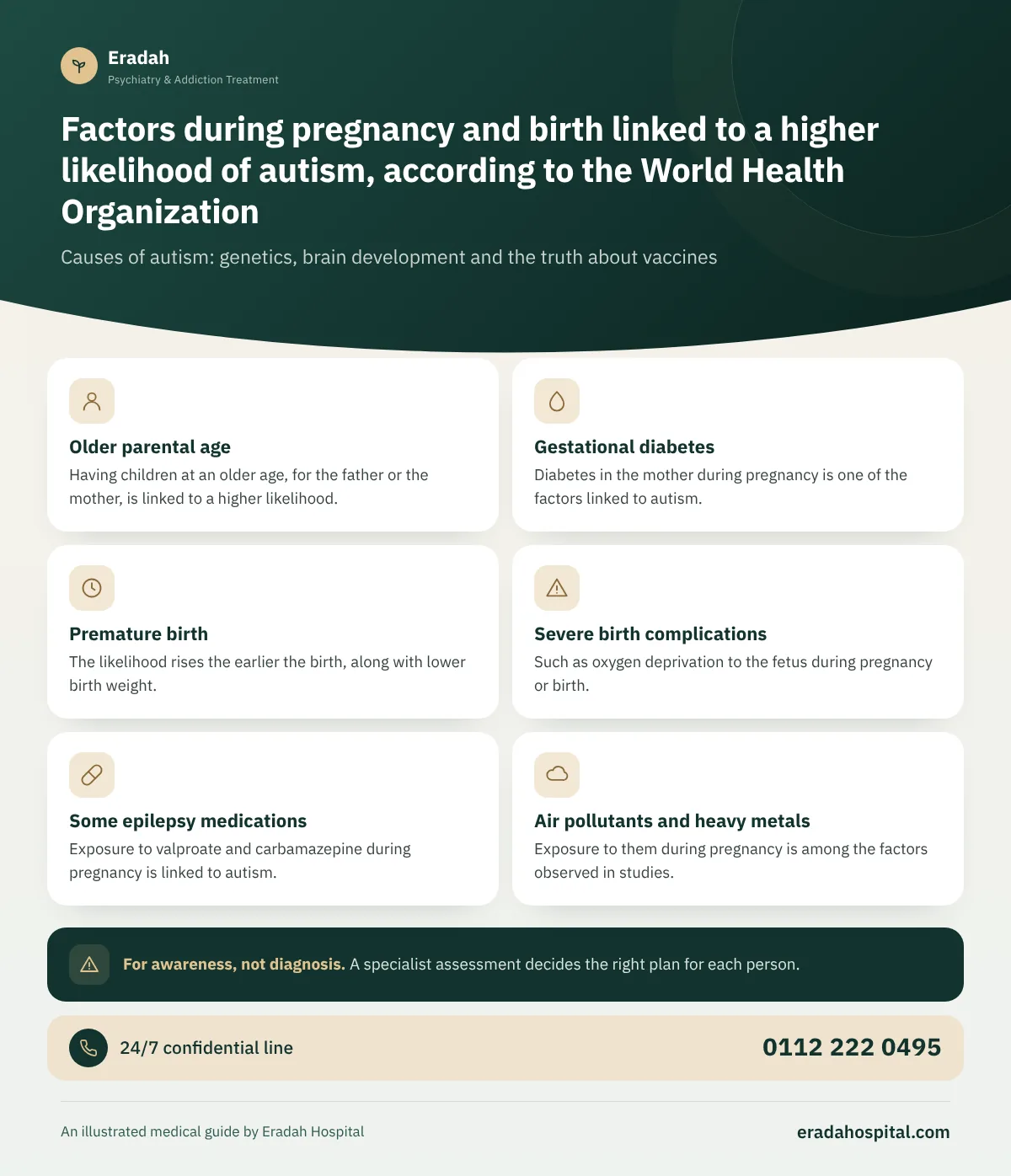
These factors are statistical associations that raise the likelihood slightly and do not mean it is inevitable, and the World Health Organization stresses that understanding the role of each one and how it interacts with genetics needs more research.
What happens in the brain of an autistic child?
The MSD Manual holds that differences in brain structure and function most likely underlie most cases of autism, and differences have been observed in the cerebellum, amygdala, hippocampus, frontal cortex and brainstem nuclei. This difference is not “damage” that happened after birth; it is a different way of developing the networks responsible for communication, sensory processing and flexibility, beginning in the early stages of development.
Do vaccines cause autism?
No. The World Health Organization confirms that extensive research using different methods over many years has shown that the measles, mumps and rubella vaccine does not cause autism, and that the study that was interpreted as linking them was proven wrong and manipulated, so the journal retracted it and its author lost his medical license. It adds that other vaccines, and ingredients such as thimerosal and aluminum, do not raise the risk of autism.
Among the largest pieces of evidence is a Danish study published in Annals of Internal Medicine in 2019 that followed 657,461 children and found no increase in autism risk after vaccination, even in children with an autistic sibling or other risk factors. The signs sometimes coincide with vaccination time because both happen at the same age, not because one causes the other.
Does paracetamol in pregnancy cause autism?
This question was raised widely in 2025. In a statement issued on September 24, 2025, the World Health Organization affirmed that there is no conclusive scientific evidence linking the use of paracetamol (acetaminophen) during pregnancy to autism, and that extensive research over the past decade has not shown a consistent association. The organization advises pregnant women to follow their doctors' guidance and to use any medication with caution, especially in the first trimester.
Common causes that science does not support
- A cold mother or lack of affection: an old theory proven wrong, and the NHS affirms that autism is something a person is born with.
- Screens and mobile phones: there is no evidence they cause autism itself, but excessive use in the early years reduces speech and interaction, and this may be confused with autism, so the child needs an assessment, not guesswork.
- Food, gluten and milk: they do not cause autism, and diets free of them have not been shown to help treat it, according to the MSD Manual.
- The evil eye or possession: explanations that delay assessment and support during the most valuable years of a child's life.
Can autism be prevented?
There is no proven way to prevent autism, because most of its causes are genetic. But good prenatal care, keeping diabetes under control, reviewing medications with the doctor before pregnancy, and regular follow-up of the birth all protect the health of mother and child in general. More important than prevention is early detection, especially for the siblings of an autistic child. See the signs on the autism symptoms page, and the assessment steps on the autism diagnosis page.
A seizure, severe self-harm, or suicidal thoughts? Get help now
- A seizure that happens for the first time, lasts more than 5 minutes, or after which the person does not recover as usual
- Head-banging, biting, or severe self-harm to the point of injury or bleeding, with no way to calm them
- The child leaving home or getting lost without understanding the danger of roads or water
- An adolescent or adult talking about death or suicide, or about being a “burden” on their family
- A sudden, rapid decline in speech, walking, or awareness, or complete refusal to eat and drink
Stay calm, move dangerous objects and medications away from them, do not restrain them by force except to prevent clear injury, and reduce light and noise as much as you can. During a seizure, lay them on their side away from hard edges and do not put anything in their mouth. Call the ambulance on 123 or go to the nearest emergency department. If an adolescent or adult talks about suicide, do not leave them alone, ask them calmly and listen to them, and call the mental health support line 16328 (24 hours).
Ambulance 123 Mental health support line 16328