Who diagnoses autism?
Diagnosing autism is the work of a team more than the verdict of one doctor in one visit. The CDC notes that the specialist assessment may be done by a developmental pediatrician, a child psychologist, a speech-language pathologist, an occupational therapist, or a group of them.
The American Psychiatric Association adds the child neurologist and the child and adolescent psychiatrist. In Egypt the path often starts with the pediatrician, then child development clinics or child psychiatry at university and private hospitals. What matters is that the specialist has real experience with autism and does not rely only on a quick look or a questionnaire.
When can autism be diagnosed?
According to the CDC, autism can sometimes be detected at 18 months or younger, and at age 2 an experienced specialist's diagnosis can be reliable. Even so, many people are not diagnosed until adolescence or adulthood, and miss out on early support. The American Academy of Pediatrics recommends an autism-specific screening at the 18- and 24-month visits, alongside ongoing developmental monitoring at every visit.
The M-CHAT autism test: what is it and how is it used?
The best-known screening tool for toddlers is the M-CHAT-R/F, the “Modified Checklist for Autism in Toddlers, Revised with Follow-Up.” It is a questionnaire that parents fill out, with 20 yes-or-no questions about everyday behaviors such as pointing, eye contact and play; it takes less than 5 minutes and is designed for children aged 16 to 30 months. If needed, it is followed by a second part, a follow-up interview conducted by a specialist to clarify the answers.
| Level | Likelihood level | The next step |
|---|---|---|
| 0–2 | Low | No further assessment needed unless there are other risk factors or ongoing concern |
| 3–7 | Moderate | Conduct the follow-up interview to decide whether a referral is needed |
| 8–20 | High | Immediate referral for diagnostic evaluation and early intervention |
In the validation study of more than 16,000 children, 47.5% of those whose results stayed positive after follow-up were diagnosed with autism, and 94.6% of them had a developmental delay or a concern worth attention. This means a positive result almost always signals that the child needs assessment and support, even if the child is not autistic. For older children, the Social Communication Questionnaire (SCQ) is used, as the MSD Manual notes.
Steps in the diagnostic assessment of a child
- Step oneInterview and developmental history
Questions about pregnancy and birth, when the child started talking and walking, and what the family notices at home.
- Step twoObservation and structured play
The specialist observes the child's communication, play and interaction, and may use a structured tool such as ADOS-2.
- Step threeMedical and hearing exam
A physical exam and a hearing test to rule out hearing loss as a cause of delayed speech, and lab tests when needed.
- Step 4Language and ability assessment
An assessment of speech and language, and of cognitive and motor abilities, and gathering reports from nursery or school.
- Step 5Report and support plan
A report explaining the diagnosis, strengths, needs and co-occurring conditions, and the support that follows.
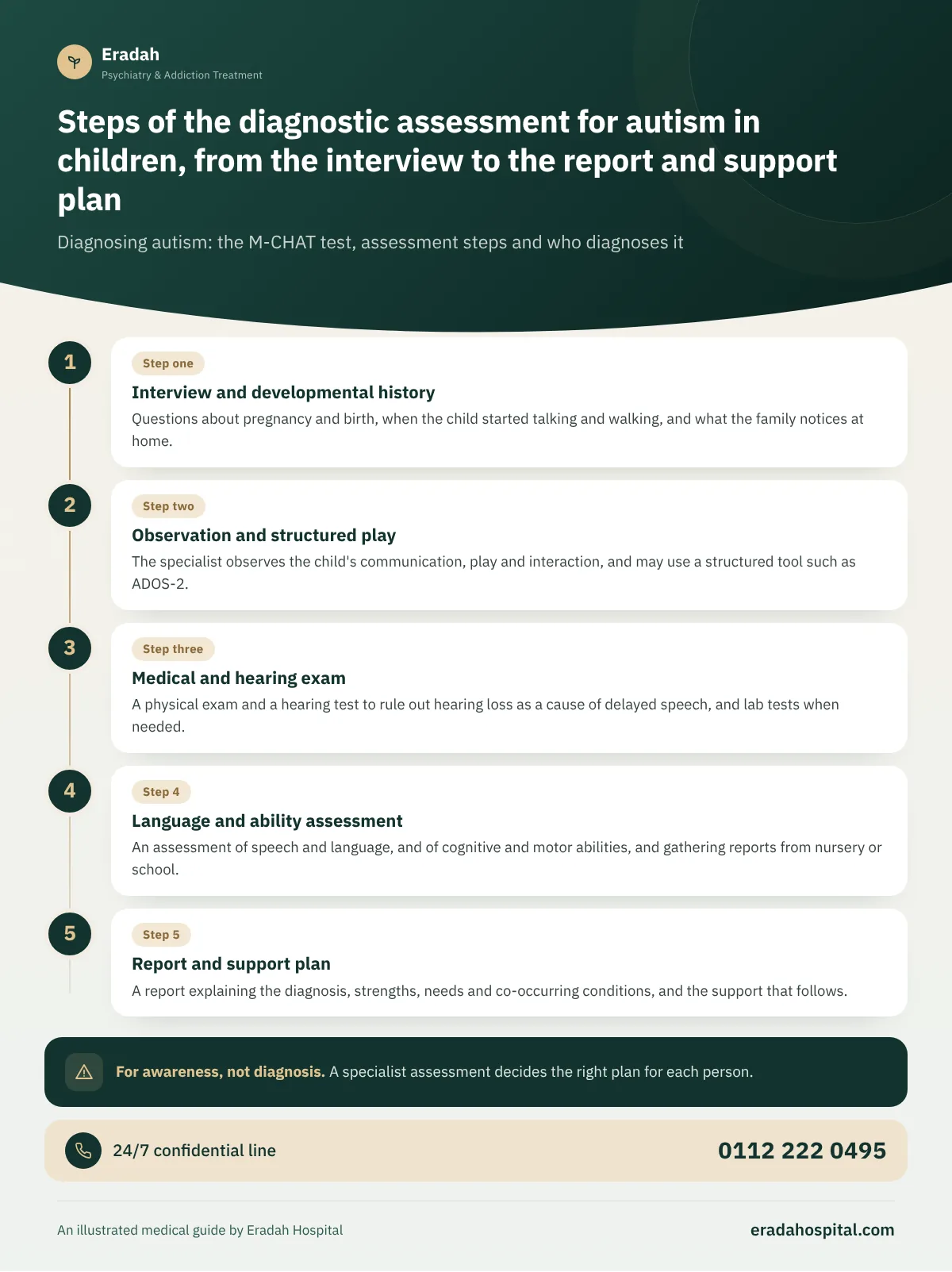
These steps summarize what the NHS and CDC describe, and they may take place in one long visit or several visits. A member of the team may also visit the school to observe the child in class and at break times.
Diagnostic tools and accepted criteria
- DSM-5-TR criteria: difficulties in the three social areas, and at least two repetitive or sensory behaviors, present since early childhood, to a degree that disrupts life.
- The ADOS-2: a structured observation session in which the specialist interacts with the child or adult through specific activities and questions, usually conducted by psychologists or developmental doctors.
- The CARS-2: a rating scale for the severity of autistic traits, with a version for those whose language and cognitive abilities are higher.
- Intelligence and ability tests: they help in understanding strengths and weaknesses and in planning education, and a child's performance on practical tasks may be better than on verbal ones.
Is there a lab test or scan to diagnose autism?
No. Cleveland Clinic affirms that there are no blood or urine tests or biomarkers that diagnose autism. However, the MSD Manual recommends genetic and metabolic tests after diagnosis to look for treatable or inherited conditions such as fragile X syndrome. These tests look for a cause; they neither prove nor rule out autism. An EEG may be requested if episodes resembling seizures appear.
Conditions that must be ruled out or found alongside it
| The situation | What they have in common | What helps tell them apart |
|---|---|---|
| Hearing loss | Delayed speech and not responding to their name | A hearing test; communication through eye contact and gesture is often normal |
| Language delay | Few words | The child compensates with gestures and eye contact and plays with others |
| Intellectual disability | Delay in many skills | Social communication matches the child's overall developmental level |
| Attention-deficit/hyperactivity disorder | Difficulty paying attention to others, and impulsivity | No core difficulty understanding nonverbal communication, though the two can coexist |
Diagnosing autism in adults
The NIMH says diagnosing adults is often harder, because some autistic traits overlap with anxiety or ADHD, and it can be done by a psychiatrist, psychologist or neuropsychologist with experience in autism. The NHS describes what it may include: self-report questionnaires, questions about childhood, work and relationships, talking with someone who knew you as a child and someone who knows you now, and reviewing old school reports. A diagnosis later in life helps many people make sense of years of unexplained difficulties.
Online autism tests: are they enough?
- They are screening tools, not diagnosis: they point to a possibility that needs assessment, they do not measure onset in childhood, and they do not rule out similar conditions.
- They may reassure you wrongly: so you postpone an assessment your child needs during the most valuable years for intervention.
- They may also frighten you needlessly: since many behaviors in young children are temporary or have other causes.
- The right alternative: write down your observations and record short videos of the child's behavior, and show them to the specialist.
After diagnosis, the most important stage begins. Learn about the options on the autism treatment page, and about the signs in detail on the autism symptoms page.
A seizure, severe self-harm, or suicidal thoughts? Get help now
- A seizure that happens for the first time, lasts more than 5 minutes, or after which the person does not recover as usual
- Head-banging, biting, or severe self-harm to the point of injury or bleeding, with no way to calm them
- The child leaving home or getting lost without understanding the danger of roads or water
- An adolescent or adult talking about death or suicide, or about being a “burden” on their family
- A sudden, rapid decline in speech, walking, or awareness, or complete refusal to eat and drink
Stay calm, move dangerous objects and medications away from them, do not restrain them by force except to prevent clear injury, and reduce light and noise as much as you can. During a seizure, lay them on their side away from hard edges and do not put anything in their mouth. Call the ambulance on 123 or go to the nearest emergency department. If an adolescent or adult talks about suicide, do not leave them alone, ask them calmly and listen to them, and call the mental health support line 16328 (24 hours).
Ambulance 123 Mental health support line 16328