Where do you start in dealing with an autistic child?
“I've started being afraid to go out with him. Every time he screams in the supermarket and people stare at me as if I don't know how to raise a child.” Mothers of autistic children say this often. Start by understanding what your child is trying to say through their behavior, before you think about “correcting” it.
The NHS explains that autistic children behave in ways that help them manage and respond to the world around them, and advises not trying to change their behavior unless it is harmful to them or to others, and making their surroundings as comfortable as possible. So instead of asking “How do I stop this behavior?”, ask: “What does my child need right now? Are they tired, scared, in pain, or overwhelmed by sounds?”
How do you communicate with your autistic child?
- Short, clear sentences: “Put on your shoes” is clearer than “Come on, we're going to be late and won't make it.”
- Give them more time to respond: they may need time to process what they heard, and repeating the question quickly confuses them.
- Use pictures and signs: such as picture cards, the Picture Exchange Communication System (PECS) and social stories.
- Avoid sarcasm and figurative expressions: many autistic people take words literally.
- Build on their interests: the trains or numbers they love are a good way into conversation and shared play.
These methods are described in the guidance of the UK's National Autistic Society, and a speech therapist can help you choose the most suitable ones for your child's age and level.
Routine and the visual schedule: an autistic child's sense of safety
A predictable routine and clear structure are very important for autistic people, and any sudden change can cause intense distress. The NHS advises keeping familiar routines, telling the child about a change as early as possible, and teaching them to adapt to change gradually in a safe, familiar place.
- Hang up a picture schedule for the day: waking up, eating, school, play, bath, sleep.
- Use a countdown timer before moving from an activity they love to another.
- If something changes, explain it with a picture and reassure them that the rest of the day is the same.
- Prepare them for new situations such as a doctor's visit with pictures or a short story a few days beforehand.
- Let a favorite toy or object go with them during transitions.
A home that is comfortable for the senses
Much of a child's daily stress is sensory. The National Autistic Society suggests creating a “low-arousal” environment, such as dimming bright lights, and using noise-reducing headphones, tinted glasses or a weighted blanket for those who find them comforting. It helps to have a quiet corner at home to retreat to when overwhelmed, to choose clothes without scratchy labels, and to visit crowded places at quieter times.
Meltdowns: not a tantrum and not spoiling
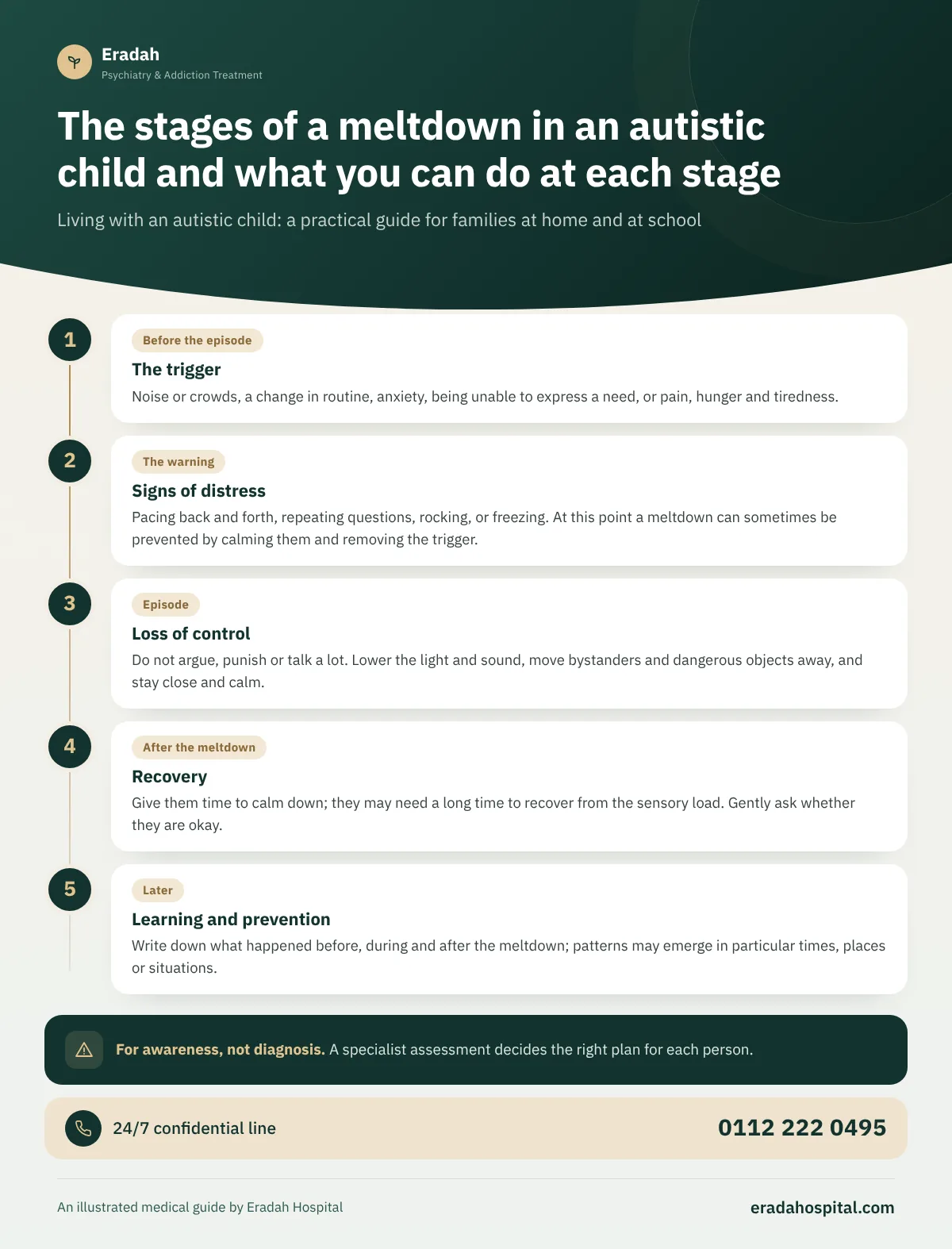
The National Autistic Society defines a meltdown as an intense response to an overwhelming situation, in which the person temporarily loses control of their behavior, through screaming, crying, kicking or biting. It stresses that it is not a tantrum to get something, and not deliberate bad behavior. Understanding its stages helps you step in at the right time:
- Before the episodeThe trigger
Noise or crowds, a change in routine, anxiety, being unable to express a need, or pain, hunger and tiredness.
- The warningSigns of distress
Pacing back and forth, repeating questions, rocking, or freezing. At this point a meltdown can sometimes be prevented by calming them and removing the trigger.
- EpisodeLoss of control
Do not argue, punish or talk a lot. Lower the light and sound, move bystanders and dangerous objects away, and stay close and calm.
- After the meltdownRecovery
Give them time to calm down; they may need a long time to recover from the sensory load. Gently ask whether they are okay.
- LaterLearning and prevention
Write down what happened before, during and after the meltdown; patterns may emerge in particular times, places or situations.
Encouragement instead of punishment
Physical punishment or shouting does not teach an autistic child what is wanted; it only increases their anxiety and meltdowns. It is more helpful to praise the behavior you want right when it happens, using what they like, not what you assume is a reward, and to teach them an alternative way to express their need, such as an “I need a break” card. The American Psychiatric Association notes that parent training teaches parents effective ways to respond to difficult behavior and encourage appropriate behavior. And if a child's behavior suddenly changes, remember that pain, constipation or lack of sleep may be the cause, as NICE guidelines point out.
Sleep, eating and personal hygiene
- Sleep: set times, calm bedtime rituals and a dark, quiet room. NICE recommends a behavioral sleep plan before considering any medication.
- Picky eating: offer new food next to familiar food in small amounts and without pressure, and consult the doctor if weight is affected.
- Bathing and teeth: break the task into picture steps, and take account of their sensitivity to water temperature and the feel of the toothbrush.
- Doctor and dentist visits: prepare them in advance, and ask for an appointment at a quiet time.
School and inclusion
The NHS says many autistic children can attend mainstream schools with the right support, while some need a specialist school. Tell the school what your child needs, such as a quiet place to retreat to, extra time for some activities, and help communicating with teachers and classmates, and watch break times and transport, which are often the hardest. Remember that their behavior at school may differ from home, and that they may need time to calm down after they return.
Siblings and parents: who takes care of you?
The American Psychiatric Association says that having an autistic child affects the whole family, and that looking after the physical and mental health of every family member is important. Explain to their siblings in simple language why their brother or sister behaves this way, set aside special time for them, and do not make them responsible for the child. Share the care with your partner and relatives, and look for support groups for other families.
If you feel constant exhaustion, sadness that does not go away, insomnia or quick irritability, these may be signs of chronic stress, burnout or depression that deserves treatment. Asking for help does not mean you are failing your child; it is what lets you keep going with them. If the autistic person in your family is an adult, the same principles apply: clear speech, respect for their routine and sensory needs, and talking with them, not about them.
A seizure, severe self-harm, or suicidal thoughts? Get help now
- A seizure that happens for the first time, lasts more than 5 minutes, or after which the person does not recover as usual
- Head-banging, biting, or severe self-harm to the point of injury or bleeding, with no way to calm them
- The child leaving home or getting lost without understanding the danger of roads or water
- An adolescent or adult talking about death or suicide, or about being a “burden” on their family
- A sudden, rapid decline in speech, walking, or awareness, or complete refusal to eat and drink
Stay calm, move dangerous objects and medications away from them, do not restrain them by force except to prevent clear injury, and reduce light and noise as much as you can. During a seizure, lay them on their side away from hard edges and do not put anything in their mouth. Call the ambulance on 123 or go to the nearest emergency department. If an adolescent or adult talks about suicide, do not leave them alone, ask them calmly and listen to them, and call the mental health support line 16328 (24 hours).
Ambulance 123 Mental health support line 16328