Does OCD have a specific cause?
Science treats OCD as a “multifactorial” condition: genes that give susceptibility, a brain whose alarm system works differently, experiences and stress that trigger symptoms at a particular time, and then patterns of thinking and behavior that maintain them.
This explains why one person develops it and their brother does not, and why OCD sometimes appears after a major event such as marriage, childbirth or a relative's death, without that event being the only “cause.”
Is OCD hereditary?
Genetics plays a clear role. OCD is more common among first-degree relatives of patients, and twin studies estimate that genetic factors explain about 48% of susceptibility, falling to about 35% when factors related to the mother during pregnancy are taken into account.
The genetic influence appears stronger in cases that begin in childhood. But no single gene is responsible; many genes each have a small effect, so having an affected relative raises the likelihood but does not mean you will inevitably develop it.
What role do brain circuits and serotonin play in OCD?
A circuit linking the front of the brain with the basal ganglia and the thalamus. It shows overactivity in patients, which keeps the “error signal” switched on.
It helps regulate this circuit, and the improvement of symptoms with SSRI medications supports its role.
A stimulating neurotransmitter whose activity recent research suggests is disrupted in OCD circuits.
It is linked to conditions that co-occur with tics, and to reinforcing rituals as a rewarding behavior.
These differences do not mean brain damage, but a different way of working in the circuits of checking and completion, and imaging studies show they improve with successful treatment.
Can infection cause OCD in children?
In a small proportion of children, OCD appears suddenly and severely after a bacterial infection, most famously strep throat. These cases are known as PANDAS, within a wider group called PANS. The immune system, while fighting the infection, is thought to mistakenly affect areas of the brain linked to movement and behavior.
These cases are marked by an abrupt onset within days, with other symptoms such as mood swings, separation anxiety and worsening handwriting. They are still the subject of research and scientific debate, and diagnosing them needs a pediatrician and a child psychiatrist together.
What thinking patterns feed OCD?
Everyone has strange, disturbing thoughts at times, but the difference lies in how they are interpreted. Researchers believe that certain beliefs turn a passing thought into an obsession:
| The belief | What it looks like | Effect |
|---|---|---|
| Excessive responsibility | “If any harm happens and I could have prevented it, then it's my fault.” | Endless checking and precaution |
| Confusing thought with action | “Just thinking that makes me as bad as doing it,” or “makes it happen.” | Guilt and dread about the thoughts themselves |
| Intolerance of uncertainty | “I have to be 100% sure.” | A constant search for impossible certainty |
| Perfectionism | “If it's not exactly right, it's wrong.” | Repeating and redoing until it feels complete |
| Overestimating danger | “Any little contamination could cause a serious illness.” | Excessive washing and avoidance |
| The importance of controlling thoughts | “I have to control my thoughts or else I'm a bad person.” | A struggle with thoughts that makes them stronger |
Why does OCD continue and get stronger over time?
OCD continues because rituals “work” in the short term: each time the patient washes their hands or checks the door, their anxiety drops, so the brain learns that this action is necessary for safety. With repetition they need longer and more exact rituals to get the same relief, and the range of situations that trigger OCD widens.
The same applies to avoidance, seeking reassurance and trying to push thoughts away by force; the more a person tries not to think about something, the more present it becomes in their mind.
What role do stress and life events play in the onset of OCD?
Many patients notice that symptoms began or got worse after a stressful period. The UK National Health Service lists factors linked to its onset: bullying or abuse, major life changes such as childbirth, the loss of a loved one or moving, along with personality traits such as extreme meticulousness, anxiety and a heightened sense of responsibility.
- Pregnancy and after childbirth: a period known for OCD appearing or worsening in some women.
- New responsibilities: such as marriage, a first job or caring for a sick relative.
- Loss and trauma: such as the death of a relative or a serious illness in the family.
- Epidemics and intensive hygiene campaigns: these may increase contamination obsessions in people who are predisposed.
Is a religious or cultural environment a cause of OCD?
Religion and culture do not cause OCD, but they shape its “theme.” OCD usually attacks what is precious and important to a person: the anxious mother is attacked by the fear of harming her child, and the religious person is attacked by doubt about the validity of their worship. Studies by the Egyptian psychiatrist Ahmed Okasha found that religion and cleanliness were among the most common themes of obsessions in Egyptian patients, reflecting the importance of purity and worship in our culture.
This means that treating religious OCD does not require giving up religion, but freeing worship from the grip of OCD.
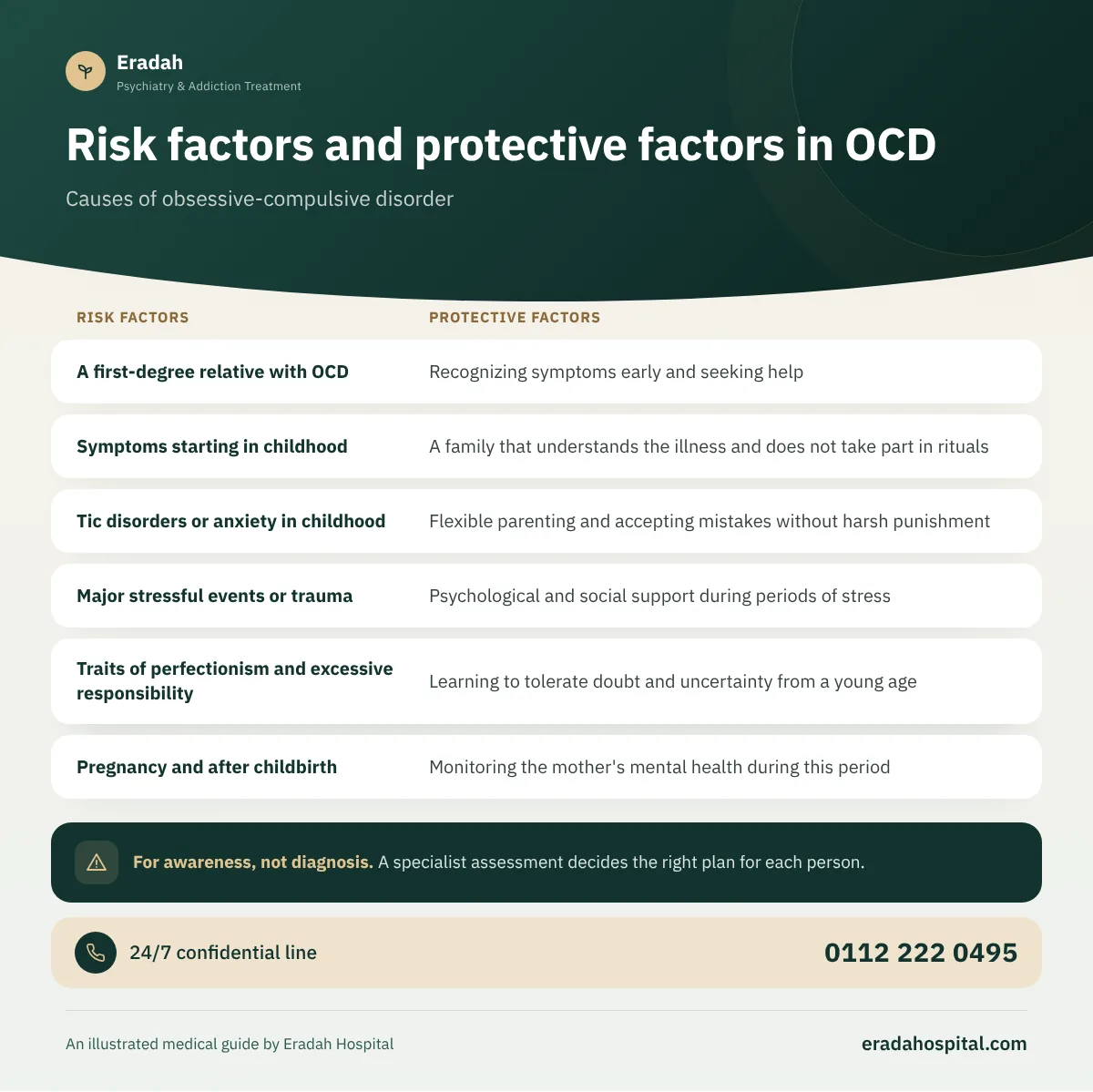
What are the risk factors and protective factors?
| Risk factors | Protective factors |
|---|---|
| A first-degree relative with OCD | Recognizing symptoms early and seeking help |
| Symptoms starting in childhood | A family that understands the illness and does not take part in rituals |
| Tic disorders or anxiety in childhood | Flexible parenting and accepting mistakes without harsh punishment |
| Major stressful events or trauma | Psychological and social support during periods of stress |
| Traits of perfectionism and excessive responsibility | Learning to tolerate doubt and uncertainty from a young age |
| Pregnancy and after childbirth | Monitoring the mother's mental health during this period |
Myths about the causes of OCD
- “OCD is caused by weak faith”: OCD is a brain and mental disorder that affects both religious and non-religious people, and many people with religious OCD are extremely careful about their faith.
- “It's caused by being spoiled or pampered”: Parenting alone does not cause OCD, and children develop it in completely different families.
- “It's caused by having nothing to do”: Being busy may ease attention to the thoughts for a while, but it does not treat the cycle, and many patients are very busy.
- “It's just a habit they can quit”: Rituals are a response to intense anxiety tied to brain circuits, and the patient does not enjoy them the way one enjoys a habit.