Does autism have types?
Many families ask after the diagnosis: “So which type does my son have?” The modern answer is that autism has become a single broad diagnosis, but within this spectrum there are large differences in speech, abilities and the amount of support needed, which the doctor describes precisely instead of placing the child in a box called a “type.”
Cleveland Clinic explains that doctors used different names in the past for conditions with autistic features, then stopped using them because autism is a spectrum and each person needs a description of their own traits and needs. The DSM-5 diagnostic manual, as the CDC presents it, states that someone previously diagnosed with one of these labels is now given the diagnosis of autism spectrum disorder.
The old labels: what did they mean?
| The old name | What it roughly described | The day |
|---|---|---|
| Autistic disorder (classic autism) | Clear difficulties in communication with repetitive behaviors and often a language delay | Autism spectrum disorder |
| Asperger syndrome | Social difficulties and narrow interests without a clear delay in language or cognitive abilities | Autism spectrum disorder |
| Pervasive developmental disorder, not otherwise specified | Autistic features that did not meet the criteria of the other types | Autism spectrum disorder |
| Childhood disintegrative disorder | Normal development for a period, then loss of acquired skills, usually after age 3 | Autism spectrum disorder |
This old division was not accurate in practice; the same child might be diagnosed with two different types by two doctors, which is why unifying the diagnosis was fairer and more useful.
Degrees of autism: the three levels
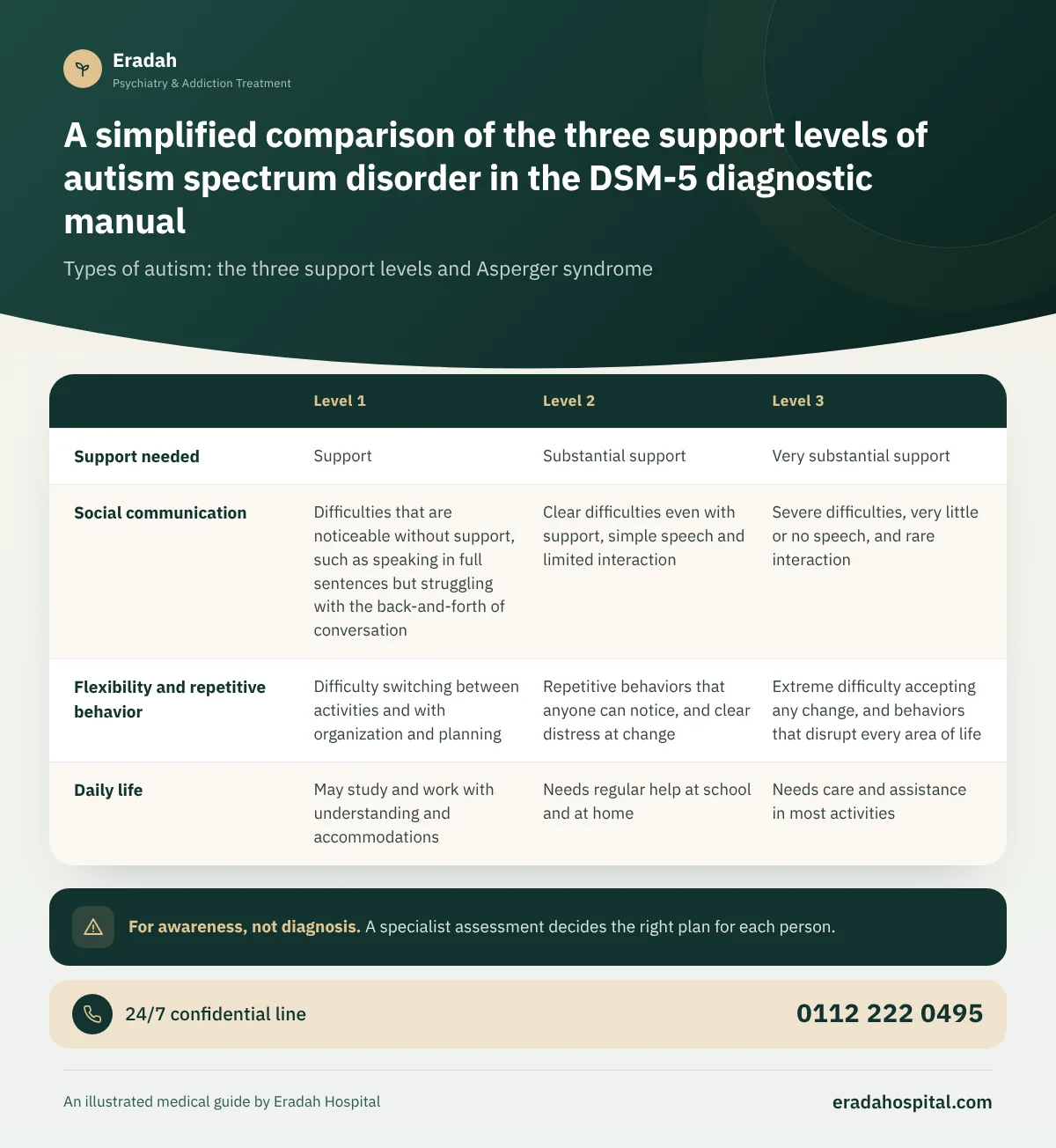
The DSM-5 diagnostic manual defines three levels of severity, rated separately for social communication and for repetitive behaviors: level 1 “requires support,” level 2 “requires substantial support,” and level 3 “requires very substantial support.” Here is a simplified picture of what each level describes:
| Level 1 | Level 2 | Level 3 | |
|---|---|---|---|
| Support needed | Support | Substantial support | Very substantial support |
| Social communication | Difficulties that are noticeable without support, such as speaking in full sentences but struggling with the back-and-forth of conversation | Clear difficulties even with support, simple speech and limited interaction | Severe difficulties, very little or no speech, and rare interaction |
| Flexibility and repetitive behavior | Difficulty switching between activities and with organization and planning | Repetitive behaviors that anyone can notice, and clear distress at change | Extreme difficulty accepting any change, and behaviors that disrupt every area of life |
| Daily life | May study and work with understanding and accommodations | Needs regular help at school and at home | Needs care and assistance in most activities |
What does the doctor add to the diagnosis?
Along with the level, the doctor specifies under DSM-5 whether the autism is accompanied by an intellectual impairment or not, and accompanied by a language impairment or not, and whether it is associated with a known medical or genetic condition, or with another developmental or psychiatric disorder such as ADHD, or accompanied by catatonia.
The International Classification of Diseases ICD-11, issued by the World Health Organization, places autism under code 6A02 and divides it by two things: the presence or absence of a disorder of intellectual development, and the degree of functional language, meaning the person's ability to use language to meet their needs: intact or mildly impaired, impaired, or absent.
Asperger syndrome: does it still exist?
Asperger syndrome is no longer diagnosed separately and has become part of autism spectrum disorder. But many people diagnosed with it in the past still use the name to describe themselves, and that is their right. The picture once called Asperger's often corresponds to a person without a delay in language or cognitive abilities, but with real difficulty understanding unwritten social rules, along with deep specific interests and sensitivity to change.
What is meant by mild or “high-functioning” autism?
People use the phrase “mild” or “simple” autism to describe someone who speaks well and attends a mainstream school, which roughly corresponds to level 1. But the word “mild” can be deceptive; many of these people put enormous effort into hiding their difficulties, and the NHS notes that this masking makes daily life exhausting, and that difficulties at work and in relationships, anxiety and depression are common in autistic adults. A “normal” appearance does not mean no need for support.
Virtual autism and false autism: are they real types?
The term “virtual autism” is widespread in Egypt and the Arab world to describe a child whose speech and interaction are delayed along with excessive screen use. This term is not a diagnosis in the DSM-5 diagnostic manual or in the international classification ICD-11. It is true that little human interaction can delay speech, and some of these children may improve with fewer screens and more play and talking with them, but some are truly autistic and need early support that should not be postponed. The deciding factor is a specialist assessment, not a label that reassures or frightens parents. Read the assessment steps on the autism diagnosis page.
Rett syndrome and other conditions that can be confused with autism
Rett syndrome is a genetic neurological condition affecting almost only girls, most often due to a mutation in the MECP2 gene, in which a child has seemingly normal development from 6 to 18 months and then loses speech and purposeful use of the hands, and repetitive “hand-wringing” movements appear, as the US National Library of Medicine describes. Some of its features may resemble autism at first, but it is a different condition with its own follow-up. Autism is also confused with intellectual disability, hearing loss and language disorders, which is why telling them apart is a task for the specialist team.
A seizure, severe self-harm, or suicidal thoughts? Get help now
- A seizure that happens for the first time, lasts more than 5 minutes, or after which the person does not recover as usual
- Head-banging, biting, or severe self-harm to the point of injury or bleeding, with no way to calm them
- The child leaving home or getting lost without understanding the danger of roads or water
- An adolescent or adult talking about death or suicide, or about being a “burden” on their family
- A sudden, rapid decline in speech, walking, or awareness, or complete refusal to eat and drink
Stay calm, move dangerous objects and medications away from them, do not restrain them by force except to prevent clear injury, and reduce light and noise as much as you can. During a seizure, lay them on their side away from hard edges and do not put anything in their mouth. Call the ambulance on 123 or go to the nearest emergency department. If an adolescent or adult talks about suicide, do not leave them alone, ask them calmly and listen to them, and call the mental health support line 16328 (24 hours).
Ambulance 123 Mental health support line 16328