What are the core symptoms of autism?
No single sign reveals autism; it is a picture made up of a group of signs that persist and appear in more than one setting. The MSD Manual describes two core areas that must occur together from an early age, even if no one noticed them at the time, and that are more pronounced than expected for the child's age and stage of development.
The first area is persistent difficulties in social communication and interaction: in the back-and-forth of conversation and feelings, in nonverbal communication such as eye contact, facial expressions and gestures, and in forming and keeping relationships. The second area is restricted, repetitive patterns of behavior and interests, including repetitive movements or speech, strong insistence on routine, intense narrow interests, and unusual sensory responses. According to Cleveland Clinic, diagnosis requires difficulties in all three social areas along with at least two of the aspects of the second area.
Signs of autism by age in infants and children
The US Centers for Disease Control and Prevention (CDC) publishes a list of social skills expected to appear at certain ages, and their absence may be among the signs of autism:
- 9 monthsName and face
Does not respond to their name, avoids eye contact, and does not show expressions of joy, sadness or surprise.
- 12 monthsGestures and back-and-forth play
Does not play simple interactive games, and uses few or no gestures, such as not waving goodbye.
- 15-18 monthsSharing and pointing
Does not share interests with others, and does not point with a finger to show you something that caught their attention.
- 2-3 yearsNoticing others
Does not notice when someone is hurt or sad, and does not pay attention to other children or join their play.
- 4-5 yearsPretend play
Does not pretend to be someone else, such as a teacher or a hero, during play, and does not sing, dance or act in front of you.
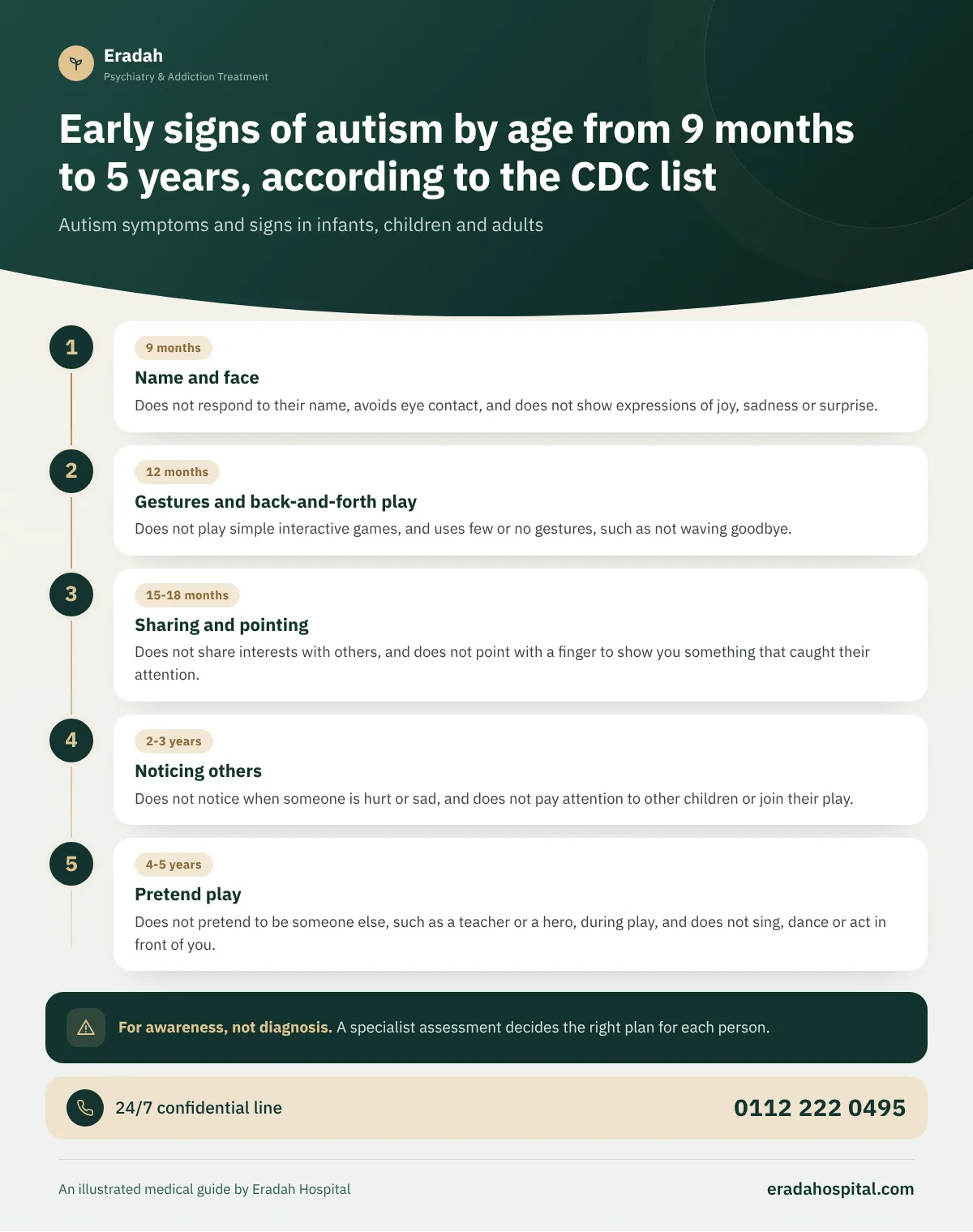
This list is for awareness, not diagnosis; some children are late in one skill for other reasons. But delay in several skills together, or repetitive behaviors alongside them, is reason enough to ask for an assessment.
Repetitive behaviors and restricted interests
- Lining up toys and objects in rows, and becoming upset if someone changes the order.
- Playing the same way every time, or focusing on one part of a toy, such as a car's wheels.
- Repeating speech, known as echolalia.
- Repetitive movements such as hand flapping, rocking and spinning.
- Sticking to a specific routine and being very upset by any small change.
- Intense, specific interests in a particular subject or object.
The CDC lists these behaviors among the signs of autism. Repetitive movements are not always a problem that needs stopping; according to the NHS they may be a way for a child to calm themselves and enjoy themselves, and they are only addressed if they are harmful to the child or others.
Sensory sensitivity: sounds, lights and food
Many autistic children react very strongly, or not at all, to lights, sounds, smells, tastes and textures. A child may cover their ears at the vacuum cleaner, refuse certain clothes, eat only certain foods with one texture, or refuse to let foods touch on the plate, and they may seem indifferent to pain or heat. The NHS also notes that it can be hard for them to describe feeling hungry, in pain or upset, so it shows up as crying or a meltdown.
Autism symptoms in older children and teenagers
- Few friends, and spending more time alone.
- Saying or doing things that seem rude or inappropriate without meaning to.
- Advanced vocabulary and formal speech beyond their age.
- Taking words literally and not understanding sarcasm and hints.
- Holding very tightly to rules and being upset if someone breaks them.
- Great difficulty with change, such as moving from one school stage to another.
Autism symptoms in adults
Autism does not begin in adulthood, but many people are not diagnosed until adulthood. The NHS describes its signs in adults: difficulty talking with others and spending more time alone, difficulty understanding facial expressions and tone of voice, taking figurative phrases literally, sticking to fixed ways of doing things, great distress at changes in routine, deep absorption in special interests, and sensory sensitivity. This may be accompanied by difficulty staying in study or work, difficulty forming friendships and romantic relationships, and mental health problems.
In many adults autism hides behind other diagnoses such as social anxiety, depression or attention-deficit/hyperactivity disorder (ADHD), which is why the doctor asks about childhood in detail.
Why do the signs disappear in girls and women?
According to the NHS, autistic girls may be more likely to imitate other children's behavior and play, stay quiet in difficult situations, and appear to be coping socially, with repetitive behaviors less obvious than in boys, and they are more prone to anxiety, depression and eating disorders. This “masking” delays diagnosis and drains energy, though boys and men may mask too.
When should you worry and see the doctor?
Do not wait for them to “grow out of it and start talking” if several of the signs above occur together, if teachers notice repeated difficulties, or if the child loses skills they had. Start with the pediatrician or a child psychiatrist, ask for a hearing test, then a specialist assessment as described on the autism diagnosis page. The earlier support starts, the greater its effect.
A seizure, severe self-harm, or suicidal thoughts? Get help now
- A seizure that happens for the first time, lasts more than 5 minutes, or after which the person does not recover as usual
- Head-banging, biting, or severe self-harm to the point of injury or bleeding, with no way to calm them
- The child leaving home or getting lost without understanding the danger of roads or water
- An adolescent or adult talking about death or suicide, or about being a “burden” on their family
- A sudden, rapid decline in speech, walking, or awareness, or complete refusal to eat and drink
Stay calm, move dangerous objects and medications away from them, do not restrain them by force except to prevent clear injury, and reduce light and noise as much as you can. During a seizure, lay them on their side away from hard edges and do not put anything in their mouth. Call the ambulance on 123 or go to the nearest emergency department. If an adolescent or adult talks about suicide, do not leave them alone, ask them calmly and listen to them, and call the mental health support line 16328 (24 hours).
Ambulance 123 Mental health support line 16328
12Signs in speech, communication and interaction
These signs are taken from the NHS description of autism signs in young children. Another common sign, as Cleveland Clinic notes, is that the child takes your hand and uses it as a tool to reach what they want, instead of asking for it or pointing.