Is there a treatment for autism?
If “treatment” means a medication that ends autism, the answer is no, and the NHS says there is no cure that removes it. But if it means that a child speaks or communicates in some way, goes to school, has fewer meltdowns, and the family lives more calmly, that is very possible with the right support.
The World Health Organization affirms that evidence-based psychosocial interventions improve communication, social skills and the quality of life of autistic people and their families. The NIMH explains that autistic people's needs are very diverse, so no single approach is best, and that interventions are more effective the earlier they start after diagnosis.
Early intervention: why does timing matter?
Cleveland Clinic says the earlier support starts, ideally before age 3, the greater its long-term benefit. The UK's NICE guidelines recommend considering a play-based social communication intervention that involves parents and teachers and aims to increase joint attention, interaction and reciprocal communication, adjusted to the child's developmental level.
Among the strongest evidence is the UK's PACT trial, which trained parents to communicate with their autistic children aged 2 to 4. The Lancet published a follow-up after about 6 years in 2016, showing a lasting reduction in the severity of autism features compared with usual care, and it was the first randomized trial to show this. Language measures did not improve at follow-up, a reminder that every intervention has limits.
The best-known approaches to autism treatment and rehabilitation
Teaching skills one small step at a time, reinforcing each advance, in speech, self-care and learning.
To develop speech, or alternative means such as signing, picture exchange and devices that speak symbols.
For fine motor skills, self-care and managing sensory sensitivity.
So parents learn ways to communicate, play and handle behavior at home every day.
An individual school plan and accommodations that take account of how the child learns and their sensory needs.
Training in conversation, friendship and understanding feelings for older children and teenagers.
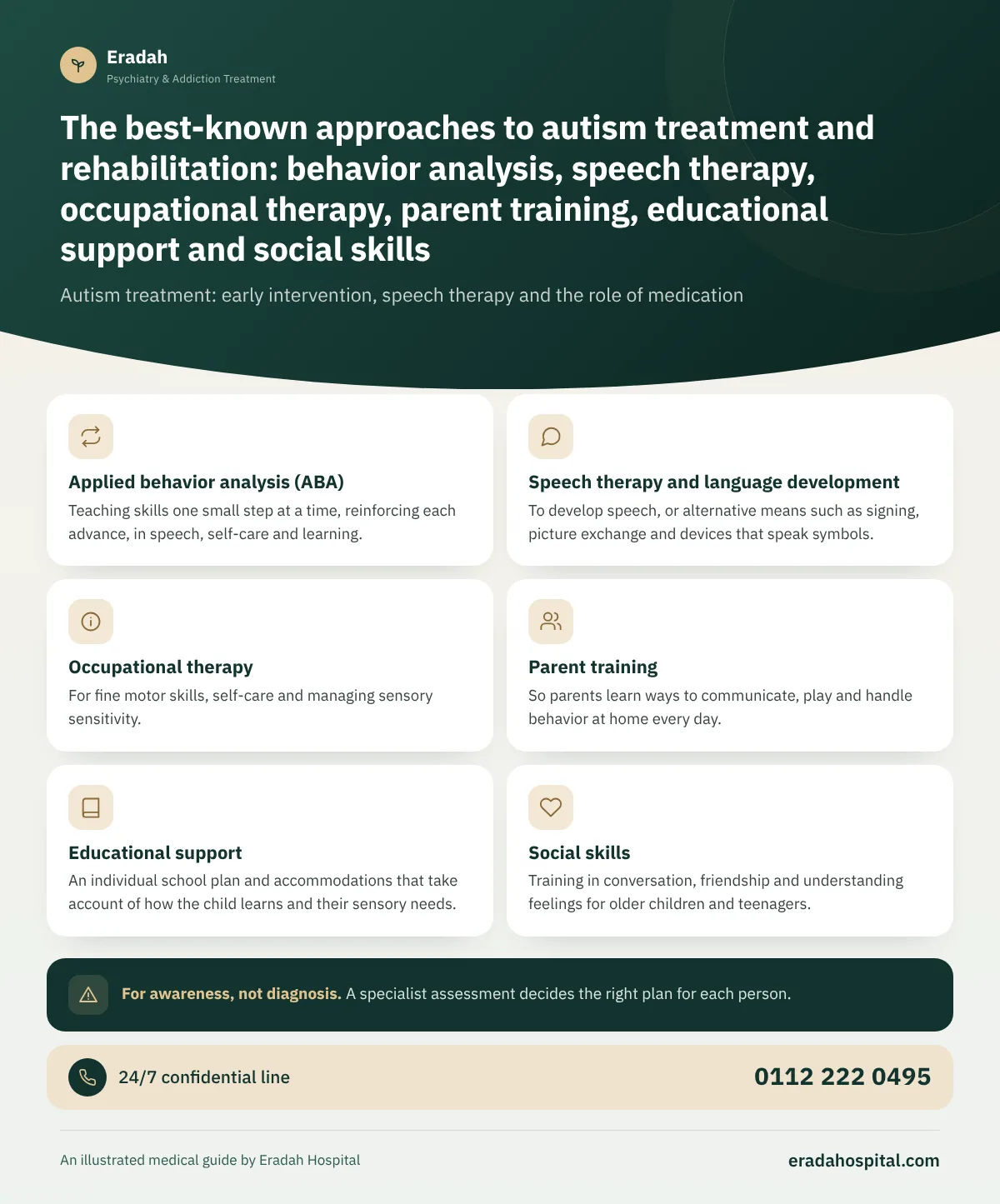
The MSD Manual states that treatment is usually multidisciplinary, and that research shows measurable benefits from intensive behavioral programs that encourage interaction and purposeful communication. But a 2018 Cochrane review of early intensive behavioral intervention found the evidence for its benefit to be of low quality because it came from small studies. The practical bottom line: choose qualified specialists, ask for clear measurable goals, review progress regularly, and avoid any program that relies on punishment or ignores the child's comfort.
Are there medications to treat autism?
No medication treats autism itself, as the US National Library of Medicine's MedlinePlus affirms. The UK's NICE guidelines state that antipsychotics, antidepressants and anticonvulsants should not be used to treat the core features of autism. But medications may help with specific co-occurring conditions:
- Severe irritability, aggression and self-injury: the US Food and Drug Administration approved risperidone for children aged 5 to 16 and aripiprazole for ages 6 to 17 for this purpose, and NICE recommends them only when psychological and behavioral interventions are not enough, with monitoring of side effects.
- ADHD: its medications may be used when it occurs together with autism, according to the MSD Manual.
- Anxiety and depression: the doctor may prescribe a medication when needed, alongside adapted psychological therapy.
- Sleep problems: NICE recommends a behavioral sleep plan first, then melatonin when needed after consulting a specialist doctor.
Treatments not recommended: beware of promises of a cure
The American Psychiatric Association warns parents to be very cautious about any treatment advertised as “curing” autism; most diets, supplements and “natural remedies” have no scientific evidence and create false hopes. This is the guidelines' position on the best known of them:
| Treatment | The scientific position |
|---|---|
| Removing metals by chelation | Should not be used in any case according to NICE, and not shown to be effective according to the MSD Manual |
| Hyperbaric oxygen | Should not be used in any case according to NICE, and not shown to be effective |
| Secretin injections | Should not be used in any case according to NICE |
| Gluten-free and casein-free diets | Not used to treat the core features of autism according to NICE, and need nutritional monitoring if a family chooses them |
| Auditory training and speech neurofeedback | Not used to treat speech and language problems according to NICE |
Treating co-occurring conditions changes the whole picture
Much of a decline in behavior has behind it pain the child cannot express, or constipation, insomnia, anxiety or epileptic seizures. That is why NICE recommends looking for these factors before addressing “difficult behavior.” For children and teenagers with the language and cognitive ability, it recommends considering cognitive behavioral therapy for anxiety after adapting it, with training in recognizing emotions and greater use of written and pictorial information.
Autism treatment in adults
Not every autistic adult needs treatment, but many benefit from understanding their diagnosis, from support at work and in relationships, and from treatment of what accompanies autism, such as depression, anxiety and insomnia. Adult men can get a confidential assessment and follow-up in Eradah's outpatient clinics, and if autism occurs together with substance use or addiction, the right place is the dual diagnosis program.
How do you know a treatment plan is good?
- It starts with a clear assessment of the child's strengths and needs, not a ready-made program for everyone.
- It has specific, measurable goals that are reviewed every few months.
- It involves and trains the family, because the child spends most of their time at home.
- It coordinates speech therapy, occupational therapy, the school and the doctor.
- It respects the child's comfort and does not rely on punishment or promises of a cure.
For the everyday side at home, from communication to meltdowns, read the guide to dealing with an autistic child.
A seizure, severe self-harm, or suicidal thoughts? Get help now
- A seizure that happens for the first time, lasts more than 5 minutes, or after which the person does not recover as usual
- Head-banging, biting, or severe self-harm to the point of injury or bleeding, with no way to calm them
- The child leaving home or getting lost without understanding the danger of roads or water
- An adolescent or adult talking about death or suicide, or about being a “burden” on their family
- A sudden, rapid decline in speech, walking, or awareness, or complete refusal to eat and drink
Stay calm, move dangerous objects and medications away from them, do not restrain them by force except to prevent clear injury, and reduce light and noise as much as you can. During a seizure, lay them on their side away from hard edges and do not put anything in their mouth. Call the ambulance on 123 or go to the nearest emergency department. If an adolescent or adult talks about suicide, do not leave them alone, ask them calmly and listen to them, and call the mental health support line 16328 (24 hours).
Ambulance 123 Mental health support line 16328