What happens if eating disorders are not treated?
Food is the fuel that every organ in the body runs on, from the heart to the brain. When eating is disrupted for a long time, through severe restriction or through binges and compensatory behaviors, the body starts to “ration” its resources, sacrificing important functions to protect the most vital ones, until it can no longer do so.
Complications vary with the type, duration and severity of the disorder, but in every type they affect the body, the mind and social life together. The main ones are listed below, and many of them improve once treatment begins.
How do eating disorders affect the heart?
The heart is a muscle, and ongoing undernutrition weakens it. StatPearls references list the heart complications of anorexia nervosa as a slow heart rate, low blood pressure, and rhythm disturbances caused by electrolyte imbalance, along with changes in the heart muscle and its lining.
In types that involve compensatory behaviors, the loss of fluids and electrolytes can cause low blood potassium, one of the most serious threats to a regular heartbeat. What is worrying is that these disturbances can strike suddenly and without warning, even in someone whose weight looks normal.
What harm do eating disorders do to other parts of the body?
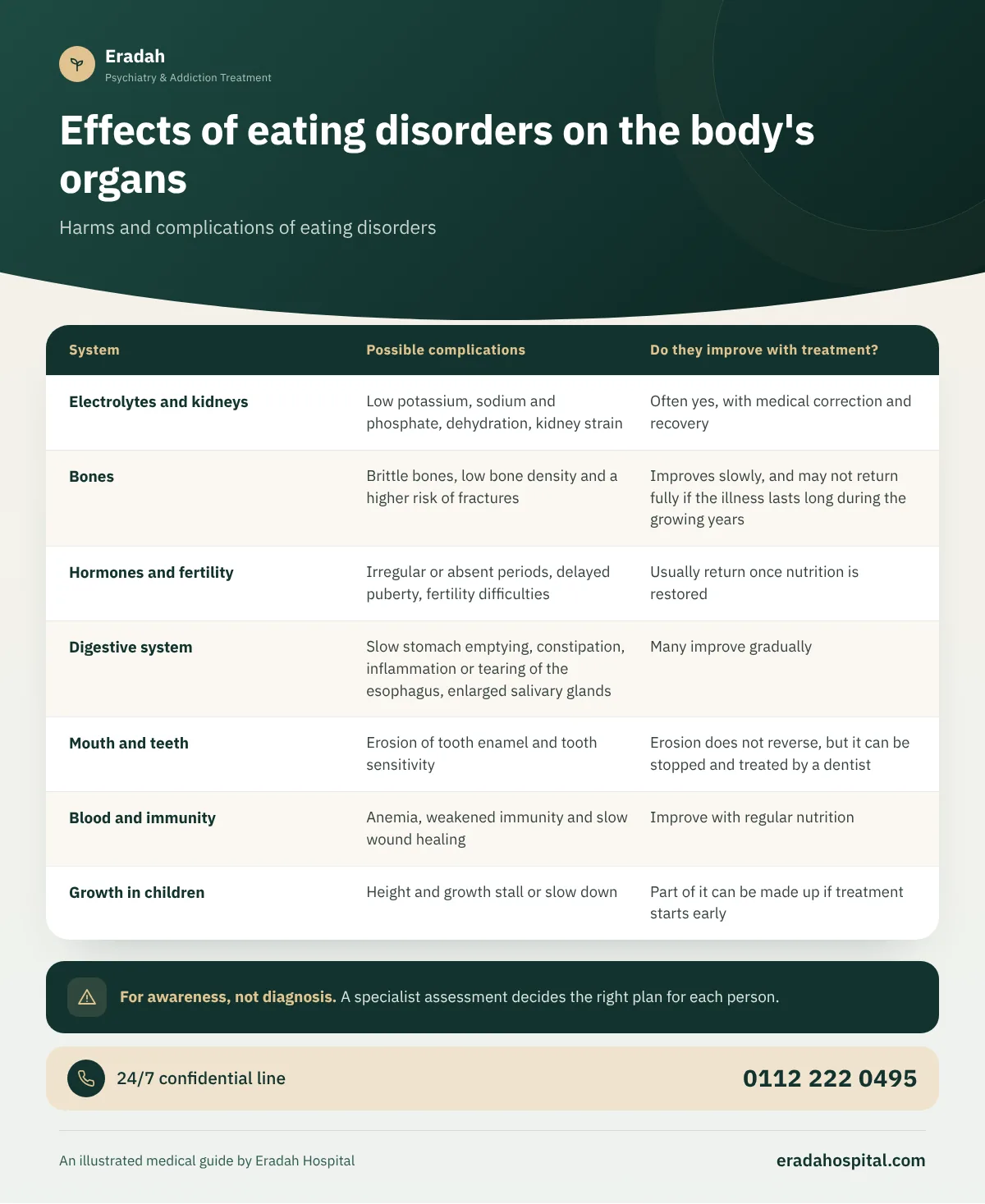
| System | Possible complications | Do they improve with treatment? |
|---|---|---|
| Electrolytes and kidneys | Low potassium, sodium and phosphate, dehydration, kidney strain | Often yes, with medical correction and recovery |
| Bones | Brittle bones, low bone density and a higher risk of fractures | Improves slowly, and may not return fully if the illness lasts long during the growing years |
| Hormones and fertility | Irregular or absent periods, delayed puberty, fertility difficulties | Usually return once nutrition is restored |
| Digestive system | Slow stomach emptying, constipation, inflammation or tearing of the esophagus, enlarged salivary glands | Many improve gradually |
| Mouth and teeth | Erosion of tooth enamel and tooth sensitivity | Erosion does not reverse, but it can be stopped and treated by a dentist |
| Blood and immunity | Anemia, weakened immunity and slow wound healing | Improve with regular nutrition |
| Growth in children | Height and growth stall or slow down | Part of it can be made up if treatment starts early |
In binge eating disorder, the condition is linked to metabolic problems such as high blood pressure, type 2 diabetes and abnormal blood fats, as well as stomach pain and reflux. The key point is that these complications are managed by treating the disorder itself, not through more deprivation, which feeds the binges.
Why are eating disorders among the most dangerous mental disorders?
According to the US National Institute of Mental Health (NIMH), anorexia nervosa has the highest death rate of any mental disorder. A review published in the British Journal of Psychiatry explains that deaths in anorexia are mostly tied to physical complications such as malnutrition, heart and metabolic complications, and infection, while the risk in bulimia and binge eating disorder is more often tied to suicide.
This is a hard fact, but we state it because it has an important other side: the same review confirms that these disorders are treatable and that most of these deaths can be prevented. In other words, delaying help adds a danger on top of the danger of the illness itself.
How do eating disorders affect the mind and mental health?
Undernutrition weakens concentration, memory and speed of thinking, and increases rigidity, preoccupation with food and irritability. Eating disorders also frequently occur together with depression, anxiety and obsessive-compulsive disorder (OCD), and each makes the others worse if left untreated.
Over time a person may lose interests, hobbies and dreams, because the disorder consumes all of their mental energy. Many of these abilities return as nutrition is restored and with psychological therapy.
How do eating disorders affect school and work?
Some people with an eating disorder may appear to excel at school because of perfectionism, but this success often comes at the cost of health, sleep and relationships, and can collapse suddenly as the condition worsens. Poor concentration, exhaustion, and repeated absences from medical appointments or because of illness lead to declining performance, and some young people drop out of school or work for periods of time.
How do eating disorders affect relationships and family?
Avoiding gatherings and shared meals gradually cuts the person off from friends and family.
Mealtimes turn into a battleground, and parents feel helpless, afraid and guilty.
Secrecy, mood swings and loss of desire can cause strain and misunderstanding between spouses.
Siblings may feel neglected or worried, and they too need explanation and support.
Parents and caregivers need support of their own. Caring for someone with an eating disorder is emotionally exhausting, and medical guidelines recommend involving them and giving them information and support.
What harm can eating disorders do during pregnancy?
Eating disorders can affect fertility and the regularity of periods, and during pregnancy they may raise the chance of some complications for the mother and baby if the mother does not receive enough nutrition and follow-up. The disorder may also return or intensify after childbirth, with the body's changes and new pressures.
A mother should not feel guilty or hide it. She should tell her obstetrician and her psychiatrist early, because joint follow-up protects both mother and baby.
Are eating disorders linked to alcohol and drug use?
Yes. The World Health Organization notes that people with bulimia nervosa are at a much higher risk of substance use, and NIMH links eating disorders in general to more substance use disorders. Some people turn to alcohol or other substances to numb anxiety or guilt, or misuse medications to control eating and weight. This is a dangerous practice that can end in addiction and raises the risk of heart complications.
When an eating disorder and addiction occur together, they need integrated treatment that addresses both at once, which is at the core of the expertise of dual diagnosis centers. Learn more about dual diagnosis.
How are eating disorders related to suicide risk?
Suicidal thoughts and attempts are more common in people with eating disorders than in the general population, especially with bulimia and binge eating disorder, and when depression or substance use is also present. But it is important to know that most people with eating disorders do not attempt suicide, and that these thoughts are a symptom of suffering that eases with treatment, not a truth about a person's worth or future.
And if you are the one having these thoughts: you are not alone, and what you feel now can change. Talk to someone you trust today, call 16328, or go to the nearest emergency room. Many people have walked this road, recovered and found a life worth living.
Can the complications of eating disorders be avoided?
- Seek an assessment at the first signs of an overwhelming preoccupation with food or the body, without waiting for a change in weight.
- Get a medical check-up that includes the heart and electrolytes when in doubt, because appearance does not reveal the danger.
- Follow the treatment team's plan, and restore nutrition under medical supervision rather than haphazardly.
- Treat any accompanying depression, anxiety or substance use at the same time.
- Keep up dental, bone and hormone follow-up as your doctor recommends.
- Involving the family in understanding the illness and knowing the danger signs.
Learn about the options for eating disorder treatment, and do not hesitate to ask for help; it is the first step in protecting your life.
Medical danger or suicidal thoughts? Get help now
- Repeated fainting or severe dizziness, or chest pain
- Very slow, fast or irregular heartbeat
- Confusion, severe weakness, or inability to stand and move
- Vomiting blood, or inability to keep down any fluids
- Talk of death, despair or saying goodbye to family
Eating disorders can cause sudden danger to the heart even if the person seems “fine.” Do not wait: call the ambulance on 123 or go to the nearest emergency room, and tell the doctors there is an eating disorder. If there is any talk of death, stay with the person and listen without blame, contact the mental health support line 16328, and keep medications and dangerous objects out of their reach.
Ambulance 123 Mental health support line 16328