Why does a person develop an eating disorder?
Doctors describe eating disorders as the result of a “vulnerability” meeting “circumstances.” The vulnerability comes from genes, brain makeup and personality, and the circumstances come from environment, stress and experiences. Often neither side alone is enough.
That is why two siblings can face the same pressures and only one develops the illness, and millions of people can follow diets without developing an eating disorder, while for a vulnerable person a diet is the start of a long road.
Are eating disorders hereditary?
Family and twin studies indicate that genetics plays a large role in eating disorders, especially anorexia nervosa. Having a first-degree relative with an eating disorder raises the likelihood of developing one compared with the general population.
A large genetic study published in Nature Genetics in 2019 identified several genetic loci linked to anorexia nervosa, and found it has genetic correlations with psychiatric disorders such as obsessive-compulsive disorder, anxiety and depression, and also with metabolic traits involved in how the body regulates energy. That is why researchers describe it as a “metabo-psychiatric” disorder in its roots.
What is the role of the brain and its chemistry in eating disorders?
Eating disorders are linked to differences in the brain circuits that regulate reward, anxiety and impulse control, and in the function of neurotransmitters such as serotonin and dopamine. Some people with anorexia, for example, appear to have high anxiety and a different sense of reward, while bulimia and binge eating may be linked to greater difficulty controlling impulses under stress.
Some people may also experience the body's internal signals differently, such as hunger, fullness and emotions, which scientists call “interoception,” making it hard for them to read what the body actually needs.
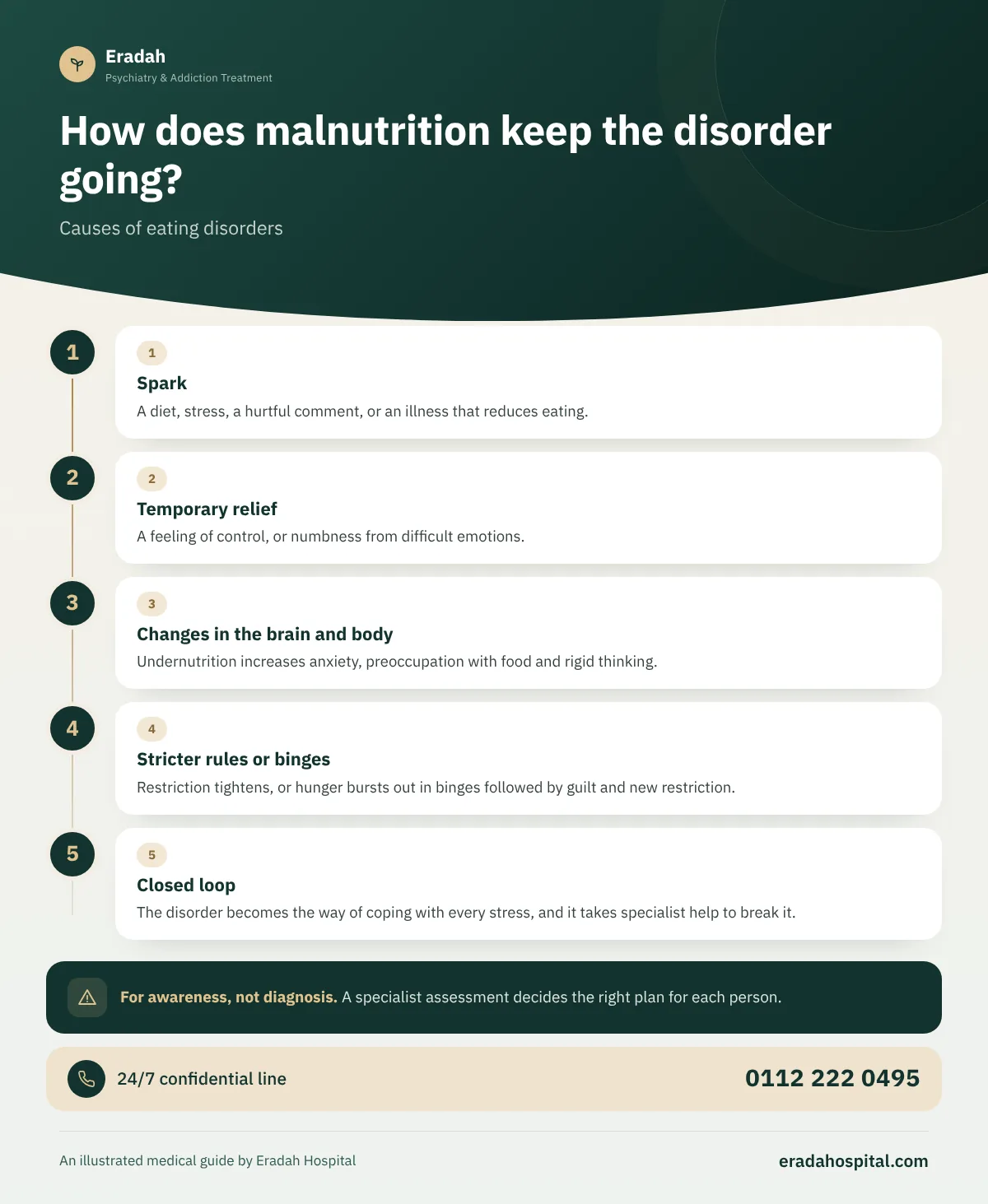
How does malnutrition keep the disorder going?
One of the most important findings of research is that ongoing undernutrition changes the brain and the mind: it increases preoccupation with food, rigid thinking, anxiety, isolation and depression. These changes in turn make restriction or binges more entrenched, forming a cycle that is hard to break by willpower alone.
- 1Spark
A diet, stress, a hurtful comment, or an illness that reduces eating.
- 2Temporary relief
A feeling of control, or numbness from difficult emotions.
- 3Changes in the brain and body
Undernutrition increases anxiety, preoccupation with food and rigid thinking.
- 4Stricter rules or binges
Restriction tightens, or hunger bursts out in binges followed by guilt and new restriction.
- 5Closed loop
The disorder becomes the way of coping with every stress, and it takes specialist help to break it.
Which psychological traits increase vulnerability to eating disorders?
Very high standards for oneself and fear of mistakes, which carry over easily to food and the body.
Many people affected had anxiety or obsessions from childhood before the eating disorder appeared.
Using food, or controlling it, as a way to numb sadness, anger or emptiness.
Tying personal worth only to appearance or achievement.
More linked to bulimia and binge eating disorder.
Autism and ADHD are more linked to avoidant/restrictive food intake disorder and some other types.
ADHD in particular is linked to a higher likelihood of binge episodes, while obsessive and anxious traits are more linked to anorexia nervosa.
Do trauma and bullying cause eating disorders?
Painful experiences, such as neglect or abuse in childhood or traumatic events, raise the risk of eating disorders, especially the types that involve binge episodes. In these cases food may become a way of coping with feelings the person cannot express.
Bullying about weight or appearance, whether at school, within the family or online, is also one of the strongest environmental factors linked to eating disorders and a negative body image. Comments that seem like “jokes” about a child's body can leave an effect that lasts for years.
What is the role of body image pressures and social media?
Whole generations today live in front of edited images and “perfect” bodies and constant messages that tie beauty and success to a particular shape. Social media does not cause eating disorders on its own, but it can increase body dissatisfaction and comparison, and can expose a vulnerable user to content that glorifies restriction or promotes harsh diets.
Vulnerability also rises in fields that focus on appearance or weight, such as some sports, dance and modeling, and in families or communities where there is a lot of talk about weight and diets and comments on other people's bodies. For healthy ways to approach platform use, see the page on social media addiction.
Does strict dieting lead to an eating disorder?
Harsh dieting is among the most common starting points for eating disorders. Not every diet causes illness, but severe deprivation in a vulnerable person can set off a cycle of restriction, or of restriction followed by binges. That is why specialists warn against harsh diets, especially in adolescents, and against presenting food as a “sin” that must be atoned for.
Why do some children develop avoidant/restrictive food intake disorder?
The causes of this type differ from the others; it usually has nothing to do with weight or body image. StatPearls references describe three main pathways: intense sensory sensitivity to taste, texture or smell, low interest in eating and weak hunger signals, or fear of the consequences of eating, such as choking or vomiting after a frightening experience. It is more linked to autism, ADHD and anxiety disorders.
What is the difference between a trigger and a cause?
A trigger is the event that comes before the disorder appears, such as moving to a new university, a breakup, an illness or a hurtful comment. The cause is the sum of the vulnerability and circumstances that made this event able to set off the illness. Understanding the difference lifts blame from the person and their family, and directs treatment toward what keeps the disorder going rather than the search for someone to blame.
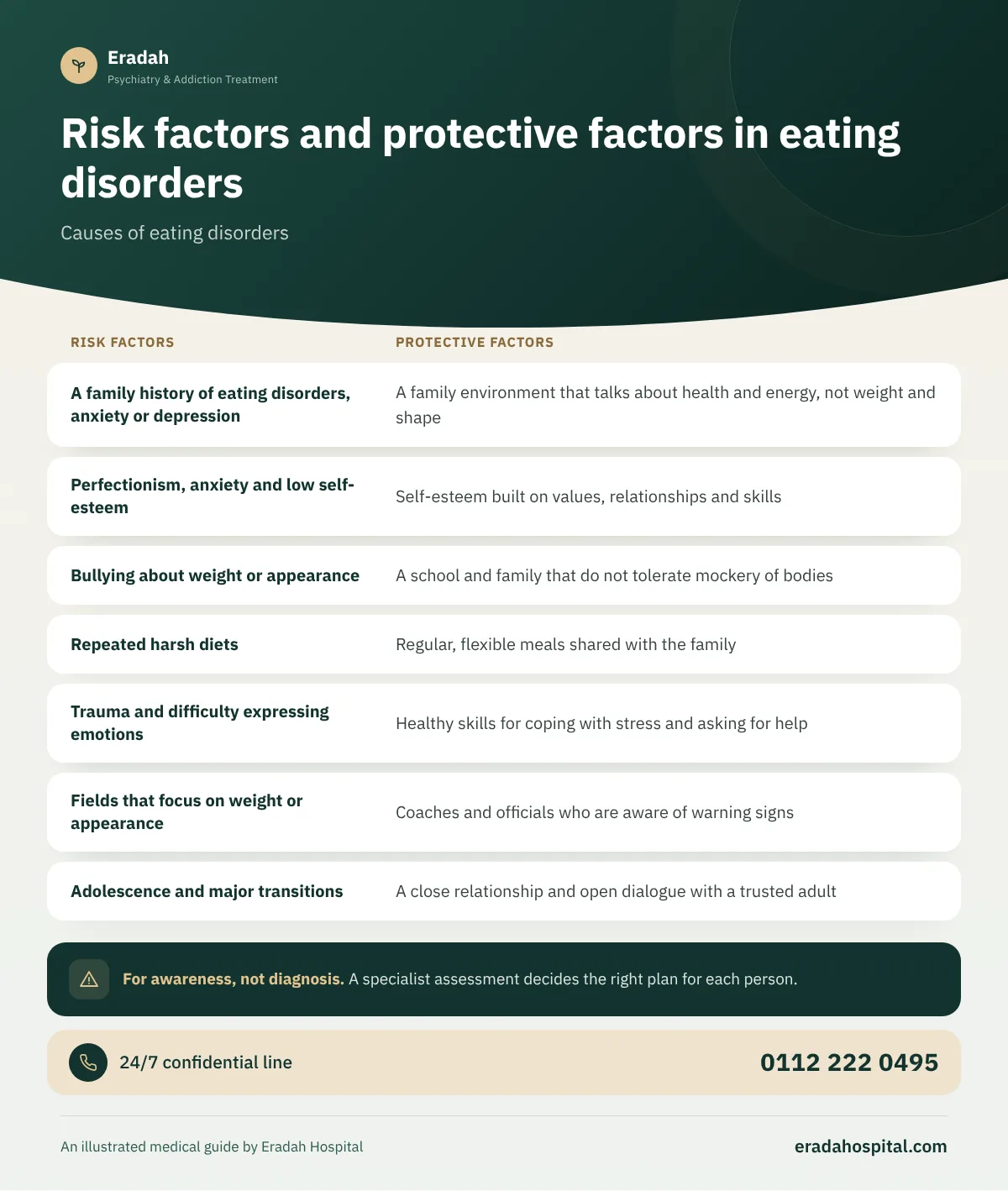
What are the risk and protective factors for eating disorders?
| Risk factors | Protective factors |
|---|---|
| A family history of eating disorders, anxiety or depression | A family environment that talks about health and energy, not weight and shape |
| Perfectionism, anxiety and low self-esteem | Self-esteem built on values, relationships and skills |
| Bullying about weight or appearance | A school and family that do not tolerate mockery of bodies |
| Repeated harsh diets | Regular, flexible meals shared with the family |
| Trauma and difficulty expressing emotions | Healthy skills for coping with stress and asking for help |
| Fields that focus on weight or appearance | Coaches and officials who are aware of warning signs |
| Adolescence and major transitions | A close relationship and open dialogue with a trusted adult |
Common myths about the causes of eating disorders
- “The mother is the cause”: This is an old idea that science has moved past; the family does not cause the illness, and is in fact an essential part of the solution.
- “She's doing this to get attention”: People with eating disorders usually hide their suffering intensely, and the disorder is not deliberate behavior.
- “The only cause is fashion and magazines”: Cultural pressures are an important factor, but they alone do not explain why some people are affected and others are not.
- “Eating disorders are a rich person's illness”: They affect all classes and backgrounds.
- “Binge episodes are caused by a lack of willpower”: They have biological and psychological factors, and are often fed by harsh diets themselves.
Understanding the causes is a first step, and the next step is to learn about eating disorder treatment and how it targets what keeps the cycle going.