“I want something for anxiety, but I don't want to get hooked like people I know with Xanax.” This sentence sums up why people ask about Buspar. It is one of the few anxiety medications that does not carry the dependence risk known with sedatives, but it comes with conditions that must be understood so that it is not judged a failure too early.
What is Buspar?
Buspar is the best-known brand name of buspirone, and generic versions are available in Egypt, with brand names including Buspalex, Neurobus and Anxipet. The StatPearls reference notes that buspirone was originally developed as an antipsychotic but did not succeed in that role, while it showed anti-anxiety properties. It belongs to a group called azapirones, which act on a type of serotonin receptor called 5-HT1A, unlike the benzodiazepine sedatives, which act on GABA.
Uses of Buspar
- Generalized anxiety disorder: the main use, meaning chronic anxiety, tension and excessive worrying that lasts for months.
- Relief of anxiety symptoms for short periods, an approved use in the United States according to StatPearls.
- Support for treating depression: sometimes added to an antidepressant, which is an off-label use.
A Cochrane review of azapirone studies in generalized anxiety concluded that they are better than placebo and are especially useful for people who have not used benzodiazepine sedatives before, though they may not outperform benzodiazepines in effectiveness, and their side effects were mild.
When does Buspar start working?
According to the US National Institute of Mental Health (NIMH), buspirone must be taken daily for 3 to 4 weeks to reach its full effect, and it is not effective if taken only as needed. The US National Library of Medicine also notes that the doctor may start with a low dose and raise it gradually, that reaching the right dose may take several weeks, and that the medication should be taken regularly and in the same way every time, either always with food or always without.
Is Buspar addictive?
The official buspirone label published on DailyMed states that it is not a controlled substance in the United States and that in studies in humans and animals it showed no potential for abuse, with no evidence that it causes tolerance or physical or psychological dependence. In fact, volunteers with a history of drug or alcohol use could not tell it apart from placebo. Even so, the label advises doctors to monitor people with a history of addiction, as with any drug that acts on the brain.
The difference between Buspar, Xanax and sedatives
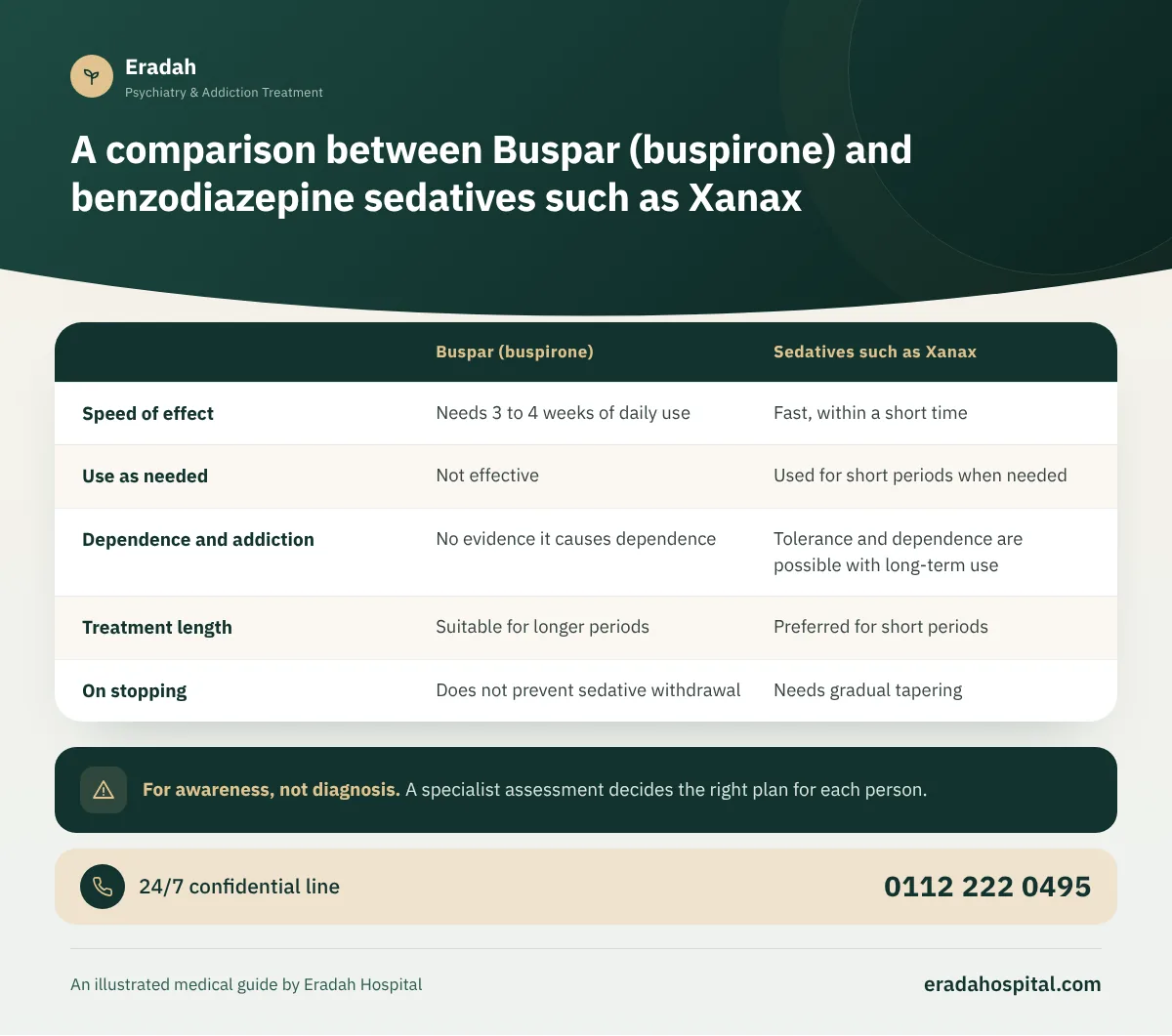
| Buspar (buspirone) | Sedatives such as Xanax | |
|---|---|---|
| Speed of effect | Needs 3 to 4 weeks of daily use | Fast, within a short time |
| Use as needed | Not effective | Used for short periods when needed |
| Dependence and addiction | No evidence it causes dependence | Tolerance and dependence are possible with long-term use |
| Treatment length | Suitable for longer periods | Preferred for short periods |
| On stopping | Does not prevent sedative withdrawal | Needs gradual tapering |
Side effects of Buspar
- Dizziness and vertigo.
- Nausea and diarrhea.
- Headache.
- Nervousness or excitability.
- Fatigue and weakness.
- Difficulty sleeping.
- Confusion or numbness.
According to MedlinePlus, rare effects that call for a doctor immediately include rash and swelling, a fast or irregular heartbeat, blurred vision, tremor, and symptoms of serotonin syndrome such as agitation, fever, sweating, muscle stiffness and confusion.
Interactions and precautions
- MAOI-type antidepressants, or stopping them within the past two weeks.
- The stomach drug cimetidine, and other medications that may require a dose adjustment.
- Large amounts of grapefruit or grapefruit juice.
- Alcohol, because it increases dizziness and drowsiness.
- Kidney or liver disease, and any history of drug or alcohol use.
- Pregnancy and breastfeeding: the decision belongs to the doctor.
When should you ask for help?
See the doctor if the anxiety has not improved after several weeks, or if bothersome effects appear. If anxiety has led you to rely on sedatives, alcohol or hashish to calm down, this is a common pattern that treating anxiety and addiction together addresses, and Eradah's dual diagnosis team provides it through outpatient treatment or residential care, depending on the case.