Does a phobia have a single cause?
Many people ask, “Why me?” The honest answer is that doctors do not know a single cause for any phobia, but a set of factors that build up: a predisposition that makes a person more sensitive to fear, then an experience or learning that ties this fear to something specific, then avoidance that keeps it from fading away.
The UK’s National Health Service stresses that what starts a phobia is not always clear, though much of it is linked to a frightening event or a stressful situation, and that it usually forms in childhood, adolescence or early adulthood. This is why a patient does not need to “remember the cause” in order to be treated.
How does a frightening experience create a phobia?
The simplest path is for a situation to become tied in memory to intense terror: a child chased by a dog, a person trapped in a broken elevator, or someone who went through violent turbulence on a flight. After that the brain links the place or thing with danger, and sounds the alarm whenever anything similar appears. Cleveland Clinic notes that the experience need not be direct; seeing another person get hurt may be enough.
Can we learn a phobia from others?
Yes. A child who sees their mother scream every time an insect appears learns that insects are dangerous without ever being bitten by one. Researchers call this observational learning. A third path is information transfer: repeated frightening stories and news about plane crashes or dogs can plant a fear that no experience preceded.
The same sources add that negative reactions to a child’s fear, such as mockery or scolding, can increase their anxiety, and that parental overprotection has been linked to a higher likelihood of phobias, because it deprives the child of the chance to find out that the world is safer than they think.
Are phobias hereditary?
There is a clear family predisposition; Cleveland Clinic notes that some types, specifically phobias of animals, blood, medical procedures and situations, are more common in people who have a relative with the same type, and the UK’s National Health Service counts a family history of anxiety disorders as a risk factor. But genetics passes on susceptibility, not the phobia itself; many people carry the predisposition and never develop one because the circumstances did not come together.
What happens in the brain in a phobia?
Fear relies on neural circuits that are faster than conscious thought, with the amygdala at the heart of them, acting as an alarm system. In a person with a phobia, this alarm is thought to learn an association with a specific trigger and become quick to fire, while the regions responsible for calm assessment are slow to rein it in. The important news is that what the brain has learned can be relearned, and this is the basis of exposure treatment.
Why do phobias last for years? The avoidance cycle
Whatever the beginning, what turns a passing fear into a settled phobia is avoidance. The cycle usually runs like this:
- 1The trigger
Anticipating or facing the situation sets off the fear alarm and physical symptoms.
- 2Escape
The person avoids the situation or leaves it quickly.
- 3Temporary relief
Anxiety calms immediately, so the brain learns that escape is what saved it.
- 4The fear is locked in
There is no chance to discover that the danger was not real, so the fear grows the next time.
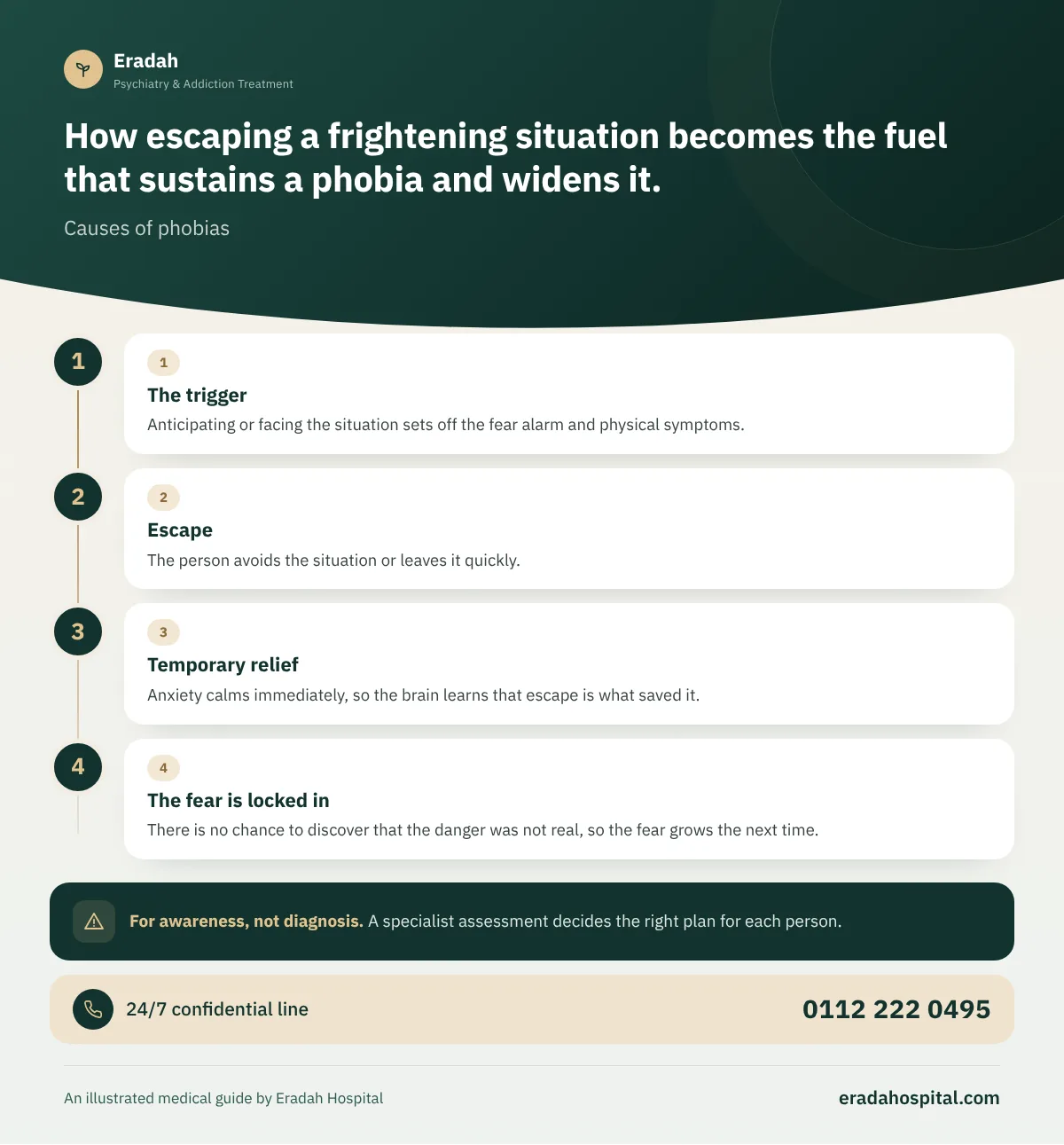
Over time the circle may widen to include closer situations: from the plane to the airport, then to watching a film with a plane in it. A review in The Lancet Psychiatry notes that specific phobia lasts for years or even decades in 10 to 30% of cases.
Who is most at risk of developing a phobia?
| Factor | What do we know? |
|---|---|
| Type | Specific phobia is more common in women: 9.8% versus 4.9% in men over a lifetime in World Health Organization surveys |
| Age | It usually begins in childhood, with a median age at onset of about 8 years |
| Family history | A relative with a phobia or an anxiety disorder |
| Experiences | A direct or witnessed frightening event, or severe stress |
| Parenting style | Overprotection, or mockery of the child’s fear |
| Other disorders | Having one phobia raises the likelihood of other fears |
In the same surveys, another mental disorder appeared during the lifetime of 60.5% of people with a specific phobia, and in 72.6% of those cases the phobia came before the other disorder; this is why researchers see it as an early sign worth paying attention to, not just a “childhood fear.”
What does not cause phobias?
- It has nothing to do with weak faith or manhood; phobias affect strong and successful people.
- It is not “pampering” or attention-seeking; people with a phobia usually hide their fear and are ashamed of it.
- It is not necessarily the result of a major trauma; many people do not remember any earlier event.
- It is not only the parents’ fault; parenting style is one factor among many.
What do you do after understanding the causes of a phobia?
Knowing the causes eases self-blame, but it is not enough on its own. A phobia recedes when the brain gets a “new experience” that corrects what it learned, and this is what gradual exposure provides, as explained in phobia treatment. To learn about the different forms of fear, see types of phobias, and for the signs of the condition, phobia symptoms.
Fear accompanied by risk to yourself or dependence on a sedative? Get help now
- Thoughts of death or self-harm out of despair over the fear or from isolation.
- Repeated fainting with injury at the sight of blood or injections, or refusing necessary medical treatment out of fear of needles.
- Chest pain or severe shortness of breath that does not improve, especially in someone with heart disease or an older person.
- Taking increasing doses of sedatives or alcohol to face the situation, or mixing the two.
- Complete withdrawal from leaving the house for weeks, with neglect of eating, sleep and self-care.
If chest pain or severe shortness of breath appears, do not assume it is “just fear”; call an ambulance on 123 so a physical cause can be ruled out. If someone close to you talks about death or harming themselves, stay with them, ask calmly and without blame, remove medications and dangerous objects, and call an ambulance on 123 or go to the nearest emergency department, or call the mental health support line 16328, available around the clock.
Ambulance 123 Mental health support line 16328