What are the core signs that distinguish a phobia?
Everyone feels afraid at times, but the symptoms of a phobia have a distinctive signature: fear tied to a specific source, appearing almost immediately every time, leading to clear avoidance, and lasting months, not days.
MSD medical references summarize the DSM-5-TR criteria in clear points: intense fear or anxiety about a specific situation or object, appearing in almost every encounter, driving avoidance or endurance with distress, out of proportion to the actual danger by the standards of the person’s culture, lasting six months or more, and causing clear distress or disruption in studies, work or relationships.
What often puzzles families is that the person seems completely normal away from the source of their fear, then changes within seconds on seeing a dog or entering an elevator. This contradiction is the nature of the phobia itself, and the patient is not acting.
What are the physical symptoms of a phobia?
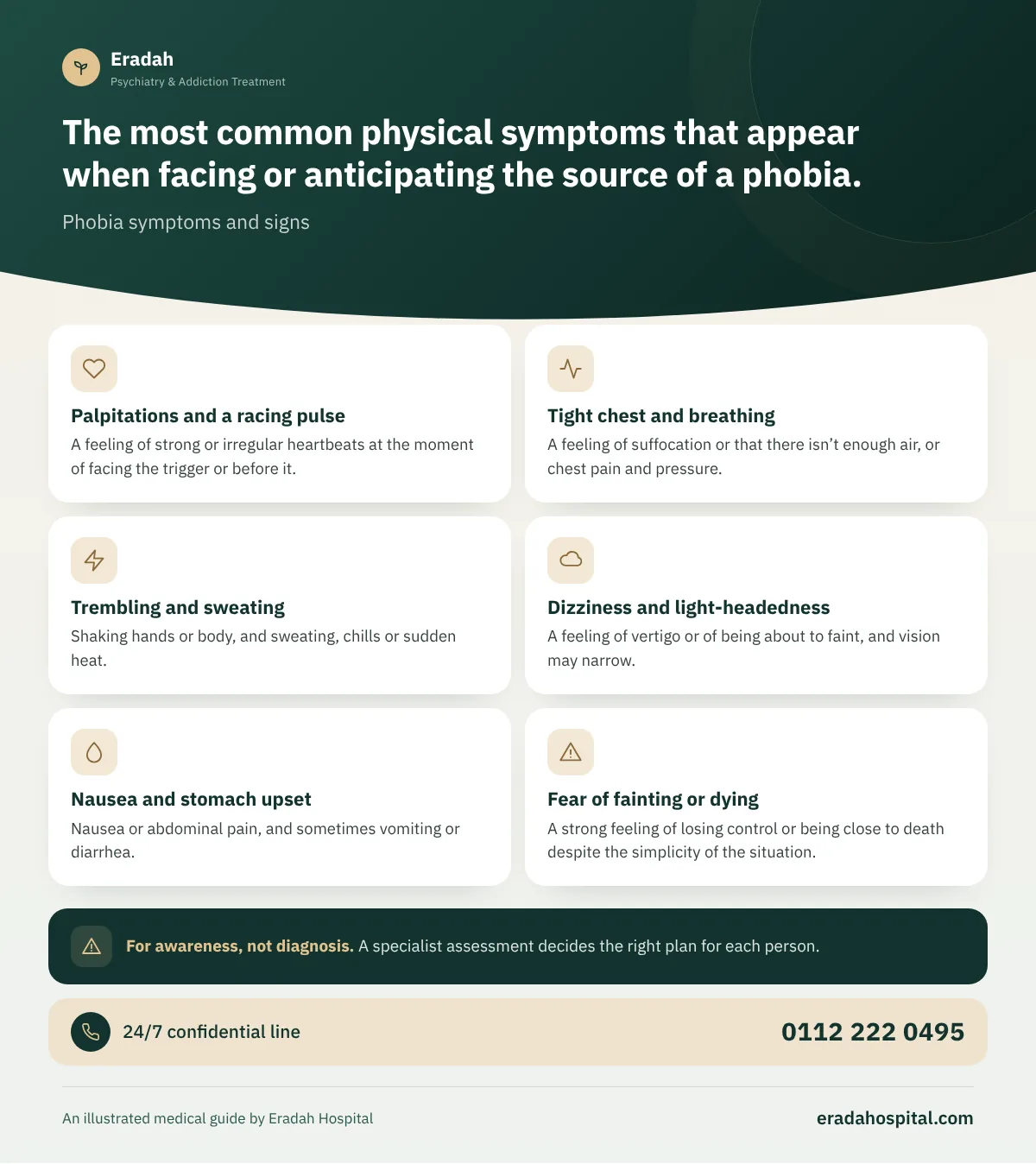
On facing the trigger, the body sets off the “fight or flight” response as if a real danger were threatening it, and the UK’s National Health Service and Cleveland Clinic list symptoms, the best known of which are:
A feeling of strong or irregular heartbeats at the moment of facing the trigger or before it.
A feeling of suffocation or that there isn’t enough air, or chest pain and pressure.
Shaking hands or body, and sweating, chills or sudden heat.
A feeling of vertigo or of being about to faint, and vision may narrow.
Nausea or abdominal pain, and sometimes vomiting or diarrhea.
A strong feeling of losing control or being close to death despite the simplicity of the situation.
These symptoms are unpleasant but are essentially not dangerous in a healthy person, and they settle on their own if the person stays in the situation or moves away from it. But severe chest pain or shortness of breath that does not improve, especially with heart disease, calls for a medical examination rather than assuming it is fear.
What are the psychological and mental symptoms of a phobia?
- Overwhelming terror and a sense of impending danger that does not respond to logic in the moment.
- Rapid catastrophic thoughts: “The elevator will stop and I’ll die,” “The dog will attack me.”
- An urgent urge to flee that overrides any other thought.
- A feeling of detachment from the body or the place, as if what is happening is not real, which Cleveland Clinic lists among the symptoms of phobia.
- Shame and self-blame after the situation, and fear that others will notice the fear.
How does a phobia show up in daily behavior?
Avoidance is the symptom most obvious to the family, and it is also what keeps the problem going. It can be open or hidden:
- Changing the route or schedule to avoid a particular place, animal or situation.
- Refusing to fly, use an elevator or drive on highways.
- Putting off tests, vaccinations and dentist visits for fear of needles or instruments.
- “Safety behaviors” such as bringing a particular person along, sitting near the door or carrying a sedative in a pocket.
- Turning down important opportunities such as a job or better housing because they involve a possible confrontation.
What is anticipatory anxiety in a phobia?
A phobia does not wait for the confrontation to happen. Just knowing that a flight is a week away, or that a blood test is needed tomorrow, can set off anticipatory anxiety that spoils sleep and concentration for days. Sometimes this waiting is harder than the situation itself, and becomes the biggest reason for canceling the plan altogether.
Why do some people faint at the sight of blood or injections?
Phobia of blood, injections and injury is an exception among types of phobia. Instead of the pulse staying high, what MSD references describe as an exaggerated vasovagal reaction can occur: the heart slows, blood pressure drops on standing, sweating and trembling appear, and the person collapses in a faint for seconds.
What are the symptoms of a phobia in children?
A child does not usually say “I have a phobia,” but the symptoms show up as crying, tantrums, freezing on the spot or clinging tightly to a parent when facing what they fear, as Cleveland Clinic notes. Many young children’s fears, such as the dark and animals, are a normal part of growing up, but they deserve assessment if they are stronger than their peers’, have lasted months, and have begun to keep them from school, sleep or ordinary activities.
Are phobia symptoms a panic attack?
Fear in a phobia can reach a full panic attack, but the difference is in its source:
| Point of comparison | Phobia | Panic disorder |
|---|---|---|
| When do symptoms come? | When facing or anticipating something specific | Suddenly, often with no obvious trigger |
| What is the person afraid of? | The situation or object itself | The attack and its physical symptoms |
| Can they be predicted? | Yes, which is why avoidance is easy | No, which is what makes it exhausting |
| What happens away from the trigger? | Relative calm | Ongoing fear of the next attack |
When do phobia symptoms become a reason to see a doctor?
- Symptoms have lasted six months or more and are becoming broader.
- Avoidance is keeping you from work, study or necessary medical treatment.
- Fainting episodes have recurred with blood or injections, or you have fallen and been hurt.
- Panic attacks have appeared away from the source of fear.
- You have begun to rely on a sedative or alcohol to get through the situation.
Knowing the symptoms is a first step, and you will find an understanding of their roots in causes of phobias, and you can learn about their different forms in types of phobias.
Fear accompanied by risk to yourself or dependence on a sedative? Get help now
- Thoughts of death or self-harm out of despair over the fear or from isolation.
- Repeated fainting with injury at the sight of blood or injections, or refusing necessary medical treatment out of fear of needles.
- Chest pain or severe shortness of breath that does not improve, especially in someone with heart disease or an older person.
- Taking increasing doses of sedatives or alcohol to face the situation, or mixing the two.
- Complete withdrawal from leaving the house for weeks, with neglect of eating, sleep and self-care.
If chest pain or severe shortness of breath appears, do not assume it is “just fear”; call an ambulance on 123 so a physical cause can be ruled out. If someone close to you talks about death or harming themselves, stay with them, ask calmly and without blame, remove medications and dangerous objects, and call an ambulance on 123 or go to the nearest emergency department, or call the mental health support line 16328, available around the clock.
Ambulance 123 Mental health support line 16328