Can a phobia be cured for good?
Phobias are among the mental disorders that respond best to treatment, and you are not asked to “love” dogs or flying; what is needed is for the fear to return to its normal size so that it no longer decides where you work, when you travel and what treatment you accept.
MSD medical references describe exposure therapy as the most studied and most effective psychological treatment for specific phobia, and often the only treatment required. Even so, a review in The Lancet Psychiatry cautions that its long-term effect may be smaller than was once thought, which is why therapists care about continued practice after sessions end.
How does exposure therapy work, step by step?
The therapist begins with the patient by building a fear ladder: a list of situations tied to the phobia, arranged from the easiest to the hardest. In fear of flying, for example, as MSD references explain, the list might start with looking at a picture of a plane, then driving past the airport, then entering it without traveling, up to an actual flight. The patient then climbs the ladder rung by rung:
- Stage 1Assessment and education
Understanding the cycle of fear and avoidance, setting goals, and learning slow breathing.
- Stage 2Building the fear ladder
Arranging situations from easiest to hardest in agreement with the therapist.
- Stage 3Exposure through pictures and imagination
Staying with the picture or imagined scene until anxiety falls on its own.
- Stage 4Graded real-life exposure
Actually approaching the situation for gradually longer periods without escaping.
- Stage 5Consolidation and preventing return
Repeating the confrontation in different situations, and a plan for handling any setback.
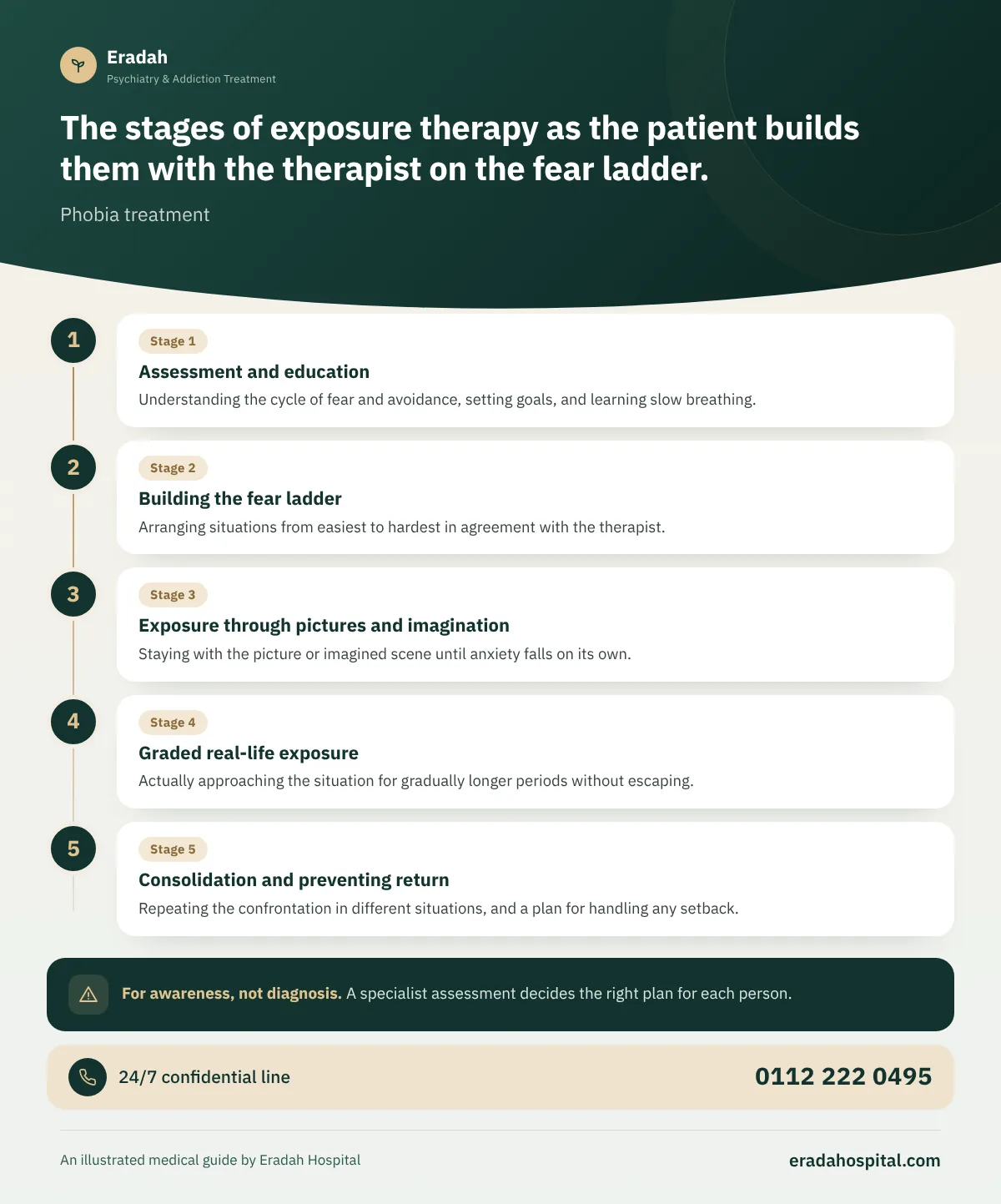
The patient is not forced onto a rung they are not ready for, and is not left alone at the start. The key is to stay in the situation until anxiety settles rather than leaving at its peak, as this is what breaks the cycle explained in the section on causes of phobias.
What does research say about the success of phobia treatment?
An analysis published by Wolitzky-Taylor and colleagues in 2008 pooled the results of 33 randomized trials and found that exposure-based treatment achieved a large improvement compared with no treatment, and outperformed placebo and alternative psychological treatments. Real-life exposure also outperformed its other forms such as imagination and virtual reality at the end of treatment, though results converged at follow-up, and a larger number of sessions was linked to better outcomes.
MSD references note that a single exposure session may be effective for some patients, which is known as intensive treatment in one extended session, and the therapist chooses between it and multiple sessions according to the type and severity of the phobia.
What is the role of cognitive therapy and relaxation techniques?
- Modifying catastrophic thoughts: examining thoughts such as “the elevator will stop and I’ll suffocate” and comparing them with reality and the numbers.
- Slow breathing and relaxation: you learn it to use before and during exposure, not to escape the situation with it.
- Gradually dropping safety behaviors: such as carrying a “backup” sedative or requiring a companion, because they prevent full learning.
- Imaginal exposure: Cleveland Clinic explains that it may be the only route for fears that are hard or dangerous to confront in real life.
- Virtual reality exposure: a useful option for fear of flying and heights when available.
How is phobia of blood and injections treated?
Since the problem in this type is a drop in blood pressure and fainting, a training called applied tension is added to the exposure: tensing the muscles of the arms, legs and trunk for a few seconds and then releasing them, repeatedly, to raise blood pressure and prevent fainting, while practicing recognizing the first signs of dizziness. In a Swedish trial led by Öst in 1991 on 30 patients, 90% of those who received applied tension improved markedly by the end of five sessions. The patient learns this technique with the therapist before using it.
Are there medications to treat phobias?
MSD references say outright that medications are not very helpful in overcoming specific phobia. But the doctor may use them in certain cases:
| Group | When might they be used? | Important notes |
|---|---|---|
| Antidepressants (SSRIs) | When the phobia comes with depression, generalized anxiety or panic, and in agoraphobia and social phobia | They take weeks to take effect and should not be stopped suddenly |
| Beta blockers such as propranolol | Before a specific performance situation, to ease trembling and palpitations | They do not treat the fear itself, and are not suitable for people with asthma and some heart conditions |
| Benzodiazepines (sedatives) | Very limited use for an occasional situation such as a necessary flight | They do not remove the phobia, may hinder learning during exposure, and carry a risk of dependence |
How long does phobia treatment take?
The duration varies with the type and severity of the phobia and what accompanies it. Some simple cases of specific phobia improve in a single extended session or a few sessions, while agoraphobia, or a phobia accompanied by depression or sedative dependence, needs a longer plan. More important than the number of sessions is practice between sessions; a patient who applies the confrontations in daily life progresses much faster.
How is phobia treated in children?
The foundation in children is gradual exposure suited to their age, in the form of play, small challenges and rewards, along with training parents to stop overprotecting without forcing the child. Parents need to avoid mockery or pushing a child into a sudden confrontation, because that may deepen the fear instead of treating it.
What helps alongside treatment?
- Practice slow breathing and relaxation exercises daily.
- Talk about your fear with someone you trust instead of hiding it.
- Don’t look for frightening pictures and clips until you are ready, as part of a plan.
- Cut down on stimulants such as coffee and energy drinks, since they can increase anxiety, especially in the evening.
- Record every successful confrontation, however small, to see your progress.
Phobia treatment at Eradah
At Eradah Psychiatry, phobia treatment begins with an assessment that identifies the type and severity of the phobia and any accompanying panic, depression or sedative dependence, then a plan that combines cognitive behavioral therapy and gradual exposure, with medication only when needed. Most cases are treated through outpatient treatment, while someone who has developed dependence on sedatives or alcohol may need the dual diagnosis program. The first consultation is free and confidential, and residential treatment is for men only.
Fear accompanied by risk to yourself or dependence on a sedative? Get help now
- Thoughts of death or self-harm out of despair over the fear or from isolation.
- Repeated fainting with injury at the sight of blood or injections, or refusing necessary medical treatment out of fear of needles.
- Chest pain or severe shortness of breath that does not improve, especially in someone with heart disease or an older person.
- Taking increasing doses of sedatives or alcohol to face the situation, or mixing the two.
- Complete withdrawal from leaving the house for weeks, with neglect of eating, sleep and self-care.
If chest pain or severe shortness of breath appears, do not assume it is “just fear”; call an ambulance on 123 so a physical cause can be ruled out. If someone close to you talks about death or harming themselves, stay with them, ask calmly and without blame, remove medications and dangerous objects, and call an ambulance on 123 or go to the nearest emergency department, or call the mental health support line 16328, available around the clock.
Ambulance 123 Mental health support line 16328