What is claustrophobia?
“I climb 12 floors of stairs every day and tell people it’s exercise. The truth is, if I get into the elevator and the door closes, I feel like I’m going to suffocate.” This is what claustrophobia looks like in everyday life: small arrangements for escape that grow over time until they control the choice of where to live, work and travel.
Claustrophobia, or fear of confinement, is a kind of phobia that medical references classify as a specific phobia of the situational type. The MSD Manual notes that specific phobia affects about 8% of women and 3% of men in any given year, and gives the example of a person who works on a high floor and fears enclosed spaces such as elevators, so that daily life is disrupted by it.
The NHS estimates that about 10% of the UK population are affected by claustrophobia at some point in their lives, and that its symptoms range from mild anxiety to a full panic attack.
What is the person actually afraid of? Suffocation and restriction
Researchers see claustrophobia as a fear not of the “place” itself but of two things expected to happen in it. The Claustrophobia Questionnaire, published in the Journal of Anxiety Disorders in 2001, was built on the idea that it consists of two linked fears:
- Fear of suffocation: “The air is going to run out,” “I won’t be able to breathe.”
- Fear of restriction: “I won’t be able to move or get out if something happens.”
In a later study in 2007 that used a simulated MRI scanner, these two fears predicted escape and avoidance behavior during the simulation. Understanding which of the two fears is stronger in you helps the therapist design the steps of treatment.
Where does claustrophobia show up?
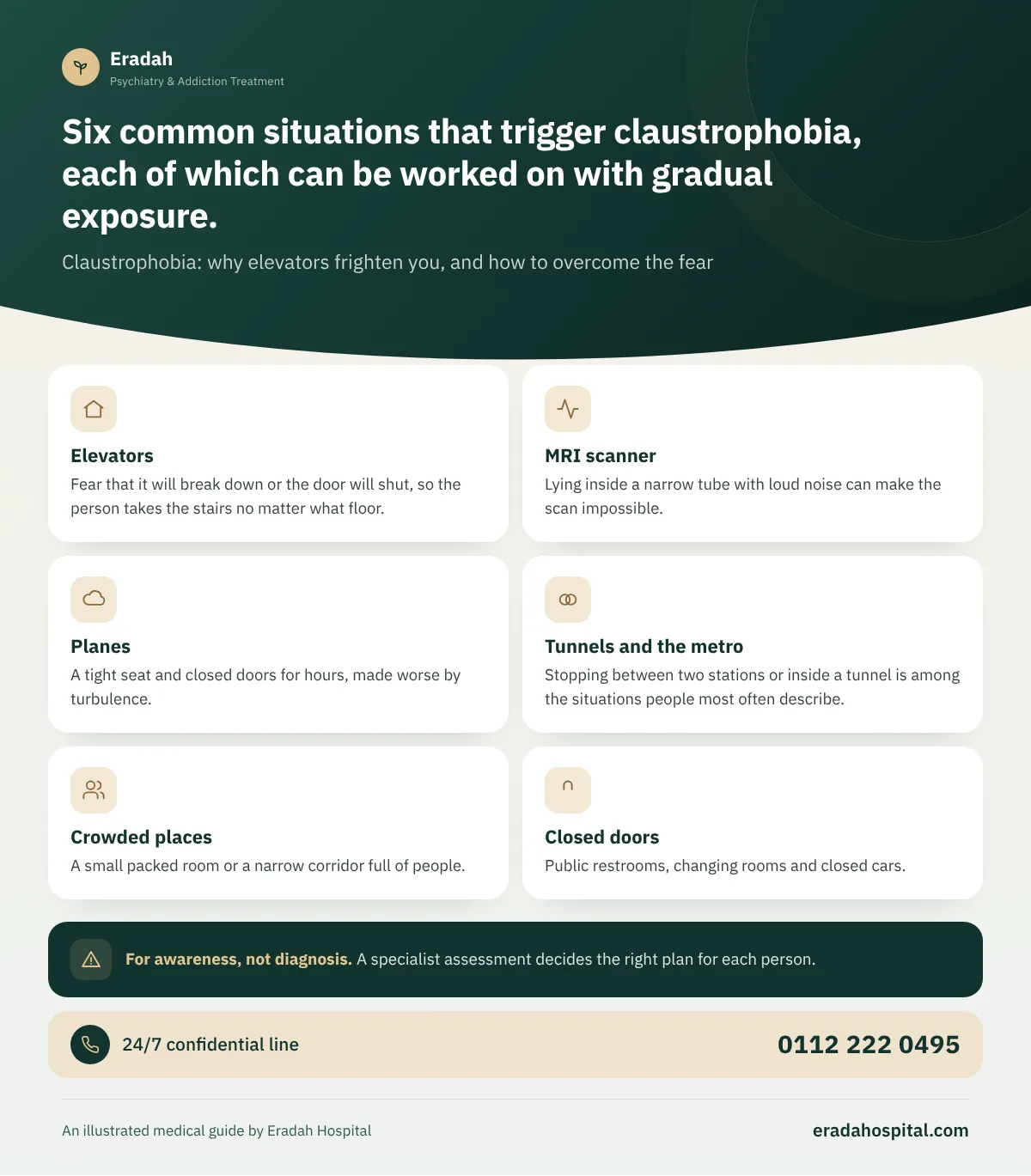
The NHS notes that people with it go to great lengths to avoid tight spaces. The most common situations are:
Fear that it will break down or the door will shut, so the person takes the stairs no matter what floor.
Lying inside a narrow tube with loud noise can make the scan impossible.
A tight seat and closed doors for hours, made worse by turbulence.
Stopping between two stations or inside a tunnel is among the situations people most often describe.
A small packed room or a narrow corridor full of people.
Public restrooms, changing rooms and closed cars.
What are the symptoms of claustrophobia?
When a person with it enters the place, or even imagines it, the body sets off the full fear response. The NHS notes that merely thinking about the situation without being exposed to it can be a trigger:
| Type | Examples |
|---|---|
| Physical | Palpitations, sweating, trembling, shortness of breath, dizziness, nausea, a feeling of pressure in the chest |
| Psychological | Terror of suffocating or losing control, a feeling that “something bad is going to happen” |
| Behavioral | Looking for the exit as soon as they enter, standing by the door, avoiding the place completely |
| Anticipatory | Anxiety hours or days before the situation, and changing plans to avoid it |
The NHS notes that a panic attack usually peaks within 10 minutes, and most attacks last between 5 and 30 minutes. It advises staying in the place if possible, reminding yourself that the frightening sensations are a sign of panic and will pass, and focusing on something visible that is not threatening. To learn more, read panic attacks.
Why does claustrophobia happen?
The NHS notes that claustrophobia is often linked to a traumatic experience in early childhood, such as being shut in a tight space or getting lost in a crowd. It may also begin after a later upsetting experience, such as severe turbulence on a plane or being stopped inside a metro tunnel. A child may also learn it when they see a parent terrified in enclosed spaces.
Then avoidance keeps the fear going: each time you escape from the elevator your body relaxes, so your brain learns that escape is what saved you, and the fear grows the next time. The details of this mechanism are in causes of phobias.
The difference between claustrophobia and agoraphobia
| Aspect | Claustrophobia | Agoraphobia |
|---|---|---|
| Focus of the fear | Suffocation and restriction inside a tight space | Difficulty escaping or getting help in many places and situations |
| Situations | Elevators, tunnels, an MRI scanner | Public transport, markets, crowds, leaving home alone |
| Scope | Usually limited to tight spaces | Extends to many situations and may confine the person to the house |
| Classification | A type of specific phobia | A separate anxiety disorder |
The two can overlap, and the phobia may also come with repeated panic attacks. The guide to types of phobias explains the other types and their names.
Claustrophobia and the MRI scanner
Some people only discover their fear when they are asked to have an MRI scan. The NHS offers practical tips for this situation:
- Tell the radiology team about your fear before the day of the scan, not when you arrive.
- Discuss with the doctor beforehand whether you could be given a sedative to help you relax, and do not take any sedative on your own.
- Ask about open MRI centers or upright MRI, designed for people with severe anxiety about the scanner.
- Ask to be told how long the scan lasts and how to communicate with the technician during it, since knowing reduces the feeling of restriction.
How is claustrophobia treated?
The MSD Manual states that exposure therapy, a type of cognitive behavioral therapy, is the most studied and most effective psychological treatment for specific phobia, and that it works better than no treatment in about 85% of patients; even a single treatment session may help considerably. Exposure is built as a ladder from the easiest to the hardest, such as:
- Looking at pictures of an elevator, then standing in front of it with the door open.
- Stepping in and out right away with the door open, with the therapist or a supportive person.
- Going up one floor, then several floors.
- Going up alone, then at busy times.
You move to the next step only once anxiety has settled at the current one. The details of exposure therapy and the limited role of medication are in phobia treatment. As for sedatives, the doctor may prescribe them for a specific situation that cannot be avoided, but they do not treat the phobia. Do not start or stop any medication without a doctor.
When should you ask for help?
The NHS notes that if you have felt anxious in an enclosed or crowded place in the past six months, or have avoided these situations because of it, you are probably affected by claustrophobia. Ask for help if the fear is dictating where you live, work or travel, has stopped you from having a necessary medical test, or you have begun to rely on sedatives or alcohol to get through situations. At Eradah Hospital it starts with an assessment and a gradual exposure plan led by a specialist through outpatient treatment. The first consultation is free and confidential.
A severe attack, or symptoms that do not feel like anxiety? Get help now
- Pressing chest pain spreading to the arm or jaw, or shortness of breath that will not ease
- Fainting, confusion, or sudden weakness on one side of the body
- Attacks that do not stop as time passes, especially for the first time
- Talk of death or that life has become “unbearable”
- Increasing use of sedatives or alcohol at night to sleep or to calm down
If chest symptoms, fainting or sudden weakness appear for the first time, do not assume it is anxiety: call the ambulance (123) or go to the nearest emergency room to rule out a physical cause. If the person talks about death or hurting themselves, stay with them, listen calmly, keep medications out of their reach, and contact the mental health support line (16328), open around the clock.
Ambulance 123 Mental health support line 16328