Can postpartum depression be treated?
Yes, with good results. The U.S. National Institute of Mental Health says most women improve with the right treatment, while noting that mothers with the condition often do not feel better without treatment. The UK's National Health Service says it usually improves within 3 to 6 months, though sometimes it takes longer.
Treatment begins with a step that seems simple but is the hardest: telling your obstetrician, family doctor or psychiatrist honestly what you are feeling. After that, the doctor determines the severity, rules out physical causes, asks about breastfeeding and any previous psychiatric history, and then proposes a plan that suits you.
What psychological therapies are used for postpartum depression?
The U.S. National Institute of Mental Health lists two evidence-based types, and cognitive behavioral therapy can be offered individually or in a group:
- Cognitive behavioral therapy: helps the mother notice thoughts such as “I'm a failed mother,” test them and modify them, and gradually return to the small activities that bring back pleasure and energy.
- Interpersonal therapy: focuses on the major shift in roles and relationships after birth, improves communication with the husband and family, and builds a support network and realistic expectations.
Psychotherapy is a common first choice in mild and moderate cases, and many breastfeeding mothers prefer it. Its length varies from a few weeks to several months.
What role do antidepressants play?
Antidepressants can be effective on their own or alongside psychotherapy, especially in moderate and severe cases. The U.S. institute notes that they usually take 4 to 8 weeks to work, that sleep, appetite and concentration often improve before mood, and that more than one medication may need to be tried to find the most suitable one.
Can treatment be given during breastfeeding?
This is one of the most common questions, and the short answer is: usually yes, but the decision is your doctor's. The UK's National Health Service says many antidepressants are safe during breastfeeding, and asks the mother to tell the doctor she is breastfeeding so they can prescribe what suits her. The UK's NICE guidelines recommend that the doctor discuss with the mother the benefits of breastfeeding, the uncertainty about the safety of some medications for the infant, and the risks of stopping or changing an effective medication, and that the doctor consult a perinatal psychiatry specialist if unsure.
This is why we do not name specific medications or doses here. The choice depends on the baby's age and health, the mother's previous medications and how she responded to them, and the severity of symptoms. Ask your doctor clearly about breastfeeding before starting, and do not decide alone or based on other mothers' experiences.
What newer medications are designed for postpartum depression?
The U.S. Food and Drug Administration has approved two medications that work differently from traditional antidepressants: brexanolone, given by intravenous infusion during a short hospital stay, and zuranolone, approved in August 2023 as the first oral treatment designed for postpartum depression in adult women, taken for a short, fixed period.
Zuranolone carries a prominent warning about its effect on the ability to drive and on hazardous activities. Its common side effects include drowsiness, dizziness, diarrhea and fatigue, and it may harm a fetus, so effective contraception is required. It passes into breast milk, so breastfeeding should be discussed with the doctor before using it. These medications are not available in every country, and the doctor decides how available and suitable they are.
Why is practical support part of treatment?
- Sharing night feeds or baby care so the mother gets hours of unbroken sleep.
- Real help at home, with cooking and shopping, without waiting to be asked.
- A short daily walk, and getting out into light and fresh air when possible.
- A little time each day for an activity the mother enjoys, however simple.
- Avoiding alcohol and any substances used to ease feelings, because they make depression worse.
How are severe cases and postpartum psychosis treated?
If depression is severe, with thoughts of harm or an inability to eat or provide care, intensive care or hospital admission may be needed. As for postpartum psychosis, the UK's National Health Service says it is an emergency usually treated in the hospital, with antipsychotics, mood stabilizers or antidepressants depending on the case, and sometimes with electroconvulsive therapy if other options fail or life is at risk. Most women recover fully with the right treatment.
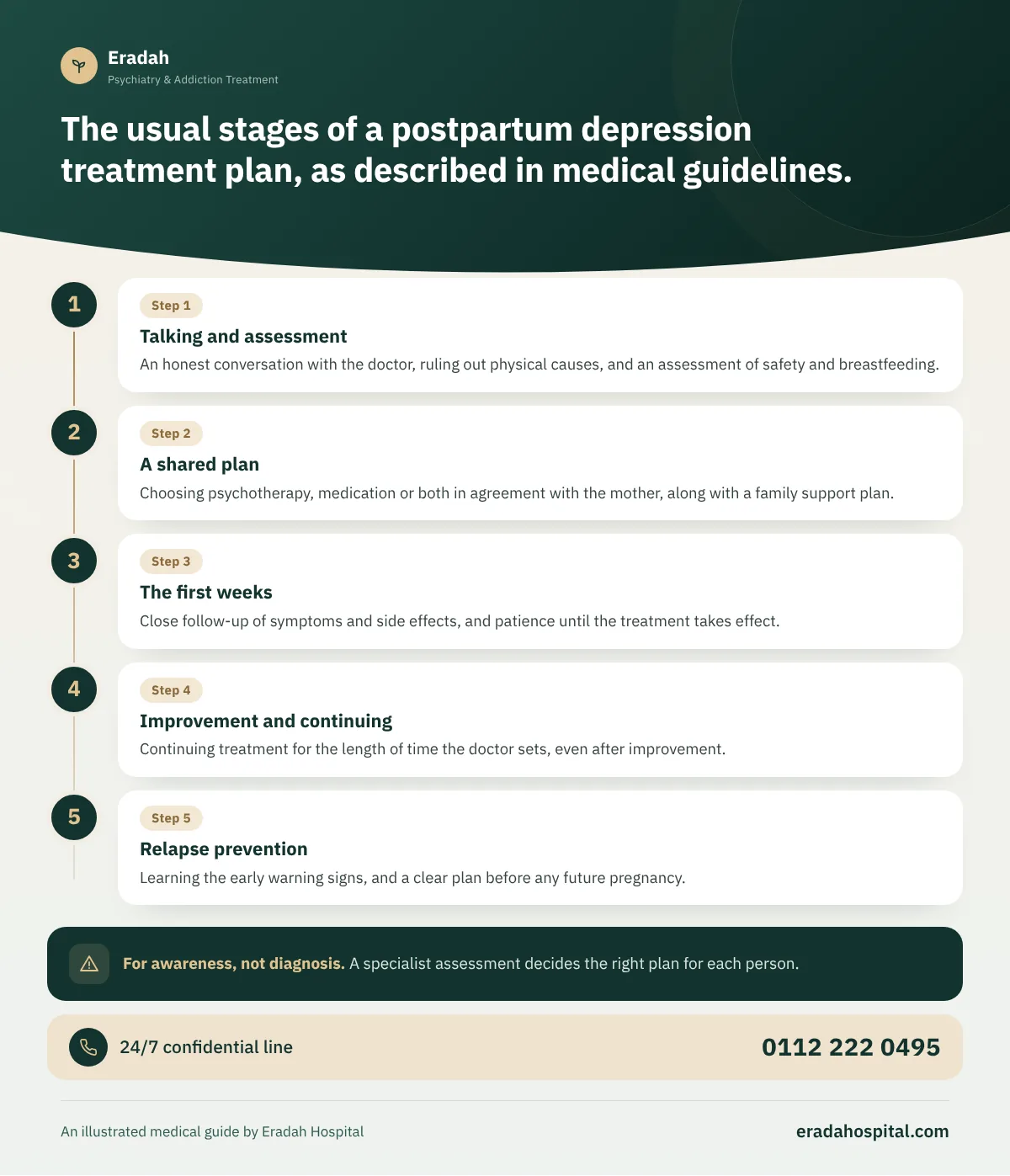
How do the stages of treatment usually go?
- Step 1Talking and assessment
An honest conversation with the doctor, ruling out physical causes, and an assessment of safety and breastfeeding.
- Step 2A shared plan
Choosing psychotherapy, medication or both in agreement with the mother, along with a family support plan.
- Step 3The first weeks
Close follow-up of symptoms and side effects, and patience until the treatment takes effect.
- Step 4Improvement and continuing
Continuing treatment for the length of time the doctor sets, even after improvement.
- Step 5Relapse prevention
Learning the early warning signs, and a clear plan before any future pregnancy.
Does Eradah see cases of postpartum depression?
Residential treatment at Eradah is for men only, and there is currently no residential unit for women. We say this plainly out of respect for your time. But the mother or any family member can contact us for a free, confidential first consultation, in which we help you understand the situation and gauge how urgent it is, and guide you to the right place for treatment in coordination with the obstetrician following her. Emergencies such as psychosis or thoughts of harming yourself or the baby need the nearest emergency room right away. And if a parent's depression is linked to alcohol or sedatives, see depression and addiction.
Hallucinations or thoughts of harming yourself or the baby after birth? Get help now
- Hearing or seeing things that aren't there, or strange ideas and unrealistic suspicions.
- Severe confusion, or going without sleep for days with unusual excess activity or talking.
- Talk of death or that the family is “better off without me,” or thoughts of self-harm.
- Thoughts or intent to harm the baby, or a complete inability to care for the baby or herself.
- Refusing food and drink, or a severe collapse in the ability to move and speak.
Do not leave the mother alone, and do not leave the baby in her sole care until she has been assessed. Talk to her calmly, without blame or threats, remove medications and dangerous objects, and call an ambulance on 123 or go to the nearest emergency department immediately, because postpartum psychosis is an emergency treated in hospital. You can also call the mental health support line 16328, available around the clock.
Ambulance 123 Mental health support line 16328