What are the core symptoms of postpartum depression?
Tiredness, crying and mood swings are familiar after birth, which is why the symptoms of depression are so often mistaken for “motherhood fatigue.” The real difference lies in three things: duration, which goes beyond two weeks; severity, which makes most of the day a bad one; and impact on your ability to care for yourself and your baby.
The U.S. National Institute of Mental Health describes the central symptom as a sad, anxious or “empty” mood lasting most of the day, nearly every day, for at least two weeks, or a loss of interest and pleasure in activities. The UK's National Health Service stresses that it is important to seek help even if only some of the signs appear, not all of them.
What are the psychological symptoms of postpartum depression?
Frequent crying, or a numb feeling as if emotions have switched off, most of the day.
Nothing brings joy the way it used to, even the moments you had been looking forward to with your baby.
A constant feeling of being a bad mother, falling short, or being a burden on those around you.
Being upset by the smallest things, restlessness and difficulty sitting still.
Ongoing worry about the baby or about whether you can cope, and sometimes panic attacks.
A sense that you cannot adapt, and difficulty thinking and making decisions.
This list is drawn from what the UK's National Health Service and the U.S. National Institute of Mental Health describe. It resembles the symptoms of depression in general, but with a distinct flavor tied to motherhood and the baby.
Does postpartum depression have physical symptoms?
| Symptom | What distinguishes it from normal tiredness? |
|---|---|
| Exhaustion | Low energy that does not improve even when there is a chance to rest |
| Sleep disturbance | Insomnia even when the baby sleeps, waking very early, or sleeping too much |
| Appetite and weight | Loss of appetite or overeating, and unplanned weight changes |
| Unexplained pain | Headaches, cramps or digestive upset with no clear physical cause that does not improve with treatment |
| Slowing down or restlessness | Slower movement and speech than usual, or being unable to sit still |
Because some of these symptoms can also result from anemia or a postpartum thyroid disorder, the doctor may order some simple tests as part of the assessment. This is part of a good examination, not doubt about what you are going through.
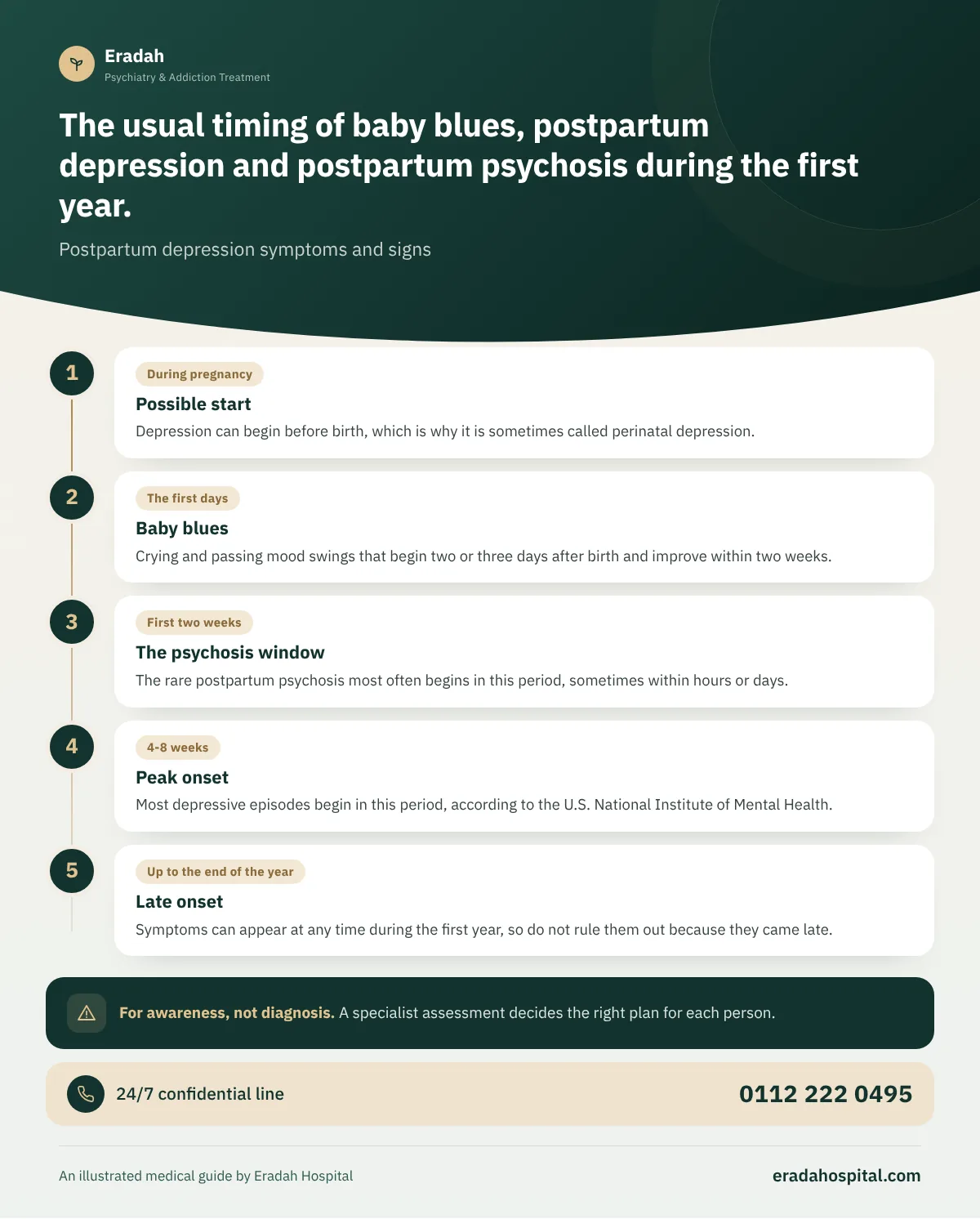
When do postpartum depression symptoms start?
- During pregnancyPossible start
Depression can begin before birth, which is why it is sometimes called perinatal depression.
- The first daysBaby blues
Crying and passing mood swings that begin two or three days after birth and improve within two weeks.
- First two weeksThe psychosis window
The rare postpartum psychosis most often begins in this period, sometimes within hours or days.
- 4-8 weeksPeak onset
Most depressive episodes begin in this period, according to the U.S. National Institute of Mental Health.
- Up to the end of the yearLate onset
Symptoms can appear at any time during the first year, so do not rule them out because they came late.
What are the symptoms of depression in fathers after birth?
In fathers, depression may show up less as sadness and more as irritability and quick anger, withdrawing from home, long working hours and loss of interest. A father's depression is linked to the mother's, as a JAMA analysis found, so fathers deserve to be asked how they are too, especially if the mother is depressed.
How is postpartum depression detected?
No blood test diagnoses it. Instead it relies on the doctor talking with the mother, and the doctor may use a questionnaire. The best-known tool worldwide is the Edinburgh Postnatal Depression Scale, which has 10 questions and was developed by Cox and colleagues in 1987. The scale is a screening tool that helps draw attention to a problem. It is no substitute for a doctor's assessment, and it should not be used to diagnose yourself online.
Which warning signs cannot wait?
- Thoughts of death or of harming yourself, or that your family would be “better off without me.”
- Thoughts of, or intent to, harm the baby.
- Hallucinations, strange unrealistic ideas or severe confusion.
- Not sleeping for days along with unusual excess energy or talkativeness.
- Complete inability to care for yourself or the baby.
In these situations: call an ambulance (123) or go to the nearest emergency room right away. For the other symptoms, the path is a prompt assessment and then a plan, which the postpartum depression treatment section explains. To understand why it happens, see the causes of postpartum depression.
Hallucinations or thoughts of harming yourself or the baby after birth? Get help now
- Hearing or seeing things that aren't there, or strange ideas and unrealistic suspicions.
- Severe confusion, or going without sleep for days with unusual excess activity or talking.
- Talk of death or that the family is “better off without me,” or thoughts of self-harm.
- Thoughts or intent to harm the baby, or a complete inability to care for the baby or herself.
- Refusing food and drink, or a severe collapse in the ability to move and speak.
Do not leave the mother alone, and do not leave the baby in her sole care until she has been assessed. Talk to her calmly, without blame or threats, remove medications and dangerous objects, and call an ambulance on 123 or go to the nearest emergency department immediately, because postpartum psychosis is an emergency treated in hospital. You can also call the mental health support line 16328, available around the clock.
Ambulance 123 Mental health support line 16328