Does postpartum depression have a single cause?
Many mothers ask: “Why me? Everything was going fine.” The answer is that doctors do not know of a single cause. They see postpartum depression as the result of biological, psychological and social pressures building up at the same time, on ground that may already be genetically primed.
The U.S. National Institute of Mental Health stresses that perinatal depression can affect any woman regardless of her age, education, income or culture, that it is not her fault or the result of anything she did or did not do, and that research points to genetic and environmental factors working together.
What role do hormones play in postpartum depression?
During pregnancy, estrogen and progesterone rise to very high levels. Cleveland Clinic notes that they increase roughly tenfold, then drop sharply after birth, returning to pre-pregnancy levels within about three days. Obstetricians and gynecologists compare this drop to the hormone swings before a period, but on a much larger scale.
However, all mothers go through this drop and only some of them develop depression. This is why some women are thought to be more sensitive than others to hormone fluctuations, which is sometimes linked to a history of premenstrual mood disorder or to previous depression.
Is lack of sleep a cause of postpartum depression?
Lack of sleep alone does not create depression, but it is one of the strongest contributing factors. Repeated sleep deprivation weakens the brain's ability to regulate emotions and makes every difficulty seem bigger. The American College of Obstetricians and Gynecologists considers exhaustion a major factor, noting that physical recovery after birth can take weeks, and longer after a cesarean delivery. This is why organizing the mother's sleep is part of treatment, not a luxury.
Does a past psychiatric history increase the risk?
Yes, and it is one of the clearest risk factors. According to the U.S. National Institute of Mental Health and the UK's National Health Service, the risk is higher for women who had depression or another mental illness before or during pregnancy, depression after a previous birth, or a personal or family history of depression or bipolar disorder.
Do a difficult delivery or a baby's illness have an effect?
Yes. A high-risk pregnancy, a difficult delivery, a premature or sick baby, a baby who needs special care, or one who cries a lot are all factors that medical sources mention, because they multiply anxiety and exhaustion. The same goes for breastfeeding difficulties, which can make a mother feel like a failure if things do not go as she expected.
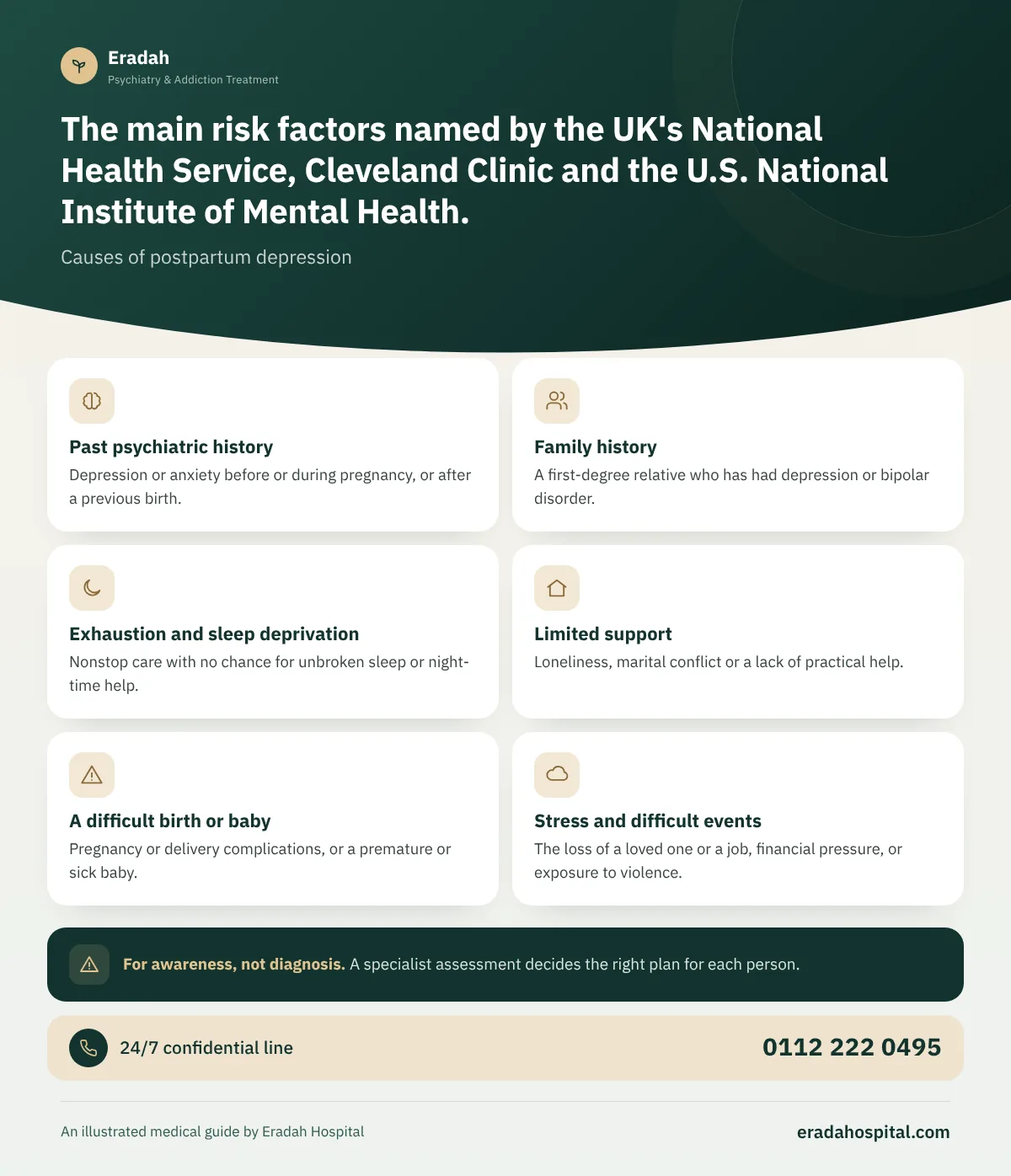
Who is most likely to develop postpartum depression?
Depression or anxiety before or during pregnancy, or after a previous birth.
A first-degree relative who has had depression or bipolar disorder.
Nonstop care with no chance for unbroken sleep or night-time help.
Loneliness, marital conflict or a lack of practical help.
Pregnancy or delivery complications, or a premature or sick baby.
The loss of a loved one or a job, financial pressure, or exposure to violence.
What does not cause postpartum depression?
- It is not a lack of love for the baby; depression does not measure a mother's feelings.
- It is not weak faith or “ingratitude”; it is a medical condition with a biological basis.
- It is not proof that you are unfit to be a mother.
- It is not the result of the way you gave birth or fed your baby alone, although difficulties with either can be a source of stress.
Can postpartum depression be prevented?
It cannot always be prevented, but its risk can be reduced. In 2019 the U.S. Preventive Services Task Force found strong evidence that counseling such as cognitive behavioral therapy and interpersonal therapy protects against perinatal depression, and recommended offering it to pregnant women and mothers at higher risk, such as those with a history of depression, current symptoms or difficult social circumstances.
- Tell your obstetrician and your psychiatrist about any psychiatric history before the birth.
- Agree in advance with your family on sharing night-time care.
- Do not stop a psychiatric medication you are taking because of pregnancy or breastfeeding without consulting your doctor.
- Keep an eye on your mood in the first weeks, and ask for an assessment if distress lasts more than two weeks.
If symptoms appear despite all this, the postpartum depression symptoms page will help you recognize them, and the postpartum depression treatment page explains the options available.
Hallucinations or thoughts of harming yourself or the baby after birth? Get help now
- Hearing or seeing things that aren't there, or strange ideas and unrealistic suspicions.
- Severe confusion, or going without sleep for days with unusual excess activity or talking.
- Talk of death or that the family is “better off without me,” or thoughts of self-harm.
- Thoughts or intent to harm the baby, or a complete inability to care for the baby or herself.
- Refusing food and drink, or a severe collapse in the ability to move and speak.
Do not leave the mother alone, and do not leave the baby in her sole care until she has been assessed. Talk to her calmly, without blame or threats, remove medications and dangerous objects, and call an ambulance on 123 or go to the nearest emergency department immediately, because postpartum psychosis is an emergency treated in hospital. You can also call the mental health support line 16328, available around the clock.
Ambulance 123 Mental health support line 16328
14How do social and family circumstances affect it?
The UK's National Health Service lists these risk factors: lack of social support, marital problems, exposure to violence or abuse, and recent difficult events such as the loss of a loved one or a job. Cleveland Clinic adds financial pressure, young age or being a mother without a partner, ambivalence or doubts about wanting to be a mother, and the gap between the expected picture of motherhood and its reality.